Location of Outbreak Fungi in the Fungal Kingdom
Opportunism and pathogenicity are polyphyletic in the fungal kingdom (Fig. 1.4). Pathogenicity was defined in an ecological sense above as having advantage of the use of a vertebrate host.
This is the case in species of Batrachochytrium (order Chytridiales, Chytridiomycota), Cryptococcus (Tremellales, Basidiomycota), dermatophytes and some systemic dimorphic fungi (Onygenales, Ascomycota), Talaromyces and Pseudogymnoascus (Eurotiales, Ascomycota), and perhaps Sporothrix (Ophiostomatales, Ascomycota). If we compare this with criteria of transmission (host-to-host versus host-environment-host), we observe that Batrachochytrium, Candida, Pneumocystis, and anthropophilic (and some zoo- philic) dermatophytes lack assimilative thalli in the environment and thus hosts are principally contagious, while Cryptococcus, geophilic dermatophytes, and systemic dimorphic fungi are environmental pathogens. Judging from PCR data, Talaromyces seems to occur in the environment (Pryce-Miller et al. 2008), suggesting that T. marneffei is also an environmental pathogen that is amplified by infection in bamboo rat hosts. Sporothrix species are somewhat outside these categories: S. brasiliensis is transmitted by cats and the fungus is able to produce a large amount of infective material in feline tissues (which is rarely the case in other mammalian hosts).Currently, the largest outbreaks, i.e., with the largest degree of acceleration, are Batrachochytrium, Cryptococcus, Pseudogymnoascus, and Sporothrix. Given the expansion of Cryptococcus in Southern Africa, it might be expected that Emergomyces africanus, which also occurs in HIV-positive individuals, might expand in the near future. In contrast, species like Candida albicans or Pneumocystis spp. are intimately associated with specific hosts, responding to transient host susceptibilities, but on average remain with comparable frequencies in animal or human populations.
Talaromyces marneffei initially stabilized due to the control of the HIV pandemic as a result of HAART therapy but now emerges in patients with other comorbidities (Chan et al. 2016) and in otherwise healthy individuals (Ye et al. 2015). The emergence of anthropophilic dermatophytes is strongly associated with human socioeconomic changes. In preindustrial societies in developmental transition, a shift is observed from anthropophilic to zoophilic dermatophytes, resulting from increasing hygiene to the growing habit in urban settings to live closely with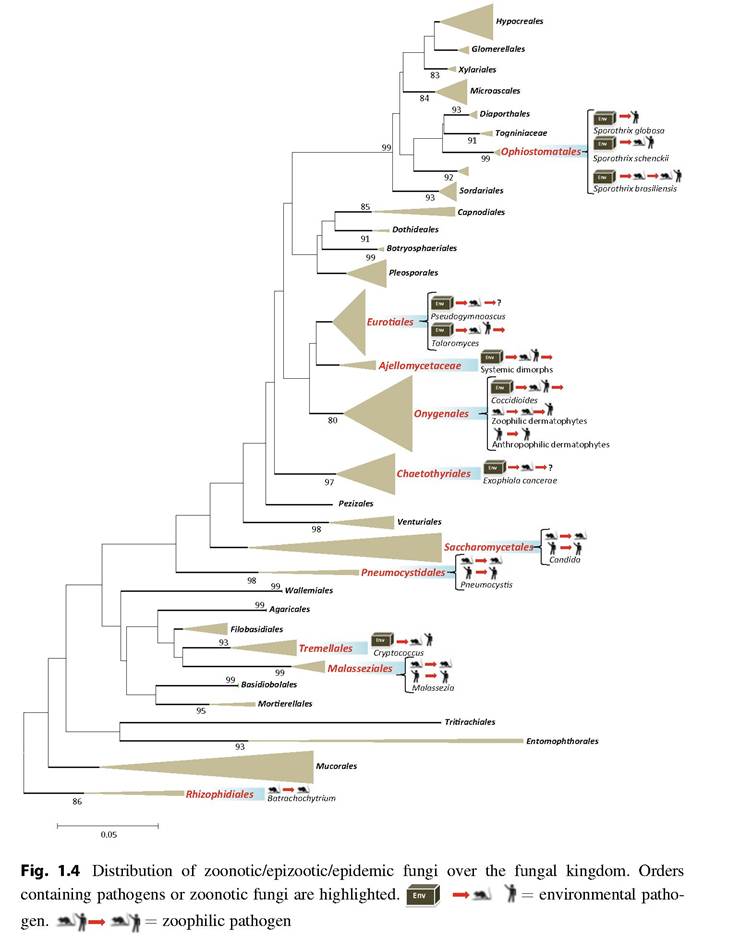
companion animals. This process was observed in Europe half a century ago (Mantovani and Morganti 1977) and currently takes place in China (Zhan et al. 2015). To a certain extent, the dermatophyte species reflect the popularity of pets, including dogs, cats, and more frequently rabbits and small rodents (Nenoff et al. 2014).
Acknowledgments The authors are indebted to Matthew Fisher for constructive discussions and comments on the text.