Mechanisms of Decreased Growth and Decreased Weight Gain
Major pathogenic mechanisms that result in decreased growth and decreased weight gain include the following:
• Inadequate dietary intake of essential nutrients
• Infections or inflammation
• Parasitism
• Genetic errors in metabolism or physiologic function
• Concurrent toxicosis
• Environmental causes
• Multiple causes
Inadequate intake of one or more essential nutrients is an important cause of decreased growth.
In many cases growing animals are not provided with a sufficient volume of feed to meet their nutrient requirements. Young animals rely on a highly digestible diet that provides energy and essential nutrients for growth. Even animals fed an appropriate volume of a poor-quality milk replacer could suffer from poor growth. Milk replacers formulated with sources of protein, fat, vitamins, and minerals that have limited nutrient digestibility may induce a state of energy, protein, vitamin, or mineral malnutrition. The process of weaning may pose substantial challenges for the growing animal, especially in dairy calves when performed abruptly, and may lead to a depression in growth.6 Weaned foals and ruminants rely on forages and cereal grains to provide essential nutrients.Hay that has been harvested at a late stage of growth usually has a lower nutrient digestibility compared with young forages. Diets low in digestible energy or protein or both reduce total daily intake in ruminants because of the decreased turnover time (T1/2) in the gastrointestinal tract and subsequent decreased throughput. This compounds the problems caused by an inadequate intake of digestible nutrients. The digestibility of forages is even lower for horses than for ruminants.
Protein-calorie malnutrition (PCM) is the most common clinical cause of decreased growth and decreased weight gain in young animals. It is characterized by smaller size and lower weight than the normal minimums for age, breed, and sex.
Inadequate intake of digestible energy and protein (or essential fatty acids in the neonate primarily adapted to a milk diet) results in inadequate levels of amino acids, fats, and carbohydrates for normal metabolism and growth. Diets that lack any of the other essential nutrients (essential fatty acids, vitamins, macrominerals, or trace minerals) can also decrease growth. Deficiencies of calcium, phosphorus, and magnesium result in improper skeletal formation. Deficiencies in other macrominerals (e.g., sodium, chloride, potassium), trace minerals (e.g., copper, zinc, manganese, cobalt, iron), and vitamins (e.g., A, D, E, thiamin) cause biochemical dysfunctions that lead to inefficient metabolism and growth. Large animal patients that grow slowly as a result of inadequate diets often have normal or increased appetites until they are terminally ill. Physical findings and clinical chemistry profiles from animals with PCM are often within the normal range until the disease process is well advanced.Infections or inflammatory processes are important causes of decreased growth and decreased weight gain in young horses and ruminants. The decrease in growth can be of short duration
followed by recovery and compensatory gain (cryptosporidiosis) or can persist (chronic bronchopneumonia). Infections or inflammatory processes can also result in nutrient malabsorption (chronic salmonellosis, acute rotavirus diarrhea, equine proliferative enteropathy), anorexia (pharyngeal abscesses, systemic disease), increased nitrogen turnover, and direct protein losses (gastrointestinal disease). Both energy and protein requirements may be increased as a result of infection and inflammation.
Parasitism often affects young horses and ruminants and results in decreased growth and decreased weight gain by increasing nutrient requirements, increasing nutrient losses, and/or decreasing nutrient absorption. The animal's metabolic rate and nutrient requirements may also increase as a result of inflammatory and immune reactions that arise secondary to parasitism.
Genetic diseases (α-mannosidosis, dwarfism) result in decreased growth through generalized errors in the genetic code or interference with strategic reactions in one or more metabolic pathways. Congenital cardiac malformations (tetralogy of Fallot, ventricular septal defect) create physiologic inefficiencies that require energy beyond the body's ability to supply it. Congenital renal disease (agenesis, dysplasia, hypoplasia, polycystic kidney disease) affects homeostatic mechanisms that regulate electrolyte and acid-base balance, results in the production of uremic toxins, and often results in partial anorexia and PCM. Digestive tract malformations, especially oral and dental defects such as cleft palate, parrot and monkey mouth, megaesophagus, and brachygnathism, can reduce nutrient ingestion and impair growth.
Toxicities, although rare in growing animals, result in decreased weight gain by interfering with metabolic pathways (e.g., ammonia toxicity, zinc-induced copper deficiency with abnormal skeletal development in foals) by causing loss of body reserves (e.g., thiamin deficiency in horses, bone marrow hypoplasia and associated bleeding diatheses in ruminants associated with bracken fern toxicity), inducing anorexia, or a combination of mechanisms. The pathogenic mechanisms of many toxins are not yet known.
Tall fescue (Festuca arundinacea) is a popular pasture grass (marketed as “Kentucky 31”) for both cattle and horses. Tall fescue is typically infected with an endophyte (Neotyphodium coenophialum) that causes ergot alkaloid toxicity problems in animals. In cattle, tall fescue consumption can decrease feed intake and weight gain. In both cattle and horses, the toxins produced by the endophyte decrease serum dopamine and prolactin, which affects reproduction in these animals. Consumption of endophyte-infected fescue in the last trimester results in late-term abortion, prolonged gestation periods, thickened and/or retained placentas, and agalactia, a decreased ability to produce milk.
While foals of mares fed fescue tend to be larger in size at birth (due to a longer gestation), decreased milk production and thus consumption by the foals can greatly affect growth rate and potential. It is recommended that pregnant animals be removed from endophyte-infected pastures for their third trimester. Alternatives are other pasture grasses, or the endophyte-free fescue varietals. In horses, domperidone paste (a dopamine antagonist) may be administered to mitigate the effects of endophyte-infected pasture on mares.Environmental factors including extreme heat or cold or high humidity result in decreased growth and decreased weight gain. Extremely cold conditions increase an animal's daily energy requirements. During extremely hot weather feed intake often decreases, which may contribute to decreased growth. Often, environmental conditions influence the development of disease, resulting in a subsequent increase in nutrient requirements in a growing animal (e.g., calves with PCM housed in poorly ventilated or overly humid conditions become much more susceptible to infectious pneumonia).
In many cases a combination of these diverse factors may influence the growth and weight gain of young animals. A period of increased growth rate and weight gain, called compensatory gain, often occurs after a period of restricted growth once adequate dietary energy and protein are available. In growing
■ BOX 9.1
Causes of Decreased Growth and Decreased
Weight Gain in Horses
Common Causes
Protein-calorie malnutrition (PCM), inadequate nutrient intake Extreme environmental factors (cold, heat)
Diarrhea (Clostridia species, Salmonella species, rotavirus, sand enteropathy, other causes)
Parasitism (Parascaris equorum, small strongyles, large strongyles, tapeworms, threadworms, bots)
Gastric ulcers
Bacterial pneumonia (Rhodococcus equi, Streptococcus zooepidemicus, other)
Viral pneumonia (equine herpesvirus, equine influenza)
Lameness (e.g., physitis, osteochondritis dissecans, contracted tendons, osteomyelitis)
Prematurity, dysmaturity
Less Common Causes
Jaw pain (fracture, dental abnormality)
Esophageal stricture, megaesophagus (idiopathic, acquired) Campylobacter jejuni
Cryptosporidium parvum
Equine proliferative enteropathy
Fungal pneumonia
Congenital cardiac and great vessel anomalies
Endocarditis
Ventricular septal defect
Abdominal abscess Peritonitis
Osteodystrophy
Goiter
Calcium deficiency
Copper deficiency
Phosphorus deficiency
Selenium deficiency
Zinc deficiency
Vitamin A deficiency
Uncommon Causes
Hydrocephalus
Biliary atresia
Hepatic portosystemic shunt
Congenital renal abnormalities (hypoplasia, dysplasia, agenesis, polycystic kidney disease)
Wound myiasis
Agammaglobulinemia
Fell Pony syndrome
Selective IgM deficiency
Severe combined immunodeficiency
Transient hypogammaglobulinemia
Congenital hypothyroidism
Gonadal dysgenesis, intersex (XO, XXY)
Thiamine deficiency
Vitamin D deficiency
Toxins
Ammonia toxicity
Fluorosis
Phenylbutazone, flunixin meglumine, and other nonsteroidal antiinflammatory drugs
Lead toxicity
Zinc toxicity
foals, compensatory gain should be closely monitored to prevent rapid growth and abnormal skeletal development, which could lead to developmental orthopedic disease.
Boxes 9.1 and 9.2 list many of the possible causes of decreased growth and decreased weight gain in horses and ruminants, respectively.
■ BOX 9.2
Causes of Decreased Growth and Decreased Weight Gain in Ruminants
Common Causes
Protein-calorie malnutrition (PCM)
Extreme environmental factors (cold, heat)
Diarrhea (Enterotoxigenic Escherichia coli, attaching and effacing E. coli, Shiga toxin-producing E. coli, Salmonella, bovine virus diarrhea, coronavirus, rotavirus infection, Cryptosporidium parvum, coccidiosis, other causes)
Ostertagiasis I and II
Parasitism (flukes, gastrointestinal worms, lungworms)
Bacterial bronchopneumonia
Viral bronchopneumonia
Umbilical infections (omphaloarteritis, omphalourachitis, omphalophlebitis, hepatic abscessation)
Hepatic abscessation
Sarcoptic mange
Lameness (infectious and claw horn lesions, bovine digital dermatitis, sole ulcers, white line disease, etc.), osteomyelitis, septic arthritis)
Agammaglobulinemia (failure of passive transfer) in neonates Copper deficiency (molybdenosis)
Selenium deficiency
Less Common Causes
Pharyngeal abscess, injury
Severe bovine papular stomatitis
Abomasal ulcers
Peritonitis
Urachal or bladder abscess
Osteodystrophy, rickets
Immune-mediated anemia
Neonatal isoerythrolysis
Sarcocystosis
Myiasis
Tick infestation
Goiter
Cobalt deficiency
Vitamin A deficiency
Zinc deficiency
Uncommon Causes
Brisket disease
Calf lymphosarcoma
Mucormycosis
Zygomycosis α-Mannosidosis31
Hypersensitivity to soy protein
Phosphorus deficiency
Congenital Abnormalities
Hydrocephalus
Cardiac or great vessel anomalies
Arthrogryposis
Osteogenesis imperfecta in Friesians
Congenital porphyria
Granulocytopathy32
Epidermolysis bullosa
Generalized glycogenosis (GM1 gangliosidosis, type II glycogenosis)33
Gonadal dysgenesis, intersex
Familial acantholysis34
Bovine leukocyte adhesion deficiency (BLAD)32 α-Mannosidosis (B)31
Bovine hereditary zinc deficiency (lethal trait A-46)35
Toxins
Aflatoxicosis
Ammonia (urea) toxicity
Fluorosis
Herbicide toxicity
Iodine toxicity
Selenium toxicity
Zinc toxicity
Plant Toxins
Bracken fern (Pteridium aquilinum)
Cassia spp.
Fescue toxicity
Oxalate toxicity
Pyrrolizidine alkaloid toxicosis (Senecio spp., Amsinckia spp.,
Crotolaria spp., and others)
White leadtree (Leucaena leucocephala)
Exotic Diseases
Babesiosis (Babesia bigemina, Babesia bovis) Schistosomiasis
Trypanosomiasis (Trypanosoma spp.)
Approach to Diagnosis and Management of Decreased Growth and Decreased Weight Gain in Horses
1. Take a general history and a diet history.
a. General history
i. Foal factors: What is the patient's age? Was the foal born prematurely? Were any congenital defects identified during the initial examination of the foal after birth? Did the foal have any complications from sepsis? What is the vaccination history of the mare and the foal? Has the foal shown any evidence of systemic illness (diarrhea, nasal discharge, cough, pyrexia)?
ii. Environmental factors: How is the foal housed? What type of protection is provided from adverse weather conditions? Has the foal experienced any extreme weather conditions (cold, heat, humidity)? Does the foal have access to a pasture or dry lot? Are there any toxins in the foal's environment? What is the stocking density of the herd? Is the foal exposed to a high parasite load in the environment? What is the foal's deworming history? Have there been previous problems with gastrointestinal parasitism on the farm? Does the farm have a history of infectious disease agents (Rbodococcusequi, Streptococcus equi subsp. equi, Clostridium difficile)? Are there any sick horses on the same farm? If so, what age cohort is sick?
b. Diet history
i. Foal: If the foal is nursing, is the mare at an ideal body weight? Is the mare producing a sufficient amount of milk for the foal? Has the mare had access to endophyte-infected tall fescue? If the foal is an orphan, what type of milk replacer is the owner using? What is the daily energy and protein intake of the foal? Is the owner mixing the milk replacer properly? Does the foal have access to a creep feed? What is the owner using as a creep feed? How much of the creep feed does the foal consume daily?
ii. Weaning: When was the foal weaned? Does the foal compete with other foals for feed? Has the owner changed the foal's diet recently? If yes, what changes were made? Does the foal have a good appetite? Has the foal's appetite changed recently?
(1) Forage: What type of forage is fed to the foal? Does the foal have access to pasture? How long is the foal turned out in the pasture? What is the nutritional quality of the hay or pasture? Is there gross evidence of dirt, mold, or weed contamination in the hay? Has a hay analysis been performed?
Is the nutrient density of the hay/pasture appropriate for a growing horse? How much hay is offered to the foal (in weight) daily? How much forage (in weight) does the foal eat each day?
(2) Supplemental feeds and grain: What type of supplemental feed or grain is fed to the foal? Is the feed of high quality and indicated for a growing foal? What is the nutrient composition of the supplemental feed? Does it contain appropriate protein quality, vitamins, and minerals? How much of the supplemental feed or grain (in weight) does the foal eat each day?
(3) Vitamins and minerals: If the foal is consuming commercial feed designed for a growing foal, it should not need supplemental vitamins or minerals. However, if the foal is being fed whole grains and hay/pasture, vitamin/mineral supplementation is warranted. Is the foal offered a vitamin and mineral supplement? Is the vitamin and mineral supplement appropriate for a growing foal? Is the vitamin and mineral supplement offered free choice? How much of the supplement (in weight) does the foal eat each day? Could any nutrients be consumed in a toxic amount? Has the owner provided any supplemental parenteral vitamins or minerals to the foal?
2. Perform a physical examination.
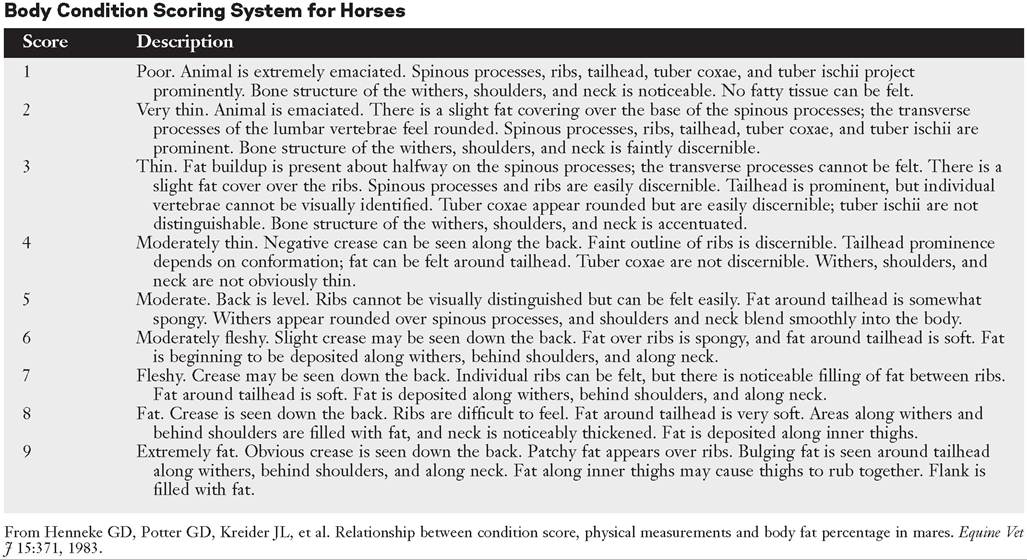
a. What is the body weight of the foal (measured by using either a scale or weight tape if the foal is 3 months of age or older)? What is the body condition score (BCS) of the foal (see Table 9.1)? Is the foal small, thin, or underweight according to growth charts (Tables 9.2 and 9.3; Fig. 9.1)?
b. Does the foal have evidence of a congenital abnormality (cardiac, renal, gastrointestinal, oral)?
c. Does the foal show any signs of infectious disease (current or resolved)?
d. Does the foal have any musculoskeletal abnormalities?
■ TABLE 9.2
Weight as Percentage of Mature Body Weight in Horses
| Age (Months) | Ponies4 (%) | Light Horses1-3,5 (%) | Draft Horses (%) |
| 6 | 55 | 46 | 40 |
| 12 | 75 | 67 | 57 |
| 18 | 84 | 80 | 75 |
3. Examine the feces. What is the consistency of the feces? Refer to Chapter 17 for the diagnosis and management of neonatal diarrhea; refer to Chapter 7 if the foal is older and has evidence of diarrhea. Is there evidence of sand in the manure? If yes, the foal should be treated with psyllium. Perform a fecal egg count. If the foal has a positive fecal egg count, follow the parasite control program recommendations in Chapter 49. If a negative fecal egg count is reported but parasitic infestation is still suspected, repeat the test in 2 to 3 weeks or follow the deworming protocols in Chapter 49. Evaluate the feces for occult blood. If the foal has a positive fecal occult blood test, review the medical management for melena in Chapter 7.
4. Perform blood analyses.
a. Perform a complete blood count (CBC) and include a plasma protein and fibrinogen concentration. If the foal is anemic, determine the cause of the anemia following the guidelines in Chapter 24. If the foal's CBC indicates inflammation, review Chapters 25 and Chapter 26 and select appropriate ancillary diagnostic tests to identify the source of the infection or inflammation.
b. Perform a serum biochemical analysis. Evaluate the results for evidence of systemic disease. Serum albumin is usually within normal limits with PCM until the condition is
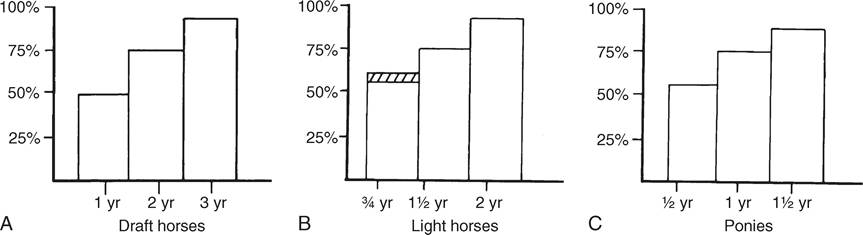
FIG. 9.1 A to C, Body weight as a percentage of mature body weight for horses at a given age. (A modified from Crampton EW. Rate of growth of draft colts. 'Jo r o J o o o ∖ JJ r Jo JJ
J AgricHortic 26:172, 1923; B modified from Lewis LD. Feeding and care of the horse. Philadelphia, 1982, Lea & Febiger; C modified from Hintz HF. Factors affecting the growth rate of horses. Horse Short Course Proceedings. College Station, Tex., 1979, Texas A&M Animal Agriculture Conference.)
■ TABLE 9.3
Body Weight Predicted by Equation 1 and Expected Mature Body Weight and Body Weight Estimated in the Previous NRC (1989) for Growing Horses
| Mature Wt | Age (months) | NRC (1989) | Equation 1 |
| 200 kg | 4 | 75 (37.5%) | 67.4 (33.7%) |
| 6 | 95 | 86.4 | |
| 12 | 140 | 128.5 | |
| 18 | 170 | 155 | |
| 24 | 185 (92.5%) | 172 (86%) | |
| 36 | No value | 189 | |
| 400 kg | 4 | 145 (36.3%) | 134.8 (33.6%) |
| 6 | 180 | 173 | |
| 12 | 265 | 257 | |
| 18 | 330 | 310 | |
| 24 | 365 (91.2%) | 343.4 (85.9%) | |
| 36 | No value | 379 | |
| 500 kg | 4 | 175 (35%) | 168.5 (33.7%) |
| 6 | 215 | 215.9 | |
| 12 | 325 | 321.2 | |
| 18 | 400 | 387.5 | |
| 24 | 450 (90%) | 429.2 (86%) | |
| 36 | No value | 472 | |
| 600 kg | 4 | 200 (33.3%) | 202.1 (33.7%) |
| 6 | 245 | 259 | |
| 12 | 375 | 385.5 | |
| 18 | 475 | 465 | |
| 24 | 540 (90%) | 515 (86%) | |
| 36 | No value | 566.4 | |
| 900 kg | 4 | 275 (30.6%) | 303.2 (33.7%) |
| 6 | 335 | 388.6 | |
| 12 | 500 | 578.2 | |
| 18 | 665 | 697.5 | |
| 24 | 760 (84.4%) | 773 (85.9%) | |
| 36 | No value | 850 |
Values in parentheses represent % of mature body weight. Equation (1) Y = 9.7 + (100 - 9.7) ? (1 - (e(-0.0772 ? X)) (R2 = 0.99); Y = percent mature body weight; X = months of age.
From National Research Council [NRC]. 2007. Nutrient requirements of horses. National Academies Press, Washington DC.
terminal. Serum glucose is usually normal, but it may be decreased in neonatal foals with sepsis. Serum glucose may be elevated in stressed animals. Serum urea nitrogen and creatinine concentrations are elevated in foals with renal disease. Serum urea nitrogen decreases in cases of chronic protein malnutrition.
c. If the foal has evidence of systemic disease, perform ancillary diagnostic tests to identify the source of the illness and then manage the case with appropriate medical or surgical intervention.
2. Analyze the diet and improve the feeding program.
a. Determine whether the energy, protein, mineral, and vitamin content of the diet meets the requirements of the growing foal (Table 9.4). Use the Nutrient Requirements of Horses free companion computer program as a reference for all essential nutrients (www.nap.edu/catalog/ 11653/nutrient-requirements-of-horses-sixth-revised -edition).
i. Dietary protein and essential amino acids are especially important in young growing horses. Lysine is the first, and threonine is the second limiting amino acid in the equine. Growing foals should consume 4.3% of their crude protein requirement as lysine (multiply the crude protein requirement by 4.3%).7 Growing foals should also consume at least 0.5% threonine dry matter (DM) in their diet. Soybean meal and alfalfa hay contain approximately 3.3% and 0.9% lysine (DM), respectively. Cereal grains are poor sources of lysine. Commercial feeds typically designed for growing horses should have sufficient lysine and threonine content, either via the inclusion of soybean meal as an ingredient, and/or direct addition of lysine and threonine as ingredients.
ii. Milk replacer: If the foal is consuming a milk replacer, review the guaranteed analysis and ingredient list of the product. Review the mixing instructions with the owner or farm manager. Develop a feeding program appropriate for the foal's age.
iii. Forage: Determine the nutrient content of forage or pasture with an analysis. Equi-Analytical forage laboratory service (www.equi-analytical.com) can analyze for major energy, protein, and major and some minor minerals. NP Analytical Laboratories (https://www.npal.com) can analyze feeds further for amino acids and vitamins if warranted. Forage sampling instructions and forage analysis companies are listed in Boxes 9.3 and 9.4. University extension services often provide a forage analysis service. If the client does not purchase a large volume of hay, or if analysis cannot be performed, forage tables from the Nutrient Requirement Council reference books (www.nap.edu) and nutrient tables from the Equi- Analytical Laboratories forage laboratory database can be referenced to estimate the concentration of different nutrients in common forages and supplemental feeds; however, if nutrient deficiency/toxicity are suspected, forage analysis should be conducted. Use the daily nutrient requirements (see Table 9.4) to recommend the type and amount of forage the foal should consume on the basis of the nutrient content of the forage.
■ TABLE 9.4
Daily Nutrient Requirements for Growth in Equines of Various Mature Body Weights
| Mature Body Weight (kg/lb) | Category | Weight | Daily Gain | Digestible Energy (Mcal) | Crude Protein (g) | Lysine (g) | Calcium (g) | Phosphorus (g) | ||
| (kg) | (lb) | (kg) | (lb) | |||||||
| Ponies 200 kg | Nursing foal (4 mo old) | 67 | 147 | 0.34 | 0.75 | 5.3 | 268 | 11.5 | 15.6 | 8.7 |
| (440 lb) | Weanling (6 mo old) | 86 | 189 | 0.29 | 0.64 | 6.2 | 270 | 11.6 | 15.5 | 8.6 |
| Yearling (12 mo old) | 128 | 282 | 0.18 | 0.40 | 7.5 | 338 | 14.5 | 15.1 | 8.4 | |
| Long yearling (18 mo old) | 155 | 341 | 0.11 | 0.242 | 7.7 | 320 | 13.7 | 14.8 | 8.2 | |
| 2-year-old (24 mo old) | 172 | 378 | 0.07 | 0.154 | 7.5 | 308 | 13.2 | 14.7 | 8.1 | |
| Horses 400 kg | Nursing foal (4 mo old) | 135 | 297 | 0.67 | 1.47 | 10.6 | 535 | 23.0 | 31.3 | 17.4 |
| (880 lb) | Weanling (6 mo old) | 173 | 381 | 0.58 | 1.28 | 12.4 | 541 | 23.3 | 30.9 | 17.2 |
| Yearling (12 mo old) | 257 | 565 | 0.36 | 0.79 | 15.0 | 677 | 29.1 | 30.1 | 16.7 | |
| Long yearling (18 mo old) | 310 | 682 | 0.23 | 0.51 | 15.4 | 639 | 27.5 | 29.6 | 16.5 | |
| 2-year-old (24 mo old) | 343 | 755 | 0.14 | 0.31 | 15.0 | 616 | 26.5 | 29.3 | 16.3 | |
| Horses 500 kg | Nursing foal (4 mo old) | 168 | 370 | 0.84 | 1.85 | 13.3 | 669 | 28.8 | 39.1 | 21.7 |
| (1100 lb) | Weanling (6 mo old) | 216 | 475 | 0.72 | 1.58 | 15.5 | 676 | 29.1 | 38.6 | 21.5 |
| Yearling (12 mo old) | 321 | 706 | 0.45 | 1.0 | 18.8 | 846 | 36.4 | 37.7 | 20.9 | |
| Long yearling (18 mo old) | 387 | 851 | 0.29 | 0.64 | 19.2 | 799 | 34.4 | 37.0 | 20.6 | |
| 2-year-old (24 mo old) | 429 | 944 | 0.18 | 0.40 | 18.7 | 770 | bgcolor=white>33.136.7 | 20.4 | ||
| Horses 600 kg | Nursing foal (4 mo old) | 202 | 444 | 1.01 | 2.22 | 15.9 | 803 | 34.5 | 46.9 | 26.1 |
| (1320 lb) | Weanling (6 mo old) | 259 | 570 | 0.87 | 1.91 | 18.6 | 811 | 34.9 | 46.4 | 25.8 |
| Yearling (12 mo old) | 385 | 847 | 0.54 | 1.19 | 22.5 | 1015 | 43.6 | 45.2 | 25.1 | |
| Long yearling (18 mo old) | 465 | 1023 | 0.34 | 0.75 | 23.1 | 959 | 41.2 | 44.5 | 24.7 | |
| 2-year-old (24 mo old) | 515 | 1133 | 0.22 | 0.48 | 22.4 | 924 | 39.7 | 44.0 | 24.4 | |
| Horses 900 kg | Nursing foal (4 mo old) | 303 | 667 | 1.52 | 3.34 | 23.9 | 1204 | 51.8 | 70.3 | 39.1 |
| (1980 lb) | Weanling (6 mo old) | 389 | 856 | 1.30 | 2.86 | 28.0 | 1217 | 52.3 | 69.5 | 38.7 |
| Yearling (12 mo old) | 578 | 1272 | 0.82 | 1.80 | 33.8 | 1522 | 65.5 | 67.8 | 37.7 | |
| Long yearling (18 mo old) | 697 | 1533 | 0.51 | 1.12 | 34.6 | 1438 | 61.8 | 66.7 | 37.1 | |
| 2-year-old (24 mo old) | 773 | 1701 | 0.32 | 0.70 | 33.7 | 1386 | 59.6 | 66.0 | 36.7 | |
Modified from National Research Council. Nutrient requirements of horses. Washington, D.C., 2007, National Academies Press.
■ BOX 9.3
Forage and Large Animal Feed Sampling Instructions
Sampling Pasture
1. Collect pasture samples from a 1-foot-square area. Sample only the same type of forage that the horses are grazing. Sample 10 to 20 sites.
2. Using scissors, cut the pasture to within 1 inch of the ground. Do not collect soil-contaminated pasture. Cut all samples to a length of 1 inch, and place all samples into a clean bucket.
3. After sampling is complete, mix the samples well and place the forage into a plastic sealable bag (1-gallon Ziplock). Label the bag with the date of sampling, the collection site, and the owner's name.
4. If the sugar and starch content of the sample is of special interest, the sample should be frozen and shipped on ice to the analysis company.
Sampling Hay Using a Core Hay Sampler
1. Choose 10 to 20 bales randomly from the hay shipment. Only one type of forage should be submitted for analysis in the same container. If more than one type of hay is analyzed, each should be placed into a separate, labeled plastic bag.
2. Use the core hay sampler with a ratchet brace or drill to collect two samples from each bale. Square bales should be sampled from the long end of the bale. Round bales should be sampled along a horizontal line at the curve of the bale. Place all samples into a plastic sealable bag (1-gallon Ziplock), and label the bag with the date, type of hay, and owner's name.
Sampling Hay by Hand
1. Choose 10 to 20 bales randomly from the hay shipment. Only one type of forage should be submitted for analysis in the same container. If more than one type of hay is analyzed, each should be placed into a separate, labeled plastic bag.
2. Open the bale, and divide the bale in thirds. Collect a handful of hay from the center of the bale at each site (two samples per bale). Include everything that you have grabbed (including weeds and other plants) in the sample. Cut all samples to a length of 1 inch, and place all samples into a clean bucket. Thoroughly mix the cut hay samples, place the forage into a plastic sealable bag (1-gallon Ziplock), and label the bag with the date, type of hay, and owner's name. Ensure that all parts of the sample (leaves and stems) are included in the final sample.
Sampling Grain or Pelleted Feed
1. Analysis of two to four samples from 10 bags is recommended to obtain a representative sample of feed. Only one type of feed should be submitted for analysis in the same container. If more than one type of grain or pelleted feed is analyzed, each should be placed into a separate, labeled plastic bag.
2. Open a bag or a bin, and obtain a 2- to 4-oz sample from two to four locations in the bag or bin. A sample should be obtained from the bottom of the bin or bag to ensure that a sample of the settled feed is analyzed. When multiple bags or bins are sampled, samples from each bin or bag should be placed into a clean plastic bucket. Once all sampling has been completed, the feed sample should be mixed well, and approximately 1 lb of the feed should be placed into a plastic sealable bag (1-gallon Ziplock). Label the bag with the date, type of feed, and owner's name.
■ BOX 9.4
■ BOX 9.5
Feed Analysis Companies
Submission forms are available online.
1. Equi-Analytical Laboratories http://equi-analytical.com
2. Cumberland Valley Analytical Services www.foragelab.com
3. NP Analytical Laboratories www.npal.com
4. Eurofins
www.eurofinsus.com
iv. Commercial feeds and grain mixes: The guaranteed analysis on the feed tag label provides the nutrient content of certain ingredients. Contact commercial feed companies for the energy content of their product and nutrients not required for the guaranteed analysis tag. Make recommendations about the appropriate use of commercial equine feeds, grain, or grain mixes to complement the forage-based ration for growing foals on the basis of the clinical health of the foal.
v. Vitamins and minerals: Ensure that the ration meets the vitamin and mineral requirements of the foal and that proper mineral ratios are maintained in the ration. Supplement the ration if necessary.
b. If the foal or weanling has a nutrient deficiency, the problem should be corrected by a change in the ration or through appropriate parenteral supplementation.
c. If the diet history indicates that nutrients for maintenance and growth have been available and steadily consumed, the search for another cause of decreased growth and decreased weight gain should continue.
3. Perform ancillary diagnostic tests. If the cause of the decreased growth and/or poor weight gain has not been determined, additional diagnostic tests should be performed. Possible tests include, but are not limited to, ultrasound, radiographs, serum or whole blood trace mineral analysis, and carbohydrate absorption tests (oral D-glucose, D-xylose).