Platelet Function Defects and Von Willebrand Disease
Defects in platelet function have been described in large animals, but diagnosis can be challenging. The template bleeding test is routinely performed in small animals to assess primary hemostasis (e.g., platelet number/function and von Willebrand factor [vWF] function) but is criticized for poor reproducibility in both humans and animals, including horses.20 Template bleeding tests have been useful for monitoring effects of aspirin therapy on hemostasis in horses and may be suitable for serial monitoring of a patient if other factors such as platelet count remain constant.
Aggregometry is considered a gold standard assay for platelet function but can be cumbersome; automated platelet function analysis with the PFA-100 device has become a standard platelet function assay in human medicine and is emerging as a valuable assay in veterinary medicine. More specific assessment of platelet function can require specialized assays.Glanzmann's thrombasthenia is a disorder resulting in poor platelet aggregation and clot retraction in humans and animals and is caused by one or more defects in quantity or quality of platelet surface glycoprotein IIb/IIIa. Hereditary Glanzmann's thrombasthenia has been diagnosed in a few adult horses of various breeds.21-24 Other hereditary thrombopathias are infrequently described in animals, including a novel disorder that is termed atypical equine thrombasthenia}5 Chediak-Higashi syndrome is reported in Hereford, Japanese Black, and Brangus cattle. The bleeding diathesis associated with this syndrome is defined by substantial impairment of platelet aggregation in response to collagen.26 A hereditary thrombopathy in Sim- mental cattle is characterized by impaired platelet aggregation, with clinical signs including periodic epistaxis and severe hemorrhage following surgical procedures.27 Inheritance of this thrombopathy appears to be multigenetic, and aggregometry was not useful in differentiating carrier versus clear animals.
A variant form of von Willebrand disease has also been described in a Simmental calf.28 Von Willebrand disease has been reported in Quarter Horses and consisted of a deficiency in high molecular weight multimers of vWF, consistent with type 2 von Willebrand disease in other species.29Acquired defects in platelet function are common secondary to drug administration. Drugs that impair platelet function include aspirin, phenylbutazone, sulfonamides, estrogens, and phenothiazines.14 Several underlying medical conditions can also negatively affect platelet function, including uremia and liver disease. Production of high levels of immunoglobulins, particularly immunoglobulin M (IgM), in monoclonal gam- mopathies hinders platelet function via protein coating of platelet surfaces.
Prolonged Prothrombin Time
The PT, or one-stage prothrombin time, is a measure of the extrinsic (tissue factor) and common pathways of coagulation (Fig. 27.1). The assay tests the time after the calciumthromboplastin reagent is added to the plasma sample until formation of a fibrin clot. The PT is prolonged when the fibrinogen level drops below 100 mg/dL or with a marked deficiency of one or more coagulation factors in the common pathway (factors II [prothrombin], V, and/or X) or the tissue factor pathway (factor VII). The sensitivity of PT testing is variable and generally insensitive to mild coagulation factor deficiencies; a study in horses found that standard PT testing is reasonably sensitive to an overall decrease greater than 20% in coagulation factor activity.30 As with other basic coagulation time assays, a common approach is to interpret the coagulation time as prolonged if it is more than 25% above the upper end of the reference interval.
Acquired defects in coagulation factors are much more common than inherited defects and generally involve deficiencies in multiple rather than single coagulation factors. Causes of acquired defects include hepatic disease, vitamin K antagonism (e.g., moldy sweet clover poisoning), and increased consumption via DiC (Boxes 27.3 and 27.4).
The PT is usually the first abnormal coagulation test with decreased coagulation factor production in chronic liver disease.14 Widespread coagulation and consumption in DIC also causes a prolonged PTT and thrombocytopenia, along with increased fibrinolysis. In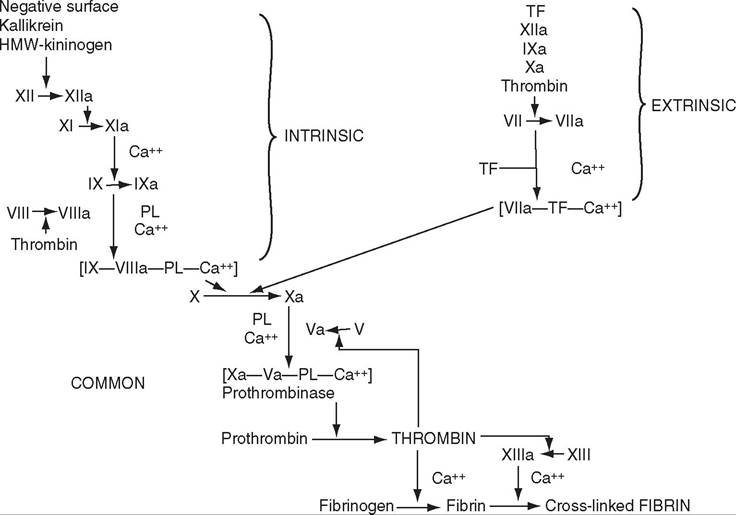
FIG. 27.1 Coagulation pathways. HMW, High molecular weight; PL, membrane phospholipids; TF, tissue factor.
■ BOX 27.3
Causes of Prolonged Prothrombin Time in Horses
Common Causes
Disseminated intravascular coagulation (DIC) Anticoagulant or rodenticide toxicosis
Acute hepatic necrosis
Pyrrolizidine alkaloid toxicosis Aflatoxicosis
Chronic hepatic fibrosis
Less Common Cause
Moldy sweet clover
■ BOX 27.4
Causes of Prolonged Prothrombin Time in Ruminants
Common Causes
Moldy sweet clover (Melilotus species) toxicosis Disseminated intravascular coagulation (DIC)
Less Common Causes
Anticoagulant or rodenticide toxicosis
Pyrrolizidine alkaloid toxicosis
Rubratoxicosis
Aflatoxicosis
Bitterweed (Hymenoxys odorata) toxicosis Chronic hepatic fibrosis
Hereditary fibrinogen deficiency
addition to quantitative deficiencies, coagulation factors may be functionally impaired by increased FDPs or circulating anti-factor antibodies.
Vitamin K is necessary for hepatic production of functional coagulation factors II, VII, IX, and X as well as anticoagulant proteins C and S. The action of vitamin K is inhibited by coumarin compounds acquired via moldy sweet clover hay or anticoagulant rodenticide ingestion or by therapeutic adminstra- tion (e.g., warfarin in horses). Vitamin K inhibition results in deficient carboxylation of coagulation factors and a resulting inability to bind endothelium stably. These incompletely carboxylated factors are termed PIVKAs (proteins induced by vitamin K entagonism/absence). A modified PT assay called the Thrombotest PT is specific for defects in factors II, VII, and/ or X and can be used in cases of suspected coumarin toxicosis; specific tests for PIVKAs are not available for domestic animals.
Clinical signs of coagulation factor deficiencies include spontaneous hemorrhage (e.g., epistaxis, melena, hematuria) or prolonged bleeding after trauma, diagnostic procedures, or surgery. Hematomas or hemarthroses are common after minor trauma or normal exercise, and bleeding into body cavities can occur. Coagulation times are designed primarily for screening purposes and are very insensitive to minor defects of one or more factors (e.g., the PT was prolonged with factor VII levels ranging from 16% to 39% of normal in one study).1 Less severe coagulation defects may require specific factor assays for diagnosis.