Polyenes
Polyenes constitute the oldest class of systemic antifungal drugs. More than
200 polyene macrolides have antifungal activity, and most are produced by the
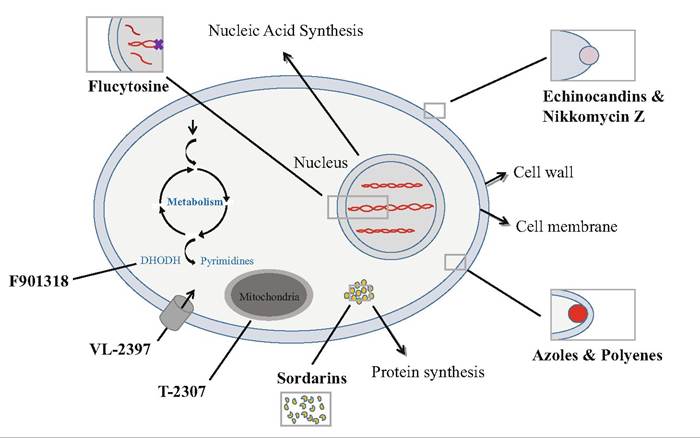
Fig.
16.1 Targets of systemic antifungal agents. F901318 is the leading representative of a novel class of drug, the orotomide, that inhibits dihydroorotate dehydrogenase (DHODH). Nikkomycin Z is an experimental chitin synthase inhibitor currently under development. T-2307 is an investigational arylamidine structurally similar to a class of aromatic diamidines that causes collapse of mitochondrial membrane potential in yeasts. Sordarins derivatives represent a novel class of naturally occurring and semisynthetic products that inhibit fungal protein synthesis through their interaction with the elongation factor 2 (EF2) in the ribosome. VL-2397 (formerly ASP2397) is a novel second generation echinocandin. Active transport of this agent into fungal cells occurs via siderophore iron transporter 1
Fig. 16.2 Timeline of development of systemic antifungals from the 1950s to present
soil actinomycete Streptomyces. Polyenes bind to ergosterol, the main component of fungal membrane sterols (de Kruijff et al. 1974; Gray et al. 2012). This interaction results in the formation of transmembrane pores, which disrupt cell membrane integrity and results in rapid cellular damage or death (Bolard 1986).
16.2.1.1 Amphotericin B
Amphotericin B is a polyene antifungal that contains a macrolide lactone ring with a series of conjugated double bonds. Its antifungal activity was discovered in 1953, and it was approved for clinical use in the USA in 1957 (Dutcher 1968). The chemical structure of amphotericin B deoxycholate is shown in Fig.
16.3. Amphotericin B is insoluble in water but forms soluble salts under both acidic and basic conditions (Gallis et al. 1990). In the current clinical formulation for humans, it is available for parenteral administration as a colloidal suspension using sodium deoxycholate as a dispersing agent and sodium phosphate as a buffer. The primary drawbacks of amphotericin B deoxycholate use are its dose-limited toxicity and significant side effects in various patients. The significant toxicities of amphotericin B include infusion-related adverse effects (fever, chills, arrhythmia, hypotension, and respiratory distress), nephrotoxicity, neurotoxicity, hematological side effects, and allergic reactions (Hamill 2013). Overall, two approaches have been used to improve the clinical response to amphotericin B in humans: the development of less toxic preparations in the 1990s and direct delivery of amphotericin B to target organs (intranasal, aerosolized, intracavitary, and intraperitoneal administration). There are three available lipid preparations of amphotericin B, which are amphotericin B lipid complex (ABLC), amphotericin B colloidal dispersion (ABCD), and liposomal amphotericin B (AmBisome) (Ostrosky-Zeichner et al. 2003a). However, these products are quite expensive and not available in some regions. In addition, the nephrotoxicity observed with the lipid formulations is reduced compared to amphotericin B deoxycholate, but not eliminated.In vitro, amphotericin B is active against most common pathogenic yeasts that cause disseminated mycoses in humans and animals. Cryptococcus (Barchiesi et al. 1994) and Candida spp. (Ostrosky-Zeichner et al. 2003b; Pfaller et al. 2004) are quite sensitive, except Candida Iusitaniae (Hadfield et al. 1987) and Trichosporon beigelii (Walsh et al. 1990), which show decreased susceptibility. Aspergillus spp. are sensitive, except A. terreus (Sutton et al. 1999). Most members of the order Mucorales (formerly indicated as Zygomycetes) are susceptible (Eng et al.
1981). Dimorphic fungi such as Blastomyces dermatitidis, Paracoccidioides brasiliensis, Histoplasma capsulatum, and Coccidioides spp. (C. immitis and C. posadasii) are also sensitive (Collins and Pappagianis 1977).Table 16.1 Recommended indications of antifungals in veterinary practice
| Drug | Animal species | Indications | Recommended dosages |
| Amphotericin B | Birds | Aspergillosis, candidiasis | Conventional AmB: IV, 1.5 mg/kg, q8 h, 3-5 days |
| Nebulization: 15 min, 1 mg/kg q24 h, 10-14 days | |||
| Dogs | Aspergillosis, cryptococcosis, blastomycosis, histoplasmosis, coccidioidomycosis, mucormycosis | Conventional AmB: 0.5 mg/kg IV q48 (slow infusion) to a cumulative dose of 4—8 mg/kg | |
| Liposomal AmB: 3 mg/kg/day IV, at a rate of more than 90-120 mg/kg, 3 times a week, up until 12 treatments | |||
| Cats | Aspergillosis, cryptococcosis, blastomycosis, histoplasmosis, coccidioidomycosis, mucormycosis | Conventional AmB: 0.25 mg/kg IV q48 (slow infusion) to a cumulative dose of 4—8 mg/kg | |
| Liposomal AmB: 1 mg/kg/day IV, at a rate of more than 90-120 mg/kg, 3 times a week, up until 12 treatments | |||
| Horses | Aspergillosis, candidiasis, histoplasmosis, coccidioidomycosis, sporotrichosis, mucormycosis | Conventional AmB: 0.3 mg/kg IV for 3 consecutive days, and repeat after 24-48 h drug-free interval, longterm treatment needed | |
| Nystatin | Birds | Candidiasis of the gastrointestinal tract | 100,000-300,000 IU∕kg, ql2 h, 7-10 days, with antibiotic therapy |
| Terbinafine | Dogs | Cryptococcosis, sporotrichosis, dermatophytosis, and Malassezia dermatitis | 10 mg/kg daily, if resistance to azole |
| Cats | Cryptococcosis, sporotrichosis, dermatophytosis | 10 mg/kg daily, if resistance to azole | |
| Ketoconazole | Birds | Aspergillosis, candidiasis | 30 mg/kg, q 12 h, 14-30 days |
| Dogs | Blastomycosis, histoplasmosis, cryptococcosis, coccidioidomycosis, sporotrichosis, Malassezia dermatitis, and dermatophytosis | 10 mg/kg PO q 12 h for 3-6 months | |
| Cats | Blastomycosis, histoplasmosis, cryptococcosis, coccidioidomycosis, sporotrichosis, dermatophytosis | 10 mg/kg PO q 12 h for 3-6 months | |
| Parconazole | Birds (guinea fowl) | Candidiasis (thrush) | Prophylaxis: 30 mg/kg feed Treatment: 60 mg/kg feed for 7-10 days |
16 AntifungaiuseinveterinaryRracticeandEmergenceofResistance 363
(continued)
| Drug | Animal species | Indications | Recommended dosages |
| Fluconazole | Birds | Candidiasis | 2-5 mg/kg, q 24 h, 7-10 days |
| Dogs | Cryptococcosis, blastomycosis, aspergillosis (nasal) | ||
| Cats | Aspergillosis (CNS infection), cryptococcosis, blastomycosis, coccidioidomycosis | 1.25-10 mg/kg/day ql2 h, 50 mg/cat ql2 h, for 3- 6 months | |
| Itraconazole | Birds | Aspergillosis, candidiasis | Treatment: 5-15 mg∕kg, ql2 h with food for 7-21 days, or 10 mg/kg q24 h for 3 weeks |
| Prevention: 10 mg/kg q24 h for 10 days, 20 mg/kg q24 h, or 15-25 mg/kg/day, for 1 week | |||
| Dogs | Aspergillosis, blastomycosis, histoplasmosis, cryptococcosis, coccidioidomycosis, sporotrichosis, dermatophytosis, and Malassezia dermatitis | 2.5 mg/kg ql2 h or 5 mg/kg q24 h PO (give with food), for 15-30 days | |
| Cats | Dermatophytosis | 5 mg/kg on a week on/week off basis (5 weeks) | |
| Aspergillosis, sporotrichosis, cryptococcosis, blastomycosis, histoplasmosis, phaeohyphomycosis | 2.5 mg/kg ql2 h, 5 mg/kg q24 h, or 50-100 mg/cat PO (give with food), for 15-30 days | ||
| Horses | Aspergillosis, coccidioidomycosis, mycotic keratitis, dermatophytosis | 2.5 mg/kg ql2 or 5 mg/kg q24 h PO | |
| Rodents, rabbits, and fur animals | Dermatophytosis | 5 mg/kg q24 h | |
| Voriconazole | Birds | Aspergillosis | 10-18 mg/kg ql2 h |
| Dogs | Aspergillosis, Scedosporiosis | 4-5 mg/kg ql2 h PO | |
| Cats | Aspergillosis | 4-5 mg/kg ql2 h PO | |
| Horses | Aspergillosis (systemic), Aspergillus keratitis | 2-4 mg/kg q24 h or 3 mg/kg q24 h PO, topical voriconazole solution for keratitis and intracorneal administration |
364 S.
Seyedmousavi et al.
| Posaconazole | Dogs | Aspergillosis, mucormycosis | 5-10 mg/kg ql2-24 h |
| Cats | Aspergillosis, mucormycosis | 5 mg/kg q24 h | |
| Flucytosine | Cats | Cryptococcosis | 25-50 mg/kg PO QID in combination with amphotericin B. Do not use as single treatment |
| Griseofulvin | Dogs | Dermatophytosis | 25-50 mg/kg, ql2-24 h, 4—6 weeks |
| Cats | Dermatophytosis | 25-50 mg/kg, ql2-24 h, 4—6 weeks | |
| Horses | Dermatophytosis, sporotrichosis | Foal: 15 mg/kg/day for 2-4 weeks Pony: 10 mg/kg/day for 1-3 weeks | |
| Ruminants | Dermatophytosis | 10 mg/kg body weight for duration of 7 days in mild infections and 2-3 weeks in severe cases | |
| Rodents, rabbits, and fur animals | Dermatophytosis | 25-50 mg/kg for 3—4 weeks | |
| Clotrimazole | Birds (raptors) | Aspergillosis | Nebulization: 45 min q24 h |
| Dogs | Aspergillosis, dermatophytosis, and Malassezia dermatitis | Single or multiple intranasal local instillation, topical treatment | |
| Cats | Aspergillosis, dermatophytosis | Single or multiple intranasal local instillation, topical treatment | |
| Rodents, rabbits, and fur animals | Dermatophytosis | Rubbing powder in the fur or treating house/nest and sandbox | |
| Miconazole | Birds | Aspergillosis | 45 min/day in raptors |
| Dogs | Malassezia dermatitis | Topical treatment (in association with Chlorhexidine) | |
| Cats | Dermatophytosis, Malassezia dermatitis | Topical treatment (in association with Chlorhexidine) | |
| Rodents, rabbits, and fur animals | Dermatophytosis | Rubbing powder in the fur or treating house/nest and sandbox | |
| Enilconazole | Birds | Aspergillosis | Nebulization: 0.1 ml/kg for 30 min q24 h (5 days on/2 days off) |
| Disinfection (Aspergillus and other pathogenic fungi) | Disinfection of environment: Flush with solutions as recommended for use in poultry houses | ||
| Dogs | Dermatophytosis, Malassezia dermatitis | Topical treatment (0.2% solution twice a week) | |
| Aspergillosis | 10 mg/kg ql2 h instilled into nasal sinus for 14 days (10% solution diluted 50/50 with water) |
16 AntifungaiuseinveterinaryRracticeandEmergenceofResistance 365
(continued)
| Drug | Animal species | Indications | Recommended dosages |
| Cats | Dermatophytosis, Malassezia dermatitis | Topical treatment (0.2% solution twice a week) | |
| Aspergillosis | 10 mg/kg ql2 h instilled into nasal sinus for 14 days (10% solution diluted 50/50 with water) | ||
| Horses | Dermatophytosis | Topical treatment (0.2% solution twice a week) | |
| Disinfection (dermatophytes and other pathogenic fungi) | Disinfection of environment with spray or smoke generator | ||
| Ruminants | Dermatophytosis | Topical treatment (0.2% solution twice a week) | |
| Disinfection (dermatophytes and other pathogenic fungi) | Disinfection of environment with spray or smoke generator | ||
| Rodents, rabbits, and fur animals | Dermatophytosis | Topical treatment (0.2% solution twice a week) | |
| Disinfection (dermatophytes and other pathogenic fungi) | Disinfection of environment with spray or smoke generator | ||
| Natamycin | Horses | Dermatophytosis | Wash lesions with topical suspension 2 times with interval of 4-5 days and repeat after 2 weeks |
| Ruminants | Dermatophytosis | Wash lesions with topical suspension 2 times with interval of 4-5 days and repeat after 2 weeks | |
| Thiabendazole | Birds | Disinfection | Use smoke generator |
| Horses | Dermatophytosis | Wash/spray lesions with topical solution or use ointment for 2 weeks | |
| Ruminants | Dermatophytosis | Wash/spray lesions with topical solution or use ointment for 2 weeks | |
| Rodents, rabbits, and fur animals | Dermatophytosis | 25-50 mg/kg for 3—4 weeks |
366 S. Seyedmousavi et al.
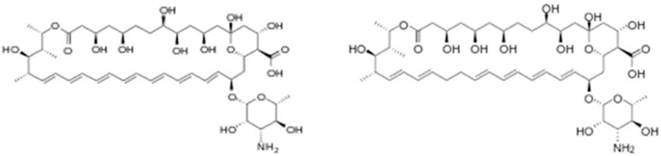
Fig.
16.3 Chemical structures of amphotericin B (left) and nystatin (right)In humans, amphotericin B in combination with 5-flucytosine is recommended for the treatment of cryptococcal meningitis (Perfect et al. 2010; Day et al. 2013), while monotherapy is effective against a wide range of life-threatening IFIs such as blastomycosis, systemic candidiasis, coccidioidomycosis, histoplasmosis, mucormycosis, and sporotrichosis. The current clinical guidelines recommend lipid formulations of amphotericin B for the treatment of aspergillosis as an alternative to voriconazole or as salvage therapy in patients who are refractory or intolerant to other antifungal therapies (Walsh et al. 2008).
None of the amphotericin B formulations are licensed for veterinary use. However, the off-label use of amphotericin B has been recommended for similar systemic fungal infections in animals (Foy and Trepanier 2010), because many of the newer drugs available for humans are cost-prohibitive in veterinary settings. Successful therapeutic response with amphotericin B has been reported in blastomycosis in dogs (Krawiec et al. 1996), coccidioidomycosis in dogs and cats (Graupmann-Kuzma et al. 2008), and aspergillosis in dogs (Schultz et al. 2008). Equine endometrial candidiasis was also successfully treated with amphotericin B (Brook 1982). In addition, nasopharyngeal conidiobolomycosis can be treated successfully with intralesional injection of amphotericin B in combination with administration of sodium iodide and potassium iodide, but there is a possibility of recrudescence of infection (Zamos et al. 1996).
16.2.1.2 Nystatin
Structurally, nystatin is an amphoteric tetraene originally isolated from Streptomyces noursei (Hazen and Brown 1951). It is a polyene antifungal agent, which was first approved by the US Food and Drug Administration (FDA) in 1955 for the treatment of vaginal candidiasis. Nystatin is not absorbed by intact mucosal surfaces and following oral administration, it is passed unchanged in the feces; therefore, it is only active against yeasts present in the gastrointestinal tract (Hofstra et al.
1979). Oral or topical nystatin is well-tolerated; however, patients with renal insufficiency receiving oral therapy with conventional dosages may experience toxicity occasionally. Of note, an investigational lipid formulation of nystatin, liposomal nystatin, showed slightly reduced incidence of toxicity (Semis et al. 2012) with expanded antifungal activity against molds (Oakley et al. 1999; Arikan 2002).The spectrum of activity of nystatin includes Candida spp., Cryptococcus neoformans (Bergan and Vangdal 1983), Trichosporon spp., and Rhodotorula spp. (Hussain Qadri et al. 1986; Pfaller and Diekema 2004). Most dimorphic fungi, such as B. dermatitidis, Paracoccidioides brasiliensis, Coccidioides spp., and Histoplasma capsulatum, are sensitive to nystatin; however, it is inactive against dermatophytes and most Aspergillus spp. (Arikan 2002).
In humans, topical and oral nystatin are recommended for the treatment of superficial Candida spp. infections of the skin, oral cavity, and esophagus including diaper dermatitis, angular cheilitis (Rezabek and Friedman 1992), and oral or vaginal candidiasis (Pappas et al. 2009). Oral nystatin has also been used for the prevention of systemic candidiasis in patients who are specifically at risk, such as those with hematologic malignancies and those undergoing induction of chemotherapy (Pappas et al. 2009). However, the response has often been disappointing. Furthermore, it is noteworthy that currently available oral azoles have been found to be more effective (Hope et al. 2012; Ullmann et al. 2012).
In veterinary practice, nystatin is licensed for use in dogs and cats as an ingredient in otic preparations for the treatment of Malassezia otitis (Nesbitt and Fox 1981). Nystatin can also be used for treatment of intestinal candidiasis. In birds, nystatin has been used for the treatment of candidiasis of the crop and/or gastrointestinal tract. Regurgitation following nystatin administration may be the result of taste, not toxicity (Orosz and Frazier 1995).
16.2.1.3 Terbinafine
Terbinafine is an allylamine antifungal agent that has largely replaced the use of griseofulvin for the treatment of dermatophytic infections and onychomycosis in humans (Shear et al. 1991). Its antifungal activity is mediated via the noncompetitive inhibition of squalene epoxidase (SE), an enzyme that acts on its substrate squalene, an early intermediate in the fungal ergosterol biosynthesis pathway (Favre and Ryder 1996; Krishnan-Natesan 2009). Notably, terbinafine inhibits the enzymatic activity of fungal SE at a very low concentration (noncompetitive inhibition) than that required to inhibit the mammalian counterpart (4000-fold higher concentration needed; competitive inhibition) (Ryder 1992).
This drug is well absorbed from the gastrointestinal tract and then rapidly diffuses from the bloodstream into several skin tissue compartments, including the dermis and epidermis. In addition, terbinafine can remain in the stratum corneum and nails for several months after terminating the medication, even after very short-term therapy in humans (Jensen 1989; Faergemann et al. 1994). Moreover, terbinafine is highly lipophilic and is highly (>99%) protein-bound in human plasma, which impairs its distribution to the brain and cerebrospinal fluid and leads to high concentration in the hair follicles, skin, nail plate, and adipose tissue (Faergemann et al. 1994).
Overall, terbinafine has a broad spectrum with potent activity against dermatophytes, Aspergillus spp., Sporothrix spp., and Malassezia yeasts, although its potency against Candida species may be reduced (Petranyi et al. 1987; Krishnan- Natesan 2009). Terbinafine has been widely reported to elicit a strong clinical response against Trichophyton species, with cure rates reaching >80% (Deng et al. 2011; Grover et al. 2012). In some instances, terbinafine is combined with other antifungals for the treatment of infections caused by highly resistance fungi due to reports of in vitro synergy (Gomez-Lopez et al. 2003a; Cuenca-Estrella et al. 2006; Cordoba et al. 2008). Terbinafine has demonstrated a good toxicity profile at the recommended dosage. Most of the reported side effects are generally limited to gastrointestinal upset and, rarely, hepatotoxicity (Hall et al. 1997; Jaiswal et al. 2007).
In humans, its use is limited to the treatment of dermatophyte infections due to high concentrations in the nails and stratum corneum that persist for long periods, while lower concentrations are found in the plasma (Faergemann et al. 1993). In contrast, one pharmacokinetic study reported elevated concentrations in the plasma and deep tissues of raptors, including red-tailed hawks (Bechert et al. 2010). In humans, terbinafine has been reported to accumulate in the lungs following high- dose administration over time (Dolton et al. 2014).
Reports of terbinafine use in dogs and cats are sparse and limited primarily to the treatment of Malassezia and dermatophyte infections (Rosales et al. 2005). Terbinafine was shown to be well-tolerated and effective for the treatment of cutaneous or lymphocutaneous sporotrichosis (Chapman et al. 2004). In dogs, terbinafine seems to be equivalent or superior to ketoconazole for the treatment of Malassezia dermatitis showing reduction in both yeast counts and pruritus with little evidence of acquired resistance during treatment (Hofbauer et al. 2002; Guillot et al. 2003; Rosales et al. 2005). Higher doses of terbinafine (30-40 mg/kg once daily over 2 weeks period) are required for treatment of dermatophytosis in cats (Kotnik et al. 2001, Kotnik 2002). Recently, an otic formulation containing terbinafine has been approved for use in dogs with Malassezia otitis. With this formulation, a weekly administration is sufficient.
16.2.2