Posterior Segment Disease
Retinal Degeneration
Most cases of chronic posterior segment disease (trauma, inflammation, hypertension) will result in some degree of retinal degeneration, which can be recognized by tapetal hyperreflectivity, retinal vessel attenuation, depigmentation and pigment clumping, the appearance of choroidal vasculature or the contours of such (particularly when they previously were not able to be visualized) and optic nerve atrophy.
There exist a great many forms of inherited retinal degeneration and dystrophy that occur at various ages in companion animals. These, too, will result in progressive decline in retinal structure and function. Presently, there are no available treatments that will reverse or slow these types of changes once they occur in veterinary patients. Some clinicians advocate the use or oral antioxidant supplements to support eye health (Kador et al. 2014).Hypertensive Retinopathy
Animals with systemic hypertension often develop ocular signs that include retinal detachments and ocular hemorrhage. Any animal with acute vision loss, mydriasis, impaired pupillary light reflexes, retinal detachments, and/or ocular hemorrhage should be evaluated for systemic hypertension and, if indicated, its underlying etiology (Maggio et al. 2000; Sansom, Rogers, and Wood 2004) (Figure 4.40). Treatment for hypertensive retinopathy requires normalization of the systemic blood pressure. Retinal detachments occur because hydrostatic pressure within the choroidal vasculature causes fluid leakage with accumulation in the subretinal space. If the pressure is lowered, the fluid will be reabsorbed and the retina will reattach as long as it has not become torn. Vision may be restored if the detachment resolved rapidly. The longer the retina is away from the choroid, the source of its oxygen and nutrition, the greater the likelihood of permanent damage and degeneration.
Hemorrhage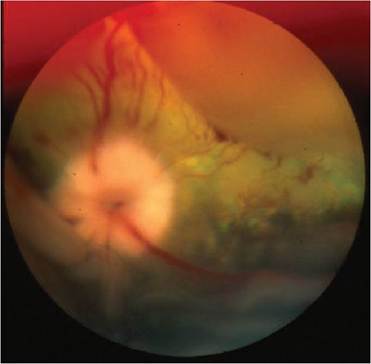
Figure 4.40 Hypertensive retinopathy in a dog secondary to renal disease. Note the multifocal retinal detachments and retinal hemorrhages.
within the eye causes uveitis, so in addition to systemic therapy for the hypertension, therapy for concurrent uveitis may ne indicated.
Blindness
The great majority of companion animals that have visual deficits or have lost sight completely can still have wonderful, happy and healthy lives as long as their human caregivers recognize their pet's limitations and take steps to ensure the animal's safety and comfort. It is important to recognize that many of the conditions that result in loss of vision are painful. When vision is lost, there may still remain the need to continue treatment and monitoring to control or restore the patient's comfort.
With a period of adjustment, visually impaired animals will acclimate to their environments and compensate with their other senses. Consideration of the patient's environment and senses of smell, hearing, and place are important when learning to live with a visually impaired pet. First and foremost, the animal's environment must remain or be made safe for an unsighted pet. Dogs and cats that cannot see will “map” their environments if given time and support. In many cases, they will develop such a sense of place and the confidence necessary to negotiate in such a way that visitors unfamiliar with the pet's deficits may not even recognize the lack of sight. If the pet is reticent or if the environment is novel, leading the pet on a short leash around and from room to room and providing treats and positive reinforcement will facilitate adjustment. Picking up cats or small dogs and carrying them around the house should be avoided as it prevents the pet from mapping the home and can be confusing to the pet if they are set down in another part of the home. It is critically important that the environment be examined for dangers that are at pet-level and that sharp edges and other hazards be removed.
Baby gates may be employed to block access to swimming pools, stairs or hazards that cannot be removed.For dogs, the leash should become an important safety tool. Keeping the pet on a short leash whenever outside of his/her home range will impart some degree of confidence and keep the pet within reach if an unexpected danger presents itself. Training the pet with new commands such as “watch,” “step up,” “step down,” “left,” “right,” and “stop,” may improve the pet's engagement and safety. Clicker training may be helpful for some pets as well. Continue to walk the dog to keep them physically and mentally fit. It is advisable to exchange a collar for a harness that provides somewhat more control and permits greater guidance. Remember that when presented with another animal, the visually impaired pet will not be able to read the body signals and visual cues that animals usually give to one another. Supervision is necessary when introducing new animals until a hierarchy and understanding has been established. Once accustomed to one another, sighted and blind companions often interact very well. Some sighted dogs become a great help to the impaired pet and will act as a form of “seeing eye” guide.
Keeping the pet's bowls and bedding in the same place can be helpful for orientation. If the pet becomes confused but can return to his/her personal effects and home-base, re-orientation will be easier. Refraining from moving the furniture, or recognizing that that will require the pet to re-orient him/herself, and keeping the house picked up and things in their normal places is helpful as well. Carpet runners or nonslip pads, especially on slick surfaces or in doorways can provide landmarks, as can different textures (mulch, pebbles, varied surfaces).
Many blind pets will have heightened senses for hearing and smell. It is possible take advantage of this to help the pet's security. Talk to your pet often and let him/ her know when you are approaching or about to touch him/her.
Keeping a radio on and in the same place will provide the pet with a landmark and provides some level of comfort and security when a human caretaker is absent. Placing windcharms on the porch, by the outside door or in a particular area of the yard may help a dog keep its bearings outside. Other pets in the house may wear jingling tags or bells to alert the impaired pet to their presence and location. Water fountains for drinking work very well for blind pets since the burbling sound of the water helps the pet locate the water source. Switching to or adding toys that have bells or squeakers may encourage or permit a pet to continue active play which is important to both the physical and mental health of the pet. Pets can and do learn the names of certain toys. This may be a way to engage the pet in play.Employing scents or pheromones in different parts of the home may be helpful for placing, particularly if used and corners or junctions in the home. Toys that are scented or have holes for treats can engage and keep a pet's interest.
It is helpful if the human companion maintains an upbeat and positive attitude with their visually impaired pet, especially if the vision loss is recent or acute. A human that feels sorry for themselves or their pet will transmit that sense of sadness or despair and may cause or increase a pet's anxiety. Speaking to the pet in a normal, cheerful voice and providing positive reinforcement will ease the pet's transition.