Prevention and Control of Mastitis
Prevention of Intramammary Infection
At the herd level, the prevalence of mastitis is a function of the incidence and the duration of IMI. Thus control programs are directed toward implementing management programs that can influence either duration of IMI or the development of new infections.
After an infection is acquired, duration of IMI is influenced by inherent characteristics of the pathogens (see Table 36.2), treatment efficacy, and culling decisions. Management practices that focus on limiting duration of infection occur after financial losses attributable to infection have already been incurred. In contrast, control programs that focus on preventing the development of new infections are profitable because they reduce the losses caused by mastitis. Thus the emphasis on controlling mastitis should be directed toward implementation of management practices that prevent new infections.Prevention is based on knowledge of where the exposure to pathogens is occurring. In general, contagious transmission occurs when teats of healthy cows are exposed to bacteria that originated from subclinically infected udders of other cows. Thus the primary principle of reducing exposure to pathogens that can be transmitted in a contagious manner is to reduce the possibility of contact with milk that came from subclinically infected cows. Successful implementation of the five-point plan is the basis for control of pathogens that can be transmitted in a contagious manner.335 The components of the five-point plan are discussed throughout this chapter and include (1) postmilking teat dipping, (2) comprehensive use of intramammary antimicrobial therapy at the end of every lactation, (3) appropriate therapy of clinical cases, (4) proper maintenance and functioning of milking equipment, and (5) appropriate culling of chronically infected cows.
The components of the five-point plan are now widely viewed as standard management procedures and are highly adopted in many developed dairy regions.260,336,337 As a result, many regions have dramatically reduced the prevalence of IMI caused by organisms that are primarily transmitted in a contagious manner.To address the increased incidence of mastitis caused by environmental pathogens, the National Mastitis Council has added five additional components focused on implementation of a comprehensive mastitis control program (http:// www.dairyweb.ca/Resources/WDD82/WDD8212.pdf). The 10-point mastitis control program incorporates all components of the five-point plan and is organized in the following checklist:
Point 1: Establishment of Goals for Udder Health. As with management of reproduction, nutrition, and production, it is difficult to improve udder health without having clear goals. While the establishment of goals seems intuitive, few farmers set aside sufficient time to develop an udder health plan that includes herd-specific goals. Surveys of veterinarians and other professionals who work with dairy producers indicate that barriers to improvement in milk quality are often related to motivation and implementation rather than lack of technical knowledge or skills.4,, Several studies have indicated that many dairy veterinarians are only marginally involved in mastitis control programs. Upon beginning a team-based milk quality improvement program, only 24% of dairy farmers (n = 180) indicated that they used their herd veterinarian to 137
plan milk quality programs.13' In a companion survey, most dairy veterinarians (n = 42) interested in participating in a mastitis control program indicated that they spent less than 10% of their professional time actively working to improve milk quality.339 Increased involvement in the development of annual udder health plans is an area of opportunity for dairy veterinarians, and the initial step can be to begin a discussion of herd-specific goals.
Point 2: Maintenance of a Clean, Dry, Comfortable Environment. Exposure to pathogens that have environmental reservoirs is strongly associated with facility and animal hygiene. Numerous hygienic practices on dairy farms have been associated with the incidence of clinical mastitis.341-344 The rate of clinical mastitis occurring in dairy cows has been shown to be strongly associated with the cleanliness of animal housing and bedding sources.341 The number of bacteria on teat skin is associated with bacterial count in bedding,194,345 and a linear relationship between the rate of clinical mastitis and the number of gramnegative bacteria in bedding has been demonstrated.182,346 Nutritional management can have an indirect influence on hygiene, as the use of high-concentrate diets has been associated with looser feces and reduced facility cleanliness.34' Cow 344348 cleanliness can be evaluted using several scoring systems.344,348 A four-point udder hygiene scoring (UHS) system for assessing udder hygiene has been described by Schreiner and Ruegg.349 Cows that are scored as having dirty udders were at increased risk of IMI and increased SCC.344 Similarly, Reneau and col- leagues350 used hygiene scores to evaluate five body areas on dairy cows.326 The udder and hind limb scores were significantly associated with SCC.326 Research has demonstrated that neither UHS nor the rate of new IMIs is improved by the use of tail 349351 docking, and this practice should not be encouraged.349,351
Mastitis control programs should focus on reducing bacterial exposures by improving facility hygiene. In many herds, clean or recycled sand will be the recommended bedding material because it does not support as much growth of coliform bacteria as organic bedding materials do.194,208,346,352,353 In some herds, bacterial counts can be reduced by adding lime or other bedding conditioners or by using other methods to reduce bacterial counts, but the effect is generally short lived.354,355 The use of dried manure solids as bedding is a risky strategy because these substances are ideal to support growth of bacteria found in the intestinal tract of dairy cows.
Point 3: Proper Milking Procedures. Milking hygiene and the risk of new IMIs can be improved by ensuring that milking technicians wear disposable nitrile or latex gloves.356-358 Essential aspects of an effective premilking routine include effective teat disinfection, examination of foremilk, sufficient stimulation to allow for effective milk letdown, complete drying of the teats, and timely attachment of the milking unit. Research has definitively established that the gold standard for premilking teat disinfection is application of an effective disinfectant for a sufficient contact time, followed by drying the teat using a single cloth or paper towel for each cow.359-362 To ensure that clinical mastitis is detected and abnormal milk does not reach the human food chain, two or three streams of foremilk should be removed and examined before attaching milking units. Drying teats has been demonstrated to reduce bacterial counts of teat ends,360 reduce the number of colonies of spore-forming bacteria in bulk milk,363 and effectively reduce the risk of contaminating milk with iodine residues from predips.359 Teats should be dried using one dry cloth or paper towel for each cow. Use of towels to dry teats on multiple cows has been associated with a greater monthly rate of clinical mastitis as compared to herds that use a single towel per cow.137
Modern dairy cows in high-producing herds have been selected to milk rapidly, and removal of foremilk is often sufficient stimulation to achieve milk letdown. The time between stimulation and attachment of the milking unit should be approximately 60 to 90 seconds, but disturbances in milk flow and yield have not been reported until lag times have exceeded 3 minutes.364,365 To prevent bimodal milk flows, premature attachment of the milking unit should be avoided.364 To minimize stress on teat ends, milking units should be removed when milk flow rates drop to a level that indicates that most milk has been harvested.
On most high-producing herds, milking units are removed when milk flow rates fall below 0.5 to 1.0 L/min. The use of automatic take-off units is encouraged, as they increase consistency of milking and allow milking technicians to focus more on premilking preparation.The purpose of postmilking teat disinfection is to reduce the transmission of pathogens that can be transmitted in a contagious manner.335,366,367 The principle is based on killing pathogens deposited on the teat skin during the milking process before they colonize the teat orifice and invade the gland, and effective application of postmilking teat dips can result in more than a 50% reduction in new IMIs.368 Postmilking teat dipping is a highly adopted practice,21,120 but it is not always properly implemented. Milking technicians should be trained to use an application method (such as use of a dip cup) that ensures that at least 75% of the teat skin is covered with an approved, commercially formulated teat disinfectant. Efficacy of the postmilking teat dip should have been demonstrated through properly performed scientific trials.
Point 4: Proper Maintenance and Use of Milking Equipment. Ihe impact of machine milking on development of new IMIs is well known, and veterinarians should be aware of how to evaluate key indicators of milking equipment function. Improper functioning of milking machines can result in reduced resistance of the teat canal to IMI; vacuum fluctuations and liner slips may provide forces that overcome the resistance of the teat canal to bacterial invasion or dispersion of bacteria within the udder, and milking equipment can serve as fomites to transfer bacteria among cows. Providing stable teat end vacuum is a 369370 central objective of a properly functioning milking system.369,3'0 A high rate of liner slips has been demonstrated to be associated with increased rates of clinical mastitis and increased risk of IMI.370 Improperly functioning machines may cause congestion in the teat wall, which can result in slower closure of the teat canal and development of IMI.371,372
Point 5: Good Record Keeping.
Measuring outcomes is an integral part of effective management.373 Mastitis is a bacterial disease that occurs in individual animals, but mastitis control programs must be implemented at the herd level. Successful mastitis control depends on effective detection, accurate diagnosis, evaluation of appropriate treatment options, and implementation of preventive practices that address herd-specific risk factors associated with exposure to mastitis pathogens. Veterinarians who wish to reduce mastitis should regularly review herd records for SCCs and clinical mastitis and evaluate key performance indicators relative to herd goals. The program should be structured to allow for the evaluation of cow factors, environmental factors, and milking machine factors that can contribute to exposure to mastitis pathogens. An effective surveillance system for mastitis includes clear case definitions and effective mechanisms to detect both clinical and subclinical mastitis, the use of recording systems that allow for timely evaluation of risk factors, and feedback mechanisms that allow management personnel and veterinarians to develop goals and evaluate actions.Points 6 and 7: Appropriate Management of Clinical Mastitis During Lactation and Effective Dry Cow Management. Both of these topics are discussed later in the chapter.
Point 8: Maintenance of Biosecurity for Contagious Pathogens and Marketing of Chronically Infected Cows. Biosecurity programs are designed to reduce the risk that healthy cows will be exposed to bacteria originating from other animals. The goal of mastitis biosecurity programs is to reduce the probability that teats of healthy cows will be exposed to infected milk and to enable the cow to have an effective immunologic response if exposure occurs (see Prevention Through Immunization section later). Many farmers arrange the milking order so that lower risk animals (first lactation cows or cows with lower SCCs) are milked first to reduce the risk of transmission of mastitis pathogens during the milking process. Physical segregation of chronically infected cows has been shown to be an effective method of reducing the new infection rate,3'4,3'5 but it is dependent on using diagnostic methods that can accurately detect infected cows. Automated backflush of liners with disinfectants between cows has reduced the risk of new IMIs caused by S. aureus f16 but the cost effectiveness of these systems depends on the prevalence of of infections within the herd. The use of an automated teat dipping and backflush system was shown to result in reduced bulk tank SCC and decreased new increased SCC, but the effect became more significant after 6 to 18 months of use.311
The prevalence of chronically infected cows is a strong predictor of risk of new infection with pathogens that can be transmitted in a contagious manner. One study demonstrated that the odds of a cow becoming infected with S. aureus doubled with each 5% increase in the herd prevalence of existing infection.357 Chronically infected cows must be identified through routine testing of individual cows’ SCCs, and microbiological analysis should be performed to identify the causative pathogens. Cows that develop chronic infections with pathogens that are refractory to treatment should be culled to reduce the risk of transmission to healthy animals.
When animals from outside sources are purchased, they should be bought from recognized individual herds (rather than sale barns), and historical information such as bulk tank culture results and individual cow SCC histories should be reviewed. Animals should be screened for Mycoplasma spp., and a history of recent respiratory disease should be viewed as an important risk factor for this syndrome.
Point 9: Regular Monitoring of Udder Health Status. Udder health recording systems must include monitoring programs that allow assessment of both clinical and subclinical disease. Animal health recording systems for mastitis should consist of both temporary cow-side records that are used for day-to-day decision making and permanent records (such as cow cards or computerized records) that are used to summarize trends over time. ’ ’ Ihe recording system should be accessible and allow the veterinarian to determine important risk factors and epidemiologic trends. The first step in monitoring subclinical mastitis is to ensure that SCC values are routinely obtained from all cows. Generally all cows with SCC values greater than 200,000 cells/mL (linear somatic cell score of approximately 4.0) are considered to have subclinical mastitis. SCCs should be reviewed monthly at both the herd level and the cow level. At the herd level, evaluation of monthly SCC patterns can be highly diagnostic for troubleshooting subclinical mastitis problems. Recommendations for key performance indicators for monitoring udder health are available.313
Point 10: Periodic Review of Mastitis Control Program. Dairy farming is a complex process that involves interactions between animals, nature, and people. Like other research-based businesses, the growth in knowledge about dairy management practices is extraordinary. Dairy farmers acquire information about animal health from a variety of sources, including veterinarians, nutritionists, other producers, dairy magazines, and consultants. Veterinarians visit multiple farms, see results from a wide variety of management decisions, and bring an outside perspective to farm decisions. On-farm management teams can be formed to troubleshoot specific farm issues or to meet periodically and review farm performance. A properly formed management team can aid the farmer by bringing together advisors with a range of experiences. Management teams also allow for dialogue between consultants (such as veterinarians and dairy plant personnel) who have a shared interest in specific outcomes. The management team format is extremely successful in solving mastitis problems. Farms that participated in a team-based milk quality program in Wisconsin increased adoption of best management practices and improved mastitis p 318 gpp
control.318
Prevention Through Immunization
Understanding the principles of the immunologic response to immunization is helpful in successfully implementing an effective vaccination program. Lymphocytes will respond to a specific microbial antigen only if the antigen (protein) is combined with a major histocompatibility complex (MHC) molecule on the surface of host cells, a process referred to as antigen presentation.65 Cells such as macrophages and dendritic cells are particularly efficient in antigen processing by phagocytizing, digesting, and presenting antigens on their membrane surface in conjunction with an MHC molecule. In response to antigen presentation, naive lymphocytes then undergo clonal expansion and differentiation. A specific antigen can only be presented to a lymphocyte that solely recognizes that antigen.62 Thus successful immunization against a pathogen must link the invasion of the pathogen with recruitment of innate phagocytic cells that recognize and digest the microbe, and subsequently present one of potentially hundreds of different antigens from the pathogen on the cell surface in order to attract and activate a matching lymphocyte for that specific antigen. T-helper cells play a central role by (1) enhancing B-lymphocyte clonal expansion and differentiation to antibody-producing plasma cells, and (2) completing the inflammatory response loop by releasing cytokines such as IL-11 and IFN-γ that stimulate phagocytes to more efficiently phagocytize and kill ingested microbes. Antigen-specific antibodies that arise from the acquired immune response also enhance phagocyte function by opsonizing microbes, thus assisting in target recognition and ingestion.
The decision to use a vaccine as part of a mastitis control program should be founded on the practitioner’s ability to access peer-reviewed studies and compare incidence and severity of natural infections between vaccinated animals and unvaccinated controls. Such studies should encompass a diversity of herd management practices and geographic regions. Unfortunately, such trials require large numbers of animals and long duration. Alternatively, challenge-exposure trials are often performed to assess vaccine efficacy. This type of trial requires fewer animals and less time, and many variables such as different strains of bacteria, challenge dose, and physiologic status of the animal can be uniformly standardized. In addition, more comprehensive outcomes, including shedding of bacteria in milk, physical examination of the cow, and changes in biochemical parameters of serum and milk can be reliably measured. However, these studies may have limited application in relation to the diversity of dairy farm management and environment, as well as among pathogens.
As with therapeutics, appraisal of vaccine efficacy should not be made on testimonials, especially herd-level impressions of “before-and-after” responses. Assertions are often made based on perceptions that initiating a vaccine program decreased the incidence and severity of mastitis cases, lowered SCCs, increased milk production, et cetera, without using a concurrent nonvaccinated control group for comparison. This is a frequent flaw in the evaluation of autogenous bacterins, in addition to a lack of the quality control standards rigorously followed in commercial production. Mastitis incidence and SCCs within a herd can rise and fall based on many factors, including weather, changes in the proportion of younger to older animals in the herd, history of herd additions, correction of milking techniques or deficiencies in equipment, and culling decisions.
IMMUNIZATION AGAINST SPECIFIC MASTITIS PATHOGENS
Gram-Negative Core-Antigen (Escherichia coli J5) Bacterins. Gram-negative core-antigen bacterins are used on many dairy herds. The variants studied most extensively are formulated with a mutant strain of E. coli O111:B4 (Rc mutant, commonly termed J5) lacking the “O” antigen capsule of the cell wall but with the core lipopolysaccharide, membrane proteins, and lipid A antigens intact. These core antigens are highly conserved among gram-negative bacteria, and elicit cross-reactive anti-gram-negative antibodies in J5-vaccinated cows.381-383 Thus dairy cattle immunized with these bacterins develop immune resistance against a wide variety of gramnegative bacteria, including mastitis-causing coliforms.
Initial studies in California determined that higher serum anti-E. coli J5 immunoglobulin G (IgG) was correlated with a lower incidence of clinical coliform mastitis.384 A subsequent field trial demonstrated that cows administered three immunizations (at drying off, 30 days after drying off, and in the postpartum period) had a fivefold decrease in the rate of clinical coliform mastitis in the first 100 days of lactation, as compared to unvaccinated cows.385 A field trial in Ohio using a similar dose regimen reported that core-antigen immunization did not reduce the prevalence of gram-negative IMIs at calving; however, 67% of the infections present at calving in unvaccinated cows developed clinical mastitis, as compared to only 20% in the J5-vaccinated cows.386 In addition, vaccination with J5 bacterin increased anti-E. coli J5 IgG in serum and milk as compared to unvaccinated controls,386-388 although anti-E. coli J5 antibody titers in milk are orders of magnitude lower than in serum. Following intramammary challenge of E. coli, coreantigen immunization reduced the severity of infection but did not prevent infection.386
The pathogenesis of severe coliform mastitis is dependent on LPS-induced immune mediator responses, and a high proportion of severe coliform mastitis cases become bactere- mic.313 Thus J5 bacterins may have a greater impact on the systemic effects of coliform mastitis than on local mammary inflammation. This concept is supported by a field trial from New York that determined that two doses of J5 bacterin decreased the proportion of clinical mastitis cases that resulted in culling or death by threefold but did not reduce the overall incidence of clinical mastitis cases.389 However, coliform mastitis cases contracted during the first 50 days of lactation resulted in less milk production loss among J5-vaccinated cattle.390
Gram-negative bacterins are regarded as weakly immunogenic in dairy cattle because they elicit poor amnestic IgG1 and IgG2 responses.81 An Ontario study found that a substantial population of cows that were administered two J5 bacterin doses during the dry period had poor antibody responses and a higher incidence of mastitis in the subsequent lactation.391 This relatively short duration of immune protection is supported by several trials.392-394 A New York study determined that cows vaccinated with two doses of J5 bacterin lost less milk production following clinical mastitis and survived longer as compared to unvaccinated cows. However, this protection, as well as anti-J5 antibody titers, declined as lactation (and time since vaccination) progressed and did not exist by 75 days in milk.392 In a Michigan study, hyperimmunization of cows with six doses of J5 bacterin resulted in a threefold decrease in severe clinical coliform mastitis from 42 to 126 days in milk, as compared to cows that received three doses. This suggested that supplemental immunizations extended protection beyond that offered by traditional vaccination regimens.393 A subsequent Michigan study determined that cows immunized with five doses ofJ5 bacterin had elevated anti-E. coli J5 antibody IgG1 and IgG2 titers, relative to unvaccinated cows, for up to 60 to 90 days longer than cows administered three doses of J5 bacterin only.394 In addition, the best response to immunization, in terms of intensity and duration of antibody response, was gained when multiple immunizations were given as a series in different anatomic locations on the cow.394
Use ofJ5-type bacterins relies on five principles: (1) Diagnose if coliform organisms cause a substantial portion of clinical mastitis within a herd, (2) determine the severity and incidence of clinical coliform mastitis cases, (3) describe the epidemiology of the problem in the herd, (4) decrease other herd risk factors that may contribute to clinical coliform mastitis, and (5) develop a vaccination protocol that best integrates immunology with herd needs and practical limitations (Table 36.3). Veterinarians should review these steps when developing a protocol for dairy herds and periodically review progress and changes in the herd that may lead to a re-evaluation of the immunization protocol.
Use of Staphylococcus aureus Bacterins. Considerable effort, encompassing numerous antigens, virulence factors, and
■ TABLE 36.3
Guidelines for Core-Antigen Gram-Negative Bacterin Use in Dairy Herds
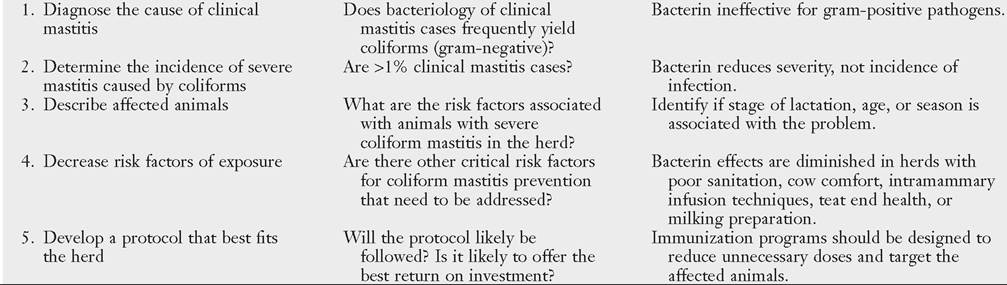
bacterial strains, has been made to develop an efficacious and practical S. aureus vaccine. Much of the interest has focused on vaccination of primiparous heifers. A bacterin containing a lysed culture of polyvalent phage types, including a variety of capsular serotypes, is commercially available in many regions (Lysigin). This product originated from work in Louisiana that determined that two initial doses 2 weeks apart, followed by doses at 6-month intervals, reduced IMI at calving caused by both NAS and S. aureus. However, a subsequent challengeinfection study determined that this bacterin did not prevent IMI, accentuate clearance of IMI, affect SCC, or milk yield post challenge.395 The Lysigin-vaccinated heifers did have improved clinical scores and shorter duration of clinical mastitis.395 Although immunization with Lysigin increased serum anti-S. aureus IgGl in heifers, milk concentrations of IgGl, IgG2, and IgM were not affected.396 In a subsequent report in lactating cows, representing multiple parities, two doses of Lysigin administered 14 days apart did not reduce the number of mammary quarters that developed new S. aureus or NAS IMI, the time after vaccination to develop new IMI, SCC, or milk antibody isotype to positive ratio.395 The authors speculated that the bacterin may have induced insufficient opsonizing antibodies in milk to promote phagocytosis.
S. aureus vaccines would likely have limited use in many dairies, especially in herds with low prevalences of IMI, as is typical for herds with SCCs less than 200,000 cells/mL. Thus it is unlikely that S. auereus bacterins will have a significant impact in herds that successfully control contagious mastitis by practicing excellent milking techniques and maintaining milking equipment. Conversely, herds that immunize in lieu of good management practices are likely to have disappointing results. Investigators have administered S. aureus bacterins in an attempt to augment antimicrobial therapy, with conflicting 395 397
results.395,397