Surgery of the Male Reproductive Tract
Preparation of Teaser Bucks
There are many situations in which the presence of a teaser animal is desirable. A teaser can be used to stimulate the onset of cyclicity at the beginning of the breeding season or in the off season (male effect).
If the teaser is incapable of inseminating his does, breeding can be intentionally postponed until the second estrus, when there is an increased ovulation rate.A teaser animal may also be more efficient than a human caretaker at eliciting or observing signs of estrus, including tail wag, buck-seeking behavior, and willingness to stand. The teaser, then, generally simplifies protocols involving superovulation, artificial insemination, or breeding to a distant buck. It can also be used to detect returns to estrus when rebreeding must be to the same distant buck or buck in a straw. One study showed a decrease in the duration of estrus and an increase in fertility to artificial insemination (from 59 to 74%) when a vasectomized buck serviced the does before artificial insemination was performed (Romano et al. 2000). Finally, the owner can be more sure of the last possible due date, as for induction of parturition, if there was no postbreeding exposure to a fertile buck.
Angora goats are reported to be inactive outside the normal breeding season, and selection and preparation of a less seasonal goat such as the Boer have been recommended for use as an early-season teaser in South Africa (Van der Westhuysen et al. 1988).
Non-surgical Teasers
There is a teaser to fit almost every situation. If a small herd has only one buck, that animal can be fitted with an apron to ensure that copulation does not occur. If no bucks are present, other animals can be substituted. One of the simplest teasers is the intersex goat. This infertile animal usually has no idea that it is a genetic female. Where year- round masculine behavior is not desired or the expense of maintaining an otherwise non-productive animal is too great, a temporary teaser can be created with hormones.
A wether or a doe that will not be bred for several months is chosen. The animal is then given testosterone by injection to develop adequate libido. One protocol involves using 100 mg of testosterone propionate every third day (Barker and Bosu 1980; Bosu and Barker 1982). Another uses 150 mg repositol testosterone weekly, beginning three weeks before intended use and continuing until the teasing job is done for the year (E. Herndon, Uvalde, TX, USA, personal communication 1989). Intravaginal sponges impregnated with 100 mg testosterone have also been used (Gordon 1997). Practitioners in the United States should note that testosterone is currently regulated as a schedule III drug under the Controlled Substance Act (Parkhie 1991) and this extralabel use of testosterone for production purposes would also be illegal.Penile Translocation
The owner of a large herd may want one or more surgically prepared teasers. A penile translocation (deviation) is the surgery of choice if later breeding to the selected buck might be desirable (Barker 1977). The buck should be held off feed and water 12 hours before surgery, because he will be positioned in dorsal recumbency. If surgery is done under general anesthesia, a cuffed endotracheal tube should be used. If the buck is only tranquilized and analgesia is provided with local injection of 1% lidocaine, the head should be positioned lower than the neck. The abdomen is clipped and scrubbed and a new location, above the fold of the flank and on an angle from the base of the scrotum that is 45° off midline, is chosen for the preputial opening. The right flank is preferred if a right-handed person is trying to collect semen from the buck with an AV at a later date. A circle of skin and cutaneous trunci muscle (4-5 cm in diameter, lower edge 1 cm above the fold of the flank) is removed and discarded (Edmondson et al. 2012; Tibary et al. 2017). Next, a circumferential skin incision approximately the same size as that of the target hole (5 cm diameter) is made around the preputial orifice and extended along the midline, over the shaft of the penis, from the preputial incision two-thirds of the way to the base of the scrotum (Figure 13.14).
The prepuce and penis are dissected free of the body wall. A reference suture is placed to mark the most cranial aspect of the skin of the prepuce (Edmondson et al. 2012), and the finger of a sterile glove is slipped over the prepuce to prevent tissue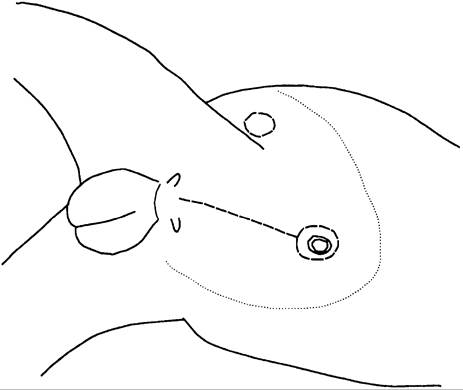
Figure 13.14 Location of incisions for penile deviation is shown by the dashed lines, while local anesthetic is infiltrated along the dotted line.
contamination as the penis is pulled through a subcutaneous tunnel to the flank incision with the aid of long forceps. Finally, the prepuce is sutured into its new location with two layers of interrupted absorbable sutures, being careful to locate the reference suture dorsally. The midline incision is closed except for the most cranial aspect, which is left open for drainage (Edmondson et al. 2012). Postoperative penicillin and tetanus prophylaxis are warranted. Hot-packing or anti-inflammatory drugs may be needed for several days to control swelling at the preputial orifice. The buck thus prepared can still breed an AV. He can also breed a cooperative doe, given adequate time for maneuvering, and he should not be allowed to run loose with the does unless aproned or sterilized with a further surgery.
Vasectomy
If no additional breeding with the animal is planned, a vasectomy can be used to create a permanent teaser. Possibilities for anesthesia (see Chapter 17) include sedation and local infiltration, epidural anesthesia, or general anesthesia. The procedure is as for rams and has been well described elsewhere (Copland 1986; Tibary et al. 2017). Briefly, the neck of the scrotum is prepared for surgery and draped. An incision can be made anteriorly, laterally, or posteriorly, according to the surgeon’s preference. It is also possible to perform a bilateral vasectomy through a single cranial midscrotal incision (Lofstedt 1982). The firm, cord-like ductus deferens is located and ligated twice, and a section 2-3 cm long is removed between the ligatures.
Both pieces of excised ductus should be examined to verify that an artery was not removed by mistake. An impression smear can be made to look for sperm in the ductus of a mature male. The center of the ductus of an immature male appears as a red dot. Under a dissecting scope, however, the lining has a stellate appearance. The tissue should be preserved in formalin in case histologic verification of the vasectomy should be required. The vaginal tunics need not be sutured; skin can be closed with absorbable or nonabsorbable suture or with wound clips. The va.sectomized buck should be permanently identified (e.g., by tattoo) to prevent later confusion, and it should not be used for at least two weeks after surgery. Some authors suggest a minimum of 30 days before the animal should be used as a teaser (Mobini et al. 2002), but numbers are greatly decreased and 95% of the sperm in the ejaculate are already dead by one week (Batista et al. 2002b).Inflammatory and degenerative changes have been reported after vasectomy. Palpable granulomas, anecho- genic on ultrasound and consisting of dead sperm, develop in the firm and enlarged tail of the epididymis. Efferent ductules may rupture, causing extravasation of spermatozoa into the tissues and evoking an immune response with multinucleated giant cells (Batista et al. 2002a). Some bucks showed degeneration of seminiferous tubules by four months after vasectomy. In another report, anechoic granulomas developed in the deferent duct of six bucks and in the head of the epididymis of a seventh. Only in the latter animal, with obstruction of the epididymis occurring close to the testis, were ultrasonographic changes visible in the parenchyma of the testis by five months after vasectomy (Ahmad and Noakes 1995).
Epididymal Surgery
An alternative to vasectomy is destruction or removal of the tail of the epididymis. Tranquilization or infiltration of a local analgesic should be used, although neither is mentioned in the original descriptions.
As always, tetanus prophylaxis should be ensured. One technique involves simply incising through skin and tunics over the tail of the epididymis and then amputating it with scis - sors. Heat cautery or ligation of the exposed stumps of epididymal tissue is recommended to hinder recanalization (Van Rensburg et al. 1963; Shelton and Klindt 1974; Mobini et al. 2002), which otherwise frequently occurs. The current recommendation is to ligate on each side of the tail of the epididymis before removing it (Tibary et al. 2017). The skin should be sutured to avoid infection. Semen should be collected at least three times before the buck is used as a teaser. Another technique involves injecting a sclerosing agent such as 1 mL of 10% calcium chloride into the tail of each epididymis (Smith 1986a).Castration
Castration is commonly performed to avoid undesirable odors and aggressive sexual behavior in male goats kept as pets, and to prevent breeding by bucks deemed to be of inferior genetic quality. The flavor of the meat of males raised past puberty is also affected by castration, although in some societies, especially where meat is served with plenty of spices, the rank buck remains quite acceptable. An intact male is preferred for some religious feasts (such as Muslim), so producers should plan according to their intended markets.
Numerous methods of castration are covered in standard surgery and medicine textbooks (Edmondson et al. 2012; Tibary et al. 2017). The procedure is usually performed by an experienced producer; the veterinarian is asked to castrate the maturing pet or the buck with a scrotal lesion (abscess, hernia). Tetanus prophylaxis is advised for all techniques. (See discussion in Chapter 18.) Small goats are restrained on their rumps with front and hindlimbs held together on each side by an assistant. Larger (tranquilized) goats are held in a standing or laterally recumbent position. Postcastration analgesia can be supplied with a non-steroidal antiinflammatory drug such as oral meloxicam at 1-2 mg/kg.
When a goat is to be kept as a pet wether, delaying castration until puberty permits separation of urethral process and glans penis from the prepuce, thus simplifying manipulations to examine or catheterize the goat if urolithiasis develops. Delaying castration also may lead to some additional increase in diameter of the urethra (Kumar et al. 1982). In general, anyone willing to plan this far ahead to prevent deaths caused by urolithiasis should be encouraged to choose a doe kid as a pet instead or to manage the diet carefully. Ejaculatory behavior may be retained for months after castration of adult bucks (Hart and Jones 1975).
Surgical Castration
Young kids (less than 1 month old) are often castrated by producers by the knife method, without anesthesia. By the time the well-fed kid is several months old, surgical removal of the testes is the preferred technique unless environmental conditions make an open wound unacceptable. By this age the desirability of anesthesia is also evident; older bucks sometimes die very quickly after being subjected to the stress and pain of castration.
Large bucks are tranquilized lightly. Diluted (0.5-1%) and buffered lidocaine can be injected with a fine needle to avoid provoking as much reaction from the injections as castration itself would have engendered. Depending on the size of the goat, 1-2 mL is deposited in each of four sites: high in the cord and at the distal end of the scrotal sac bilaterally. Alternatively (and especially in larger animals), an intratesticular injection can be made, placing 2-10 mL of 1% local anesthetic into each side, with most of this being injected into the testis and the remainder being deposited subcutaneously in the bottom of the scrotum (Hall and Clarke 1983).
A U-shaped skin incision is made over each testis or the distal third of the scrotum is cut off. Testes, still within their tunics, are expressed and removed by scraping the cords with a sterile knife or (for larger bucks) by an emas- culator with a crushing blade. Caprine testicular size approaches that of a stallion, and a good, well-used equine emasculator is appropriate. If such an instrument is not available, the cords of a mature buck should be transfix ligated with absorbable suture and a secure knot such as a miller's knot, constrictor knot, or strangle knot (Hazenfield and Smeak 2014). An alternative technique for bloodless castration of a large buck is use of a Henderson Castrating Instrument (Stone Manufacturing, Kansas City, MI, USA). This device is clamped across tunic and cord above but close to the testis, and rotated with a variable-speed drill until tissue separation occurs. General anesthesia (see Chapter 17) in addition to the local anesthetic seems ideal.
If very young kids are castrated by simply pulling on the testis until the cord snaps, a finger should be placed at the inguinal ring to avoid enlarging it while traction is being applied, with subsequent risk of herniation. In warm weather, a fly repellant is needed and the kid should ideally be kept on clean grass rather than in a dirty pen or on sawdust. Hands and equipment should be disinfected between animals.
If the animal is cryptorchid (see above) and a pet, castration is best done under general anesthesia, from a flank, inguinal, or parainguinal approach after the testis has been located by ultrasound. Laparoscopic cryptorchidectomy has also been described (Tibary et al. 2017).
Rubber Rings and Banding
Very young kids are commonly castrated with elastrator rings, very heavy rubber rings that are first soaked in alcohol or iodine to disinfect them and then placed around the neck of the scrotum with a special applicator. The scrotal sac and whatever has been trapped within it (hopefully both testes and none of the penis) become ischemic and eventually drop off several weeks later. There is no hemorrhage and no open wound, but there is an increased risk of tetanus relative to several of the other techniques, and blowflies may be attracted to the gangrenous scrotum in hot weather (Van der Westhuysen et al. 1988). Rubber bands also evoke more prolonged signs of pain in older animals than does surgical castration (Shutt et al. 1988), but this can be attenuated by injection of buffered lidocaine intratesticular and into the neck of the scrotum in advance of application. A device designed by the Moredun Research Institute (Penicuik, UK) for castrating and docking lambs (Numnuts®) automatically injects the lidocaine before releasing the castration band. On humane grounds, it seems preferable to restrict the use of rubber rings to kids younger than 3 weeks of age. There is a very real danger of an incomplete castration if the operator is not careful to verify the entrapment of both testes in the scrotum below the band. While fertility is probably decreased because of the elevated temperature of a testis forced into an inguinal position, testosterone production (and thus male behavior and odor) will continue. Some unwanted pregnancies might occur if the improperly castrated male is allowed to run with females. If the retained testis is to be removed, wait until all inflammation related to the banding has resolved and provide local anesthesia with a line block over the testis and intratesticular lidocaine.
Special instruments have been produced to tightly stretch solid rubber tubing around the neck of the scrotum of bulls. These same devices, such as the Callicrate® bander (No-Bull Enterprises, St. Francis, KS, USA) can be used to castrate mature bucks. The band is applied close to the dorsal aspect of the testes, because higher placement results in a larger skin defect when the scrotum sloughs. The animal should receive two doses of tetanus toxoid in advance. With the aid of light tranquilization, 7-10 mL of 1% lidocaine is infiltrated into the skin of the neck of the scrotum and into the spermatic cords or testes before the band is applied. The scrotum should be amputated about 2.5 cm distal to the band two or three days later and the stump sprayed with a fly repellant. This technique is especially useful for avoiding hemorrhage or when the animal must be bedded on shavings, which would otherwise contaminate an open castration wound. Meloxicam should be used for several days after banding for pain relief and systemic antibiotic treatment is also advised. Recently a method has been devised for impregnating lidocaine into castration bands of various sizes for slow release into the tissue of calves, with therapeutic concentrations achieved for a week (Saville et al. 2020). If these bands reach the market, they should be evaluated on goats.
Burdizzo
The small Burdizzo emasculatome can be used to crush the contents of the cord above each testis (Edmondson et al. 2012; Gilbert and Fubini 2017). Each cord in turn is held tightly against the lateral aspect of the scrotum with one hand, while the instrument is applied twice on each side. The crushes are made approximately 1-2 cm apart, both above the testis, and should not cross the midline of the scrotum (to avoid sloughing skin) or include the penis. The testis is manipulated vigorously while the instrument is in place in an attempt to snap the cord. The kid should be evaluated one month or longer afterward to ensure that
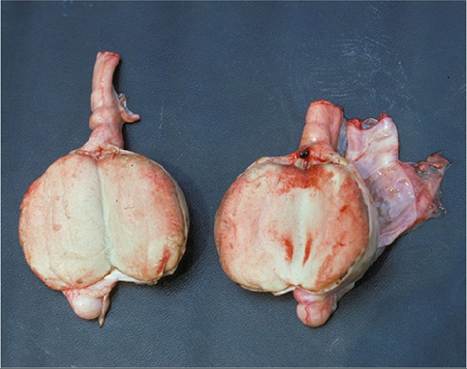
Figure 13.15 Necrotic testicular parenchyma and crimp lines on the cords above the testes following Burdizzo castration. The testes were too large when the procedure was performed to be resorbed. Source: Courtesy of Dr. M.C. Smith.
both testes have atrophied. Improper technique or a sprung instrument (as from using it to dock tails) gives the Burdizzo method a bad reputation. If castration is delayed until the testes enlarge with spermatogenesis, too much tissue will be present to be completely resorbed. The infarcted testis (often with a viable epididymis, see Figure 13.15) remains as a palpable mass in the scrotum, engendering uncertainty in the owner's mind as to the sterility of the wether.
The chief advantages of this technique are the absence of hemorrhage and open wounds and the decreased risk of tetanus. Anesthesia is usually not used, except when the buckling is dehorned at the same time. A small (to avoid toxicity) quantity of lidocaine can be injected into the cords before crushing. Disadvantages include swelling or sloughing of the scrotum or survival of a testis if the clamp is not applied properly.
Similar results might be obtained using a pinhole castration technique recently described for calves and rams (Ponvijay 2007; Fazili et al. 2009). Under local anesthesia, the spermatic cord is forced laterally, and an 18-gauge needle is used as a guide to pass absorbable suture through the scrotum. The needle is then withdrawn, the cord forced medially, and the needle reinserted through the same holes, to permit passage of the suture to now completely encircle the cord. After ligation to constrict the cord within the neck of the scrotum, the knot is trimmed short and becomes subcutaneous.
Manipulation of the Testes into the Inguinal Ring
It has been reported that in Venezuela, producers twist each testis around the spermatic cord and push it back into the inguinal canal (Gall 1981). This takes manual dexterity and must be done at an early age. The animal is rendered sterile without risk of hemorrhage, infection, or tetanus, and without the need for any specialized equipment. The more rapid growth characteristics and carcass composition of the buck kid are retained. The results of a short scrotum castration (elastrator band intentionally applied below the testes) would have similar effects on growth, although the potential for partial fertility has not been studied in bucks.
Chemical Castration
In the United States, an 88% solution of lactic acid was briefly marketed for castration of calves (Chemcast®, Bio- Ceutic Labs, St. Joseph, MO, USA). This product was used on lambs and kids also. A 20-gauge or smaller needle (to avoid leakage from the injection site) was inserted from above, downward into the center of each testis. A small quantity (0.3-0.5 mL) of solution was deposited; larger amounts leaked back and caused adhesions between testis and scrotum or draining tracts (Blackburn 1985). Although this method was praised by the manufacturer as being superior to the Burdizzo technique, verification of castration before “wethers” are allowed to run with females of breeding age should be mandatory. Other sclerosing chemicals such as cadmium chloride (200 μg∕kg; Kar 1962) have also been injected to destroy testicular tissue, without consideration of possible meat contamination. More recently, injectable zinc gluconate has been licensed for castrating dogs (Levy et al. 2008), but evaluation of efficacy in goats has not been reported. By contrast, calcium chloride at 40 mg/kg bodyweight per testis in 2 mL of normal saline has successfully rendered mature bucks sterile (Jana et al. 2005).