TheSuddenDisaster
In 1997, crab collectors and biologists first reported an unusually large-scale mortality in a population of the Brazilian mangrove-land crab Ucides cordatus (Brachyura: Ocypodidae) near the city of Goiana (state of Pernambuco, Brazil).
Subsequently, epizootic events spread northward and southward, affecting populations of U. cordatus in 8 of the 17 coastal states, particularly in the northeast (states of Piaui, Ceara, Rio Grande do Norte, Paraiba, Pernambuco, Sergipe, Bahia) and southeast regions (state of Esplrito Santo), spanning over 3500 km of the Brazilian Atlantic coast (Fig. 11.1). Mortalities occurred extensively at least until 2006, but anecdotal reports of mortalities in the mangroves of the state of Esplrito Santo (southeast Brazil) prevailed for the next 4-5 years.Crabs in areas of high-profile mortality shared several common clinical signs, such as lethargy, poor motor control, and inability to return to the upright position when turned upside down, and the name lethargic crab disease (LCD) was coined (Boeger et al. 2005). The disease caused extensive population depressions in the mangrove-land crab, which represents an important fishery resource for artisanal exploitation by local communities along the Brazilian coast (Alves and Nishida 2003; Schmidt 2006). Some mangroves in the states of Paralba and Bahia have experienced reductions in the fishing yields of 84 and 97.6%, respectively (Nobrega and Nishida 2003; Schmidt 2006), causing severe socioeconomic problems in the affected regions. The overall impact of this infirmity, although not directly evaluated, was likely severe (Glaser 2003) since the crab species affected has unquestionable ecological importance to West Atlantic mangroves. The species is responsible for the accelerated decomposition of mangrove litter and, thus, for nutrient remineralization and energy transfer into the sediment (Nordhaus 2003).
Greatly ignored by the authorities, despite its extent and conspicuous damage, the mortalities remained unstudied for almost a decade, with only anecdotal hypotheses about its origin and causative agent. Newspapers and even scientists, in unpublished accounts (i.e., abstracts in meetings and conferences), provided some reasonable but others not so serious hypotheses to explain the ongoing mortalities. The popular opinion speculated that the mortalities were caused by sewage, in contaminated areas close to large cities; by oil spills, where petroleum was being explored; and by fecal “chloroform” (this is the actual spelling used in some newspapers, but we can imagine what it meant) near large cities. Naive hypotheses apart, some scientists suggested that deforestation of mangroves, over-capture, and even pathogens of invasive species could be associated with the mortalities. One hypothesis, however, was preferred by most: that viruses associated with the Pacific shrimp (Litopenaeus vannamei), a species widely cultured in the Brazilian northeastern coast, were causing the mortalities (Schaeffer-Novelli et al. 2004).
However, it was not until 2003 that a systematic scientific research was conducted to define the origin and the causative agent of these extensive mortalities. The study resulted in a series of publications that revealed the causative agent and the dynamics of the disease (Boeger et al. 2005, 2007; Ferreira et al. 2009; Orelis-Ribeiro et al. 2011; de Hoog et al. 2011; Pie et al. 2011; Avila et al. 2012; Vicente et al. 2012; Guerra et al. 2013) (Fig. 11.2).
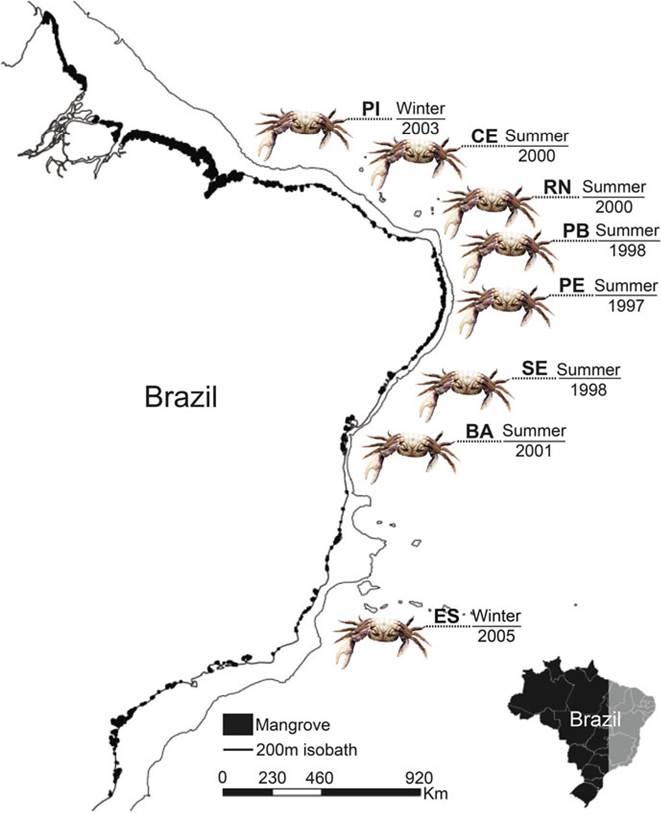
Fig. 11.1 Spatiotemporal distribution of lethargic crab disease outbreaks in Brazil. Season and year of the first epizootic events are indicated alongside crab pictures to the right of each Brazilian state affected. PI Piaui, CE Ceara, RN Rio Grande do Norte, PB Paraiba, BA Bahia, ES Espirito Santo. Adapted from Vicente et al. (2012)
11.2