Trace Minerals
Trace minerals are needed in smaller quantities than major minerals, but are still indispensable for the health of the goat. Requirements have been reviewed by Lamand (1981) (see Table 19.4).
Other authors make slightly different suggestions. In particular, the AFRC Technical Committee (1998) proposes similar levels for most of the trace minerals, but a lower requirement of only 0.05 mg/ kg diet for selenium. The literature on trace mineral nutrition of goats has been reviewed by Haenlein and Anke (2011).Cobalt
Cobalt is a component of vitamin B12, and in the absence of cobalt rumen microorganisms cannot synthesize this essential vitamin. Vitamin B12 is required as a coenzyme for methyl malonyl-CoA mutase, needed for the transformation of propionate to succinyl CoA, which then can enter the citric acid (Krebs) cycle. Methionine synthase is also vitamin B12 dependent (Underwood and Suttle 1999).
Table 19.4 Summary of trace mineral requirements of goats.
| Element | Deficiency limit | Diet requirements, standard diet | Diet with interference from other minerals |
| Cobalt | 0.07 | 0.1 | 0.1 |
| Copper | 7 | 10 | 14 |
| Iron | 15 | 30 | 30 |
| Iodine | 0.15 | 0.6 | 1 |
| Manganese | 45 | 40-60 | 120 |
| Molybdenum | 0.1 | 0.1 | 0.1 |
| Nickel | 0.1 | 1 | 1 |
| Selenium | 0.1 | 0.1 | 0.1 |
| Zinc | 45 | 45-50 | 75 |
Measured in mg/kg dry matter (parts per million).
Source: Lamand 1981; Kessler 1991; Meschy 2000.
Signs of Deficiency
Signs of cobalt deficiency include inappetence, poor production, weight loss, weakness, and anemia. Diarrhea is noted and is related to disequilibrium of the digestive flora, which also need cobalt, and to increased susceptibility to strongyles. White liver disease (i.e., hepatic lipodystrophy associated with low vitamin B12 levels in sheep; see Chapter 11) has been reported in young goats in New Zealand and responded to vitamin B12 injections and pasture top-dressing with cobalt (Black et al. 1988). The condition has also been produced experimentally in young goats (Johnson et al. 2004).
Dietary Recommendations and Supplementation
For sheep, 0.1 mg/kg DM (ppm) of cobalt in the diet is probably adequate and 1 mg/kg ensures maximum vitamin B12 levels. Goats presumably have similar requirements, although several authors have found goats to be less sensitive to cobalt deficiency than are sheep (Clark et al. 1987). A dietary level of 0.11 mg/kg DM has been specifically recommended for goats (NRC 2007). Some studies suggest that this level is marginal, as demonstrated by improved growth of young goats when supplemented with injectable vitamin B12 (Kadim et al. 2006). In regions where the soil is deficient in cobalt, commercial trace mineralized salt mixtures may not supply enough cobalt to meet the goat's needs (Mackenzie 1975). Cobalt chloride or cobalt sulfate can be added to the salt at a rate of 12 g/100 kg salt (NRC 1981b). Slow-release rumen bullets or boluses may be an alternative to dietary supplementation or topdressing of deficient pastures with cobalt salts (Underwood and Suttle 1999; Constable et al. 2017); a 5 g bolus is available for sheep in some countries.
Copper and Molybdenum
These two minerals are closely interrelated. High molybdenum (above 3 mg/kg) in the feed results in a relative copper deficiency, probably through formation of copper-molyb- denum complexes in the tissues.
Signs of Deficiency
Inappetence, poor growth, weight loss, and decreased milk production are non-specific signs of copper deficiency (Anke et al. 1972) related to decreased cytochrome oxidase activity. Anemia occurs because ceruloplasmin is required to mobilize stored iron for synthesis of hemoglobin and myoglobin. Decoloration of the hair occurs because a copper-containing enzyme is necessary for melanin production. However, despite what owners read on the internet, copper deficiency does not cause “fish tail” (focal hair loss on the tail tip) in goats. Swayback and enzootic ataxia in kids (see Chapter 5) are related to defective myelination and laryngeal stridor has been associated with degeneration of the recurrent laryngeal nerve (see Chapter 9). Cardiac insufficiency is probably due to a combination of problems, including inadequate cytochrome oxidase activity and anemia. Osteoporosis and spontaneous bone fractures are also related to effects on copper-dependent enzymes. Abortions and stillbirths also occur. In addition, copper is required for proper functioning of the immune system.
Dietary Recommendations and Supplementation
Deficiency symptoms occur when dietary copper is less than 7 mg/kg and molybdenum is normal. A suitable level for ration formulation is 10-20 mg/kg DM (Lamand 1978; AFRC 1998), and it is generally recommended to keep the Cu : Mo ratio above 2 : 1 and below 10 : 1 (Buck 1986). Excessive calcium and sulfur both interfere with copper absorption (Senf 1974), as does excessive dietary iron (Schonewille et al. 1995). With feeding of corn silage or sulfur, dietary copper should be at least 14 mg/kg. Note that copper oxide is only one-third as digestible as copper sulfate. When the basal diet is deficient in copper or contains markedly excessive amounts of molybdenum, copper oxide wire particles (Copasure, Animax, Bury St Edmunds, UK) administered orally in a gelatin capsule provide long-term (six-month) supplementation because they lodge in the rumen or abomasum and release copper slowly.
Boluses of 2 and 4 g are marketed for goats in the United States. An injectable supplement containing chelated copper was previously available in the United States labeled for goats, but is no longer marketed. Some farms use a cattle product off label (Multimin USA, Fort Collins, CO, USA), but this requires an established veterinarian-client/patient relationship to be legal.Copper Toxicosis
Adult goats are not as susceptible to copper toxicity as are sheep (Soli and Nafstad 1978), in part because of lower uptake by the liver (Meschy 2000). Liver copper stores are typically lower in normal goats than in sheep and cattle. In a toxicity study, hepatic copper concentrations were six to nine times higher in 3-month-old lambs than in kids (Zervas et al. 1990). A deficiency of molybdenum (less than 0.1 mg/kg; Kessler 1991), then, does not generally induce copper toxicosis, but rather interferes with normal growth and fertility (Anke et al. 1978). Also, goats can safely consume a trace mineralized salt preparation formulated for cattle or a horse grain mix, whereas this is dangerous for sheep. Young kids, however, are sensitive to increased copper levels in the feed (Morand-Fehr 1981c). One example of copper toxicosis was reported in young Angora goat kids receiving milk replacer formulated for calves (10 mg/kg copper on a DM basis) in New Zealand. The kids died of a copper-associated hemolytic crisis (Humphries et al. 1987). It is likely that the preruminant kid absorbs copper more efficiently than does the adult goat. Fatal hepatic necrosis without hemolysis has also occurred in adult goats fed an improperly formulated mineral mix (Cornish et al. 2007), as discussed in Chapter 11.
Fluorine
Although fluorine is now viewed as an essential mineral (Kessler 1991), deficiency apparently does not occur under natural conditions. Excessive fluoride compounds from feed, water, and soil cause a chronic toxicosis in goats. Fluorosis is discussed in Chapter 4.
Iodine
In the absence of adequate iodine, the thyroid gland synthesizes an uniodinated inactive prehormone rather than thyroxine.
In response to lower thyroxine levels the pituitary gland secretes thyroid-stimulating hormone (TSH). As a result, the thyroid gland hypertrophies and produces the clinical condition goiter.Goats may produce kids with goiter on the same property where sheep and their lambs remain healthy. This is because the goats' browsing habits result in less soil ingestion compared with the grazing sheep.
Signs of Deficiency
In addition to the goiter, signs of deficiency include birth of weak or dead kids and a poor haircoat. Kids may appear “dumb” or unwilling to suckle. Growth rate of kids is reduced, as is the fertility of does. These problems are discussed in Chapters 3 and 13.
Dietary Recommendations and Supplementation
The requirements of ruminants can usually be met by feeding 0.8 mg/kg iodine to lactating females and 0.5 mg/kg to the remainder of the herd (Lamand 1978; NRC 2007). Cruciferous plants increase the iodine requirement to 2 mg/kg in the ration DM for lactation and 1.3 mg/kg for other animals. Iodized trace mineralized salt is a simple way to prevent deficiency, but it should not be force fed. Milk and urine iodine concentrations can be used as indicators of iodine deficiency in goats (Bhardwaj 2018); a milk iodine level of sheep below 8 pg/L indicates deficiency, and the lower normal limit of iodine in sheep urine is 50 pg/L.
A maximum tolerable dietary iodine level of 50 mg/kg has been established for cattle and sheep, with the proviso that the iodine concentration in the milk of animals on such a diet may be undesirable for humans (NRC 2005). Owners should likewise be discouraged from feeding large quantities of kelp and other concentrated iodine supplements.
Iron
Hemoglobin and myoglobin contain iron, as do some enzyme systems such as cytochrome oxidase and catalase. Grazing animals rarely develop iron deficiency except in association with continual blood loss. Bloodsucking strongyles (Haemonchus) and bloodsucking lice (especially in Angoras) can create such a situation.
An increased proportion of Allium (onion-type) plants in the diet can also cause iron deficiency because n-propyl disulfide in these plants induces hemolytic anemia.Signs of Deficiency
An iron deficiency causes a microcytic or normocytic hypochromic anemia (reduced mean corpuscular hemoglobin concentration in anemic animals). Appetite is often reduced. A copper or cobalt deficiency may cause similar signs. Anemia is discussed in Chapter 7.
Dietary Recommendations and Supplementation
The current recommendation for dietary iron for goats is 35 mg/kg DM (ppm) in the ration of pregnant and lactating goats and 95 mg/kg diet for growing goats. An additional 5 mg/kg has been proposed for Angoras to support mohair production (NRC 2007). If supplementation is necessary, it is useful to know that the iron in ferrous sulfate and ferric citrate is more available than that in ferric oxide. The maximum tolerable dietary level of iron is 500 mg/kg (NRC 2005).
Young kids on an all-milk diet routinely become deficient and can be treated with injectable iron dextran if diet modification is not possible. A dose of 150 mg iron dextran/ kid at two- to three-week intervals has been recommended (Bretzlaff et al. 1991a). Such supplementation is not needed if the kids have access to solid feed (Wanner and Boss 1978). Anaphylaxis occasionally occurs after repeated injections of iron dextran and can be fatal (Ladiges and Garlinghouse 1981).
Manganese
Signs of manganese deficiency in goats include reluctance to walk, deformed forelimbs (caused by defective cartilage formation), excessively straight hocks, and reduced fertility (including silent estrus) or abortion in does (Anke et al. 1977a). Buck kids appear to show a greater depression in growth rate than do doe kids when fed an extremely manganese-deficient diet (1.9 mg/kg; Hennig et al. 1972). The recommended dietary level for goats by various authors has ranged from 20 to 120 mg/kg (NRC 2007), but 60 mg/kg allows for interference with absorption, as by excess calcium.
Nickel
Nickel is required by goats, but a deficiency is unlikely to occur under normal management conditions. Signs of experimental deficiency include skin disease typical of zinc deficiency, death of kids, and decreased first service conception rate in adults (Anke et al. 1977a, b). An increase in feed intake and hence in growth rate was seen in kids when a basal corn-based diet containing 0.3 mg/kg nickel was supplemented with chelated nickel (Adeloye and Yousouf 2001). Experimental diets deficient in nickel appear to induce a severe zinc deficiency (Haenlein and Anke 2011).
Selenium
Selenium deficiency occurs when the soil in a locality is deficient (less than 0.5 mg Se/kg of soil) and locally harvested feeds are fed (less than 0.1 mg Se/kg of feed) (Meschy 2000; Constable et al. 2017). Selenium deficiency has occurred in animals and humans (Levander 1988) in many parts of the world, including the United States, China, Finland, New Zealand, and Australia.
Signs of Deficiency
Many selenium deficiency signs are identical to those of vitamin E deficiency, as mentioned earlier. Nutritional muscular dystrophy, which can be caused by either vitamin E or selenium deficiency, is discussed in detail in Chapter 4. Experimental selenium deficiency (less than 38 pg/kg DM) has produced lowered reproductive efficiency (apparent lowered conception rate) and decreased production of milk, milk fat, and milk protein in the following lactation (Anke et al. 1989). Selenoproteins act as antioxidants and are also involved in the conversion of T4 to T3 (Underwood and Suttle 1999; Surai 2006).
Increased supplementation with vitamin E masks a mild selenium deficiency. Potential selenium deficiency problems can be identified in clinically normal animals by evaluating their glutathione peroxidase (GSH-Px) status, because selenium is required for GSH-Px formation (Constable et al. 2017). The activity of this enzyme in erythrocytes declines under conditions of selenium deficiency. Normals have not been well established for goats, but are discussed in Chapter 4. Analysis for glutathione peroxidase is typically performed on blood collected in ethylenediaminetetraacetic acid (EDTA) and kept refrigerated until processed by the laboratory. Serum can be tested instead of erythrocytes, and serum GSH-Px activity changes more rapidly in response to alterations in selenium status (Wichtel et al. 1996).
Some diagnostic laboratories determine whole blood selenium instead; deficiency can be suspected if the goat has less than 5 μg selenium/dL blood (less than 0.05 mg/ kg). Serum selenium concentrations less than 0.05 mg/kg have also been deemed to indicate deficiency (Puls 1994a). Liver selenium content of animals that die or are slaughtered can be used to monitor the selenium status of the herd. Concentrations of 0.25-1.20 mg/kg wet weight are adequate, while concentrations of 0.01-0.10 mg/kg wet weight are deficient (Puls 1994a). Maternal liver stores of selenium are decreased in advanced pregnancy as transfer to the fetus occurs (El Ghany-Hefnawy et al. 2007). When conversion of units is necessary for interpretation of laboratory reports, it helps to know that 1 μg selenium/dL is equivalent to 0.127 μmo√L.
Dietary Recommendations and Supplementation
Selenium should be present in the diet at a minimum of 0.1 mg/kg of feed. Some but not all commercial ruminant feeds are supplemented with selenium, but the level of supplementation in the United States is controlled by law. Sodium selenite and sodium selenate are permitted. Feed mills cannot add more than 0.3 mg/kg selenium to a complete ration for cattle or sheep or 90 mg/kg to a sheep salt-mineral mix, nor should the maximum daily intake of added selenium for sheep exceed 0.7 mg/head/day (Federal Register 1987; FDA 2020). A feed mill also cannot “fill a prescription” for an increased level of selenium supplementation.
Organic forms of selenium are more bioavailable than inorganic compounds for cattle, sheep, and goats, and transfer better into blood, colostrum, and milk (Aspila 1991; Surai 2006). Supplementation of goat diets with selenium yeast is specifically permitted in the United States, with up to 0.3 mg/kg added selenium in this form allowed in complete feeds (NRC 2007). In the European Union, the maximum allowed selenium inclusion rate in the ruminant diet is 0.568 mg/kg, and feeding selenium yeast at 10 times this level did not result in toxicity (Juniper et al. 2008). However, dairy goats receiving 0.5 mg/kg dietary selenium had markedly elevated GSH-Px concentrations, suggesting that this level of supplementation is excessive (Dercksen et al. 2007).
When the soil, and hence the roughages and grains grown on it, is deficient in selenium, several methods have been used to improve selenium content of feeds for goats. One is to use sodium selenate in fertilizer mixes applied to the fields. In Finland, this practice has increased the selenium content of feeds from 0.02 mg/kg DM to 0.2 mg/kg DM (Aspila 1991). Another technique is to use a foliar application of sodium selenite to growing plants approximately one week before harvest (Aspila 1991).
In selenium-deficient regions, selenium by injection has been used as an alternative to oral supplementation (Kessler et al. 1986). It is common to incorporate a prescription vitamin E/selenium preparation into a herd health program at the times of year just prior to when deficiency symptoms are most likely to develop. These include shortly before breeding and four and/or six weeks before parturition for does, twice a year for bucks, and at birth and 1 month of age for kids. The dose administered is typically one to two times the labeled sheep dosage, with kids of normal size receiving the “minimum” dose at birth instead of 2 weeks of age. Dwarf breeds should receive a lower dose, more appropriate for their low birthweight. Because injectable selenium preparations available in the United States are not labeled for goats and are labeled as not for use in pregnant sheep, practitioners should be cautious about prescribing them for pregnant goats without informed owner consent. Excretion of injectable selenium supplements is rapid and this route of administration does not provide the even and dependable supply ensured by daily dietary selenium.
Selenium Toxicosis
There is a relatively narrow margin of safety with selenium; the maximum tolerable level in the feed of ruminants is currently estimated to be 5 mg/kg (NRC 2005). Certain soils are termed “seleniferous” because of an increased selenium content, and certain indicator plants require and accumulate increased concentrations of the
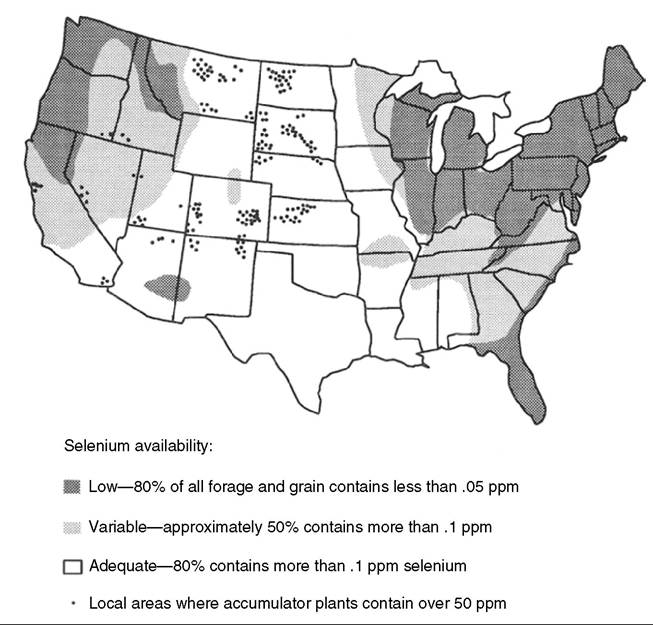
Figure 19.3 Regions of the United States with deficient or toxic levels of soil selenium. ppm, parts per million. Source: Redrawn from Ammerman and Miller (1975).
mineral. Some of these plants found in the United States are Stanleya, Haplopappus, and some species of Astragalus. They are very useful for indicating that the soil is dangerous, but they are not the only plants that accumulate toxic levels. Most crop plants, grasses, and weeds can accumulate as much as 50 mg/kg selenium when grown on selenif- erous soils (James and Shupe 1986). The map in Figure 19.3 gives an approximation of where selenium deficiency or toxicity might be expected to occur in the United States (Ammerman and Miller 1975). Local extension services can usually supply more detailed soil maps to guide the decision for or against selenium supplementation, when locally grown feeds are fed.
Acute selenium toxicosis (depression and dyspnea) has been produced experimentally in sheep with injections of 0.4 mg Se/kg bw, and the LD50 in this study was 0.7 mg Se/ kg. Necropsy lesions included pulmonary edema and myocardial necrosis (Blodgett and Bevill 1987). Similar lesions have been produced accidentally by injection of goat kids (Amini et al. 2011). Practitioners must guard against accidentally substituting an injectable selenium product marketed for adult cattle for the lower-concentration calf and sheep product when small kids are treated. Selenium is less toxic when given orally. Daily oral doses of sodium selenite at 1 mg/kg bw/day were non-toxic to growing Nubian goats, whereas a single oral dose of 40 mg/kg or two daily doses of 20 mg/kg were rapidly fatal (Ahmed et al. 1990).
Adverse reactions (deaths and abortions) in several flocks of pregnant sheep have led to the relabeling of injectable selenium in the United States as not for use in pregnant sheep. These products are not approved for goats, and thus the practitioner who prescribes injectable selenium for pregnant goats may be at increased risk of legal action should any adverse reactions or unrelated abortions occur.
Zinc
Zinc is required for formation of certain metalloen- zymes, including alcohol dehydrogenase, alkaline phosphatase, carbonic anhydrase, and superoxide dismutase (Underwood and Suttle 1999). It is also required to mobilize vitamin A from the liver and to convert beta-carotene into vitamin A.
Signs of Deficiency
The major metabolic abnormalities associated with a deficiency are caused by a blockage of protein synthesis, DNA synthesis, and cell division. Zinc deficiency in goats is reported to cause parakeratosis (see Chapter 2), joint stiffness, excessive salivation, swelling of the feet and deformities of the hooves, small testes, and low libido. Reduced feed intake and weight loss also occur. Appetite is said to return within a few hours after zinc supplementation. A serum zinc concentration of 0.36-0.85 ppm has been classified as deficient in goats (Puls 1994a), while the same author reports 0.65-2.70 ppm as adequate and that infections, fever, endotoxins, and trauma all decrease serum zinc concentrations. Ahmed et al. (2001) reported plasma zinc concentrations in Nubian goats of 0.91-7.38 mg/L, with younger kids having higher plasma zinc than older kids or pregnant adults, and high-producing lactating does having the highest concentrations.
Dietary Recommendations and Supplementation
Minimum dietary zinc requirements vary with the author and the life stage of the goat, from 20 mg/kg ration to 33 mg/kg. Addition of excess calcium to the diet interferes with zinc absorption, as does excess sulfur. Male goats may require more zinc than do female goats. Rapid intestinal transit time decreases absorption (young grass, ground feed). A reasonable feeding level to allow for variable absorption in different rations is 45-50 mg/kg diet. It is not stored in the body, so ingestion needs to be constant (Puls 1994a). Organic forms such as chelated zinc methionine are not superior to inorganic salts as dietary sources of zinc (NRC 2007).
A proposed maximum tolerable level in the feed is 300-500 mg/kg (NRC 2005). Note that a 20% solution of zinc sulfate, as used in footbaths for sheep, can cause acute abomasal necrosis if drunk, apparently because the solution causes closure of the esophageal-reticular groove and the zinc passes directly into the abomasum (Dargatz et al. 1986). In sheep, a single dose of 200 mg zinc/kg bw may be fatal.