Vector control strategies
1.4.1 Conventional vector control
Vector control programs greatly depend on the use of chemicals such as insecticides like DDT, pyrethroids, organophosphates, and temephos. The annual demand of the insecticides amounts to more than 50,000 tons, with DDT being the most commonly used insecticide in the past.
DDT, which is mainly used in indoor spraying for the control of vectors of malaria and visceral leishmaniasis, is forbidden in most of the countries today after the Stockholm Convention in 2001, when it was discovered to be dangerous to wildlife and the environment as it can remain in the environment and food chain for a considerably long time. Regarding other insecticides, most of them have undesirable effects besides their life-saving benefits. For example, vectors can become resistant and the nonbidegradability of the chemical frequently causes environmental damage. Although efforts have been conducted to develop a suitable vaccine against arboviral diseases like dengue and chikungunya,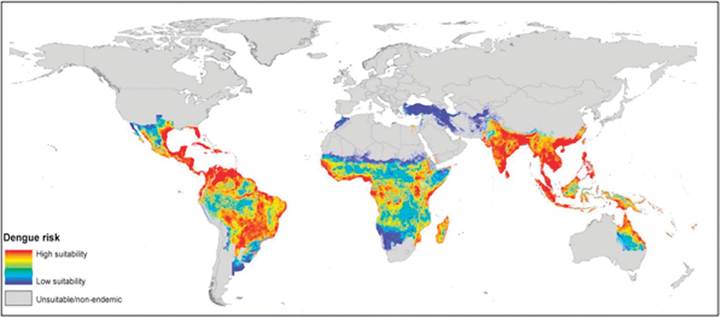
Figure 10.
Dengue risk map showing the highly suitable dengue epidemic areas around the world, depicting India to be a high-risk zone for dengue outbreaks (adapted from Simmons et al. [63]).
no vaccine has been developed with 100% efficacy to date. Therefore, the only means of reducing case fatality rate is early diagnosis and proper case management. The chief mode of controlling the disease is by eliminating the vector. It is of course much cheaper to prevent an outbreak of the disease than to diagnose and to treat the cases.
The major strategies for controlling Aedes vectors are: (1) reduction of Aedes breeding sites through environmental sanitation by the elimination of all nonessential water-containing receptacles. This is by far the most effective method in terms of long-term reduction of the mosquito population; (2) protection of water-containing receptacles by putting lids or covers to prevent egg laying by the mosquitoes; (3) release of larvivorous fish or other biological organisms as predators/parasites of larvae; (4) observation of a “Weekly Dry Day,” i.e., the containers can be emptied at least once a week through generating awareness among the local population; (5) cleaning the containers before and after the rainy season can also contribute in reducing the mosquito populations and (6) space spraying, for example, with malathion against adult mosquitoes and larviciding with temephos.
1.4.2 Wolbachia:potential biocontrol agent
Wolbachia is a bacterium belonging to the tribe Wolbachia and family Rickettsiaceae and order Rickettsiales. They are a widespread group of bacteria commonly found in the reproductive tissues of arthropods. Wolbachia have attracted much attention by virtue of its ability to manipulate the reproduction of its arthropod hosts. Mosquito vectors such as Aedes, Culex, and Anopheles transmit a variety of diseases like dengue, filaria, Japanese encephalitis, and malaria. The vectors have gained resistance against insecticide and pesticides due to their variant mutation in genetic constitution. The continuous use of insecticides for control strategies increasingly faces the problems of high cost, increasing mosquito resistance and negative effects on nontarget organisms. Wolbachia have attracted scientific interest due to their ability to manipulate host reproduction, leading to distinct phenotypic effects in the host such as parthenogenesis, feminization, male killings and cytoplasmic incompatibility [65]. These modifications typically confer a reproductive advantage to infected individuals and allow the rapid spread of Wolbachia through a population [66, 67]. The most common effect of Wolbachia infection in mosquitoes is cytoplasmic incompatibility, which was first described in Culex pipiens, when infected male mosquitoes mated with uninfected female mosquitoes of the same species. The ability of Wolbachia to manipulate its host biology enables it to increase in frequency in host populations without the need for horizontal transmissions [68]. Hence Wolbachia can be used as a potential weapon against pests and the diseases they can carry.
Molecular phylogeny represents a great source of information for better understanding the evolutionary relationships among Wolbachia to analyze changes occurring in different organisms during evolution. The strain variation, of any Wolbachia species in mosquito populations is necessary for understanding the evolutionary mechanisms of Wolbachia genotypes in vector mosquitoes. Phylogenetic analysis of Wolbachia using different molecular markers is important to understand the evolution, pathogenesis and strain typing in areas having abundant arboviral vectors. Several molecular phylogenetic studies have been reported using 16S rRNA gene, ftsz cell cycle gene, wsp Wolbachia surface protein gene, out of which wsp gene has been the most preferred for phylogenetic analysis [69].
Therefore, further studies of the natural occurrence and diversity of Wolbachia in the major Aedes vectors are of high interest. Ultimately, this will be useful for making strategies for vector control programmes by determining the specific strain of Wolbachia that is present in Aedes followed by artificial infection of Wolbachia into the major Aedes vectors that will effectively reduce their life span thereby reducing disease transmission.