Active Secretion of Electrolytes from the Crypt Epithelium Leads to Intestinal Water Secretion
In contrast to the absorptive function of the villous cells, the crypt cells have a secretory function. This secretory function appears to use a chloride transport mechanism. The mechanism seems to be similar to coupled sodium chloride transport, as occurs in the villous enterocytes, except that the direction of transport is reversed.
In the crypt cells the coupled sodium chloride transport mechanism is on the basolateral membrane, in contrast to its position on the apical membrane of the villous cells. The effect of this arrangement is to pump Na’ and CΓ into the crypt enterocytes from the lateral spaces. As these ions are transported into the enterocytes, Na+ is quickly pumped out by the Na+,Kf-ATPase pump. In contrast, Cl is trapped within the cells, reaching relatively high intracellular concentrations. Under appropriate stimuli, CΓ channels in the apical membranes of the crypt cells are opened, and the pent-up chloride from within the cells flows down its concentration gradient into the lumen of the crypt. (Ion channels and their regulation in cellular membranes are discussed in Chapter 1.) Movement of CΓ into the lumen of the crypts creates an electrical attraction for Naf, which move into the luminal fluid from the lateral spaces through the paracellular route. Water follows Na* and CΓ osmotically; thus chloride, sodium, and water are secreted from the crypt epithelium (Figure 30-21).You may find the concept of ion transport processes jumping from one side of the cell to another intuitively “unappealing," especially when you consider that the cells of the intestinal crypts will eventually mature and migrate up the villi to assume absorptive, as opposed to secretive roles. Consider, however, that ion transport mechanisms are simply
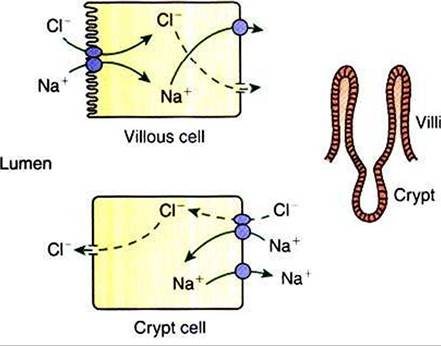
FIGURE 30-21 Water and electrolyte secretion in the crypts is affected by the secretion of chloride (Cl') from the apical membrane of crypt enterocytes.
Sodium (Na*) moves into the lumen by the paracellular route and electrically balances CΓ secretion. Water follows osmotically, the net effect being secretion of a sodium chloride (NaCI) solution into the crypt lumen. In the crypts the coupled NaCI absorption mechanism appears to exist on the basolateral membrane, with Cl gates present on the apical membrane. The opening of CΓ gates on the crypt cell apical membranes initiates crypt secretion.The membrane position of the coupled NaCI transport process reverses itself, moving from the basolateral membrane to the apical membrane as the cells mature and move up the villi.proteins inserted into the cell membranes. As with other cellular proteins» they are synthesized within the cell under the direction of genetic code. The state of maturity and cellular differentiation dictates the membrane position into which the newly synthesized proteins are directed. The differential distribution of membrane proteins to one side of a cell or another is called polarization. Enterocytes are said to be “polarized” with respect to membrane function.
The triggering mechanism that activates water secretion from the crypts is the opening of the chloride gates in the crypt enterocyte apical membrane. Much study has been devoted to determining the factors controlling the opening of the chloride gates in crypt cells. One important factor in regulating chloride gates appears to be the activity of the adenylate cyclase enzyme and the intracellular concentration of cyclic adenosine 3,,5,-monophosphate (cyclic AMP, or cAMP). (The role of adenyl cyclase and cAMP in cellular regulation is discussed in Chapter I.) As cAMP concentrations rise, chloride gates open, and secretion of water and electrolytes is stimulated. Vasoactive intestinal peptide originating from effector neurons of the mucosal plexus is probably an important normal regulator of cAMP and chloride gates in crypt apical membranes. Of perhaps greater medical significance than the normal regulation of this process is the existence of pathological, or abnormal, activators of crypt cell adenyl cyclase (see later section on the pathophysiology of diarrhea).
The physiological function of water and electrolyte secretion by the crypts is to maintain an appropriate hydration and ionic environment for digestion and absorption. Ingesta must be kept sufficiently moist to allow for the mixing of nutrients with digestive enzymes and for the circulation of digested nutrients in contact with absorptive surfaces. In addition, a constant supply of sodium must be available to promote the sodium co-transport necessary for the absorption of several nutrients. The regulated process of water and electrolyte secretion from the crypts ensures the continual availability of water and sodium in the gut lumen.