ADAPTATION AND ADAPTABILITY
Adaptation is commonly referred to as the observable characteristics or traits found in animals, which are outcomes of the process of selection. However, a more precise definition views adaptation as a process whereby natural selection adjusts the traits impacting an organism’s fitness and its offspring’s survival in successive generations.
The adaptation process typically unfolds slowly over generations and is often irreversible, which is discernible by various adaptive traits under different environmental conditions (Table 24.1). Conversely, acclimatisation denotes a swifter phenomenon where an individual animal undergoes physiological or biochemical changes due to exposure to new environmental conditions. Acclimation refers to akin processes occurring in laboratory settings in response to experimentally induced alterations in conditions. Both acclimatisation and acclimation can be described as immediate compensatory alterations in response to environmental disruptions and may be reversible. Additionally, short-term changes due to acclimation or acclimatisation lead to phenotypic plasticity that aligns with local conditions (Wilmer et al. 2009). Livestock initially responds to adverse environmental conditions through coordinated and interconnected behavioural mechanisms, and later by mutual interactions among the immune system, central nervous system, and endocrine system. This behavioural adaptation often involves seeking refuge in an unfavourable microclimate, particularly during critical periods of the day. For example, to cope with heat stress conditions, the zebu cattle native to tropical climates possess various behavioural, physiological, morphological, and genetic adaptive traits (Singh et al. 2018). Hence, animal adaptation assumes significance in comprehending observable animal responses, which is depicted in Figure 24.2.Thermal adaptation predominantly emphasises maintaining an elevated and consistent body temperature. Heat transfer can vary with the area of contact in the short term by behavioural means (basking, burrowing, wallowing, huddling, erecting or concealing appendages, etc.), while thermal conductivity, which is the function of external surface (hair, coat, skin, etc.), is often the most important longterm adaptive element in determining conductive heat gain or loss. Some ecological rules, in particular to domestic animals, explain morphological adaptations, which are the basis for their climatic plasticity and breeding tract -
1. Bergmann’s Rule (1847): Correlates body size with climate, indicating that smaller animals with larger surface area per unit weight are better suited to warmer climates, whereas larger breeds thrive in cooler temperate areas.
2. Allen’s Rule (1877): Links extremity length to climate, observing that animals in cold regions tend to have shorter extremities compared to those in warmer climates within the same species.
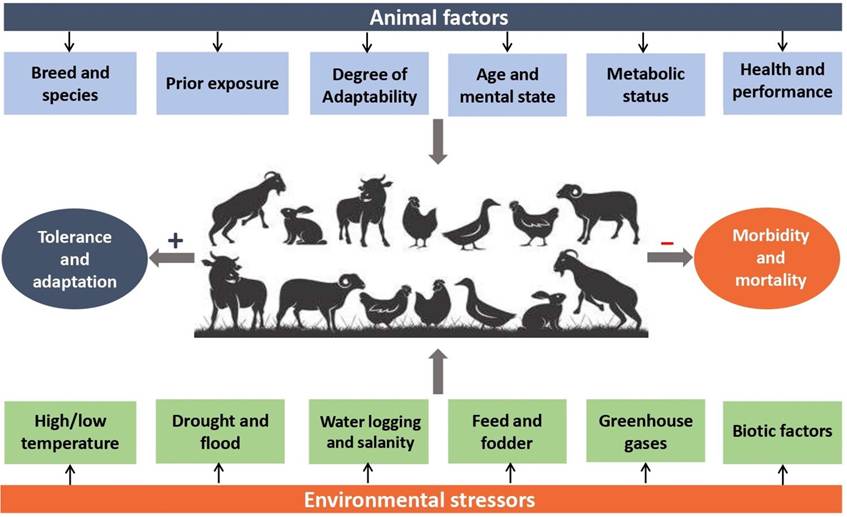
FIGURE 24.1 Bimodal interplay of animal factors and environmental stressors.
TABLE 24.1
Key Adaptive Mechanisms of Various Species of Animals Thriving in Different Environmental Conditions
| S. No. | Environmental conditions | Adaptive mechanism | Species |
| 1 | High temperature | High surface area to body weight ratio, skin folds, long external appendages, loose coarse wool, hair shedding in summer | Cattle, sheep, goat, and donkeys |
| 2 | High humidity | Dark pigmentation, smooth and scanty hairs | Buffalo, cattle |
| 3 | Solar radiation | Long limbs, short reflective coat | Camel |
| 4 | Low temperature | Long hair intermixed with fine hair, minimum exposed extremity, large body size, thick heavy coat | Temperate cattle, sheep, yak |
| 5 | Polar region | Layers of fur and long hair, layer of fat under skin, wide paws, strong sense of smell | Polar beer, reindeer, fox, musk oxen |
| 6 | Desert | Hard tissue and thick skin around mouth, better recycling rate of urea, efficient digestive system, low metabolic requirement | Camel, sheep, goat |
| 7 | High altitude | Polycythemia, high O2 carrying capacity in blood, high rate and depth of respiration, high efficiency in extracting nutrients from feed | Llama, alpaca |
3.
Wilson’s Rule (1854): Pertains to insulating cover and climate, highlighting that breeds in cold climates possess dense, heavy coats, while those in warm climates exhibit shorter, glossy, and thinner hair.4. Gloger’s Rule (1833): Relates skin pigmentation to climate, noting that animals in cooler or hot, dry climates tend to have lighter skin colour, which darkens with increased temperature and humidity.
24.4