Alveolar Hypoxia Is a Potent Constrictor of Small Puimonary Arteries
The air in poorly ventilated alveoli has a low partial pressure of oxygen, and it is of limited benefit to the animal to keep sending blood to such alveoli. To correct this problem, alveolar hypoxia results in vasoconstriction of pulmonary arteries.
This hypoxic vasoconstriction reduces blood flow to poorly ventilated alveoli and redistributes pulmonary blood flow toward better-ventilated regions of lung. Although the vasoconstrictor response to hypoxia is present in all species, the magnitude of the response varies greatly. Among domestic mammals, the response is most vigorous in cattle and pigs, less vigorous in horses, and trivial in sheep and dogs (see Figure 46-6). The response to hypoxia is also minimal in the llama, which normally lives under hypoxic conditions at high altitude.The ability of local alveolar hypoxia to cause a local reduction in blood flow has been clearly demonstrated in several species. Under conditions of atelectasis, when there is no ventilation to the collapsed region of lung, local blood flow is greatly reduced by a combination of vessel closure as the lung collapses and vasoconstriction in response to the local hypoxia.
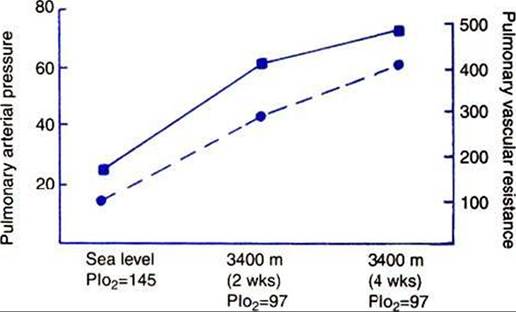
FIGURE 46-7 Change in mean pulmonary arterial pressure (squares, solid line) and pulmonary vascular resistance (circles, broken line) in calves transported from sea level to 3400 m for a 4-week sojourn. Both vascular resistance and arterial pressure increase when the calves are exposed to the hypoxia of altitude. Pressure and resistance continue to increase while at this altitude because of the proliferation of smooth muscle in the small pulmonary arteries. Pressure units are in millimeters of mercury (mm Hg); resistance units in dyne-sec∕cm5; inspired oxygen tension (PIo2) units in mm Hg.
(From data in RuizAV, Bisgard GE, Will JA: Hemodynamic response to hypoxia and hypero?ia in calves and at sea level and altitude, PfIugersArch 344:275, 1973.)Hypoxic vasoconstriction is beneficial when there is localized alveolar hypoxia, but when hypoxia is generalized, as occurs when animals live at high altitude or have diffuse lung disease, the vasoconstriction can have serious consequences. In cattle grazing at high altitude, the hypoxia of altitude causes vigorous, generalized pulmonary hypoxic vasoconstriction (Figure 46-7). This leads to an increase in pulmonary arterial pressure, which increases the work of the right ventricle and leads to right-sided heart failure. The clinical syndrome is known as brisket disease because edematous fluid accumulates in the brisket. There are genetically determined differences in the response to hypoxia; Holsteins respond most vigorously and are therefore highly susceptible to brisket disease. In these species, in which the acute hypoxic constrictor response is most vigorous, chronic hypoxia results in sustained pulmonary hypertension. This is caused by an increase in the quantity of smooth muscle in the media of the small pulmonary arteries. When animals have generalized hypoxic vasoconstriction as a result of lung disease, the resultant right-sided heart failure is known as cor pulmonale.
Hypoxic vasoconstriction can be demonstrated in isolated, perfused lungs and therefore does not require intact innervation. In the smooth muscle of pulmonary arteries, hypoxia closes voltage-gated potassium channels. This increases positivity within the cell and promotes depolarization. The depolarization leads to an influx of calcium, which causes smooth muscle contraction. Many vasoactive agents, such as histamine, catecholamines, angiotensin, and arachidonic acid metabolites, were previously suggested as being involved in hypoxic vasoconstriction. Their role appears to be modulation of the degree of constriction.