Antidiuretic Hormone Regulates Collecting DuctWater Permeability to Determine the Final Urine Osmolality
The generation of medullary hypertonicity and dilution of the tubule fluid in the distal nephron segments set the stage for the elimination of either concentrated or dilute urine, as warranted by the fluid volume status, plasma tonicity, and blood pressure of the animal.
The water permeability of the collecting duct, which is regulated by ADH (arginine vasotocin in birds), determines the osmolality of the excreted urine.During water overload, ADH is absent, and the collecting duct is relatively impermeable to water. The tubule fluid delivered by the distal convoluted tubule remains hypotonic because the water is confined within the collecting duct. Thus, in the absence of ADH, dilute urine is formed, and excess water is excreted (Figure 43-5).
Under conditions perceived as dehydration or volume depletion, ADH is released from the pituitary. ADH release is triggered by a rise in plasma osmolality of as little as 3 to 5 mθsm∕kg H2O resulting from dehydration or salt overload
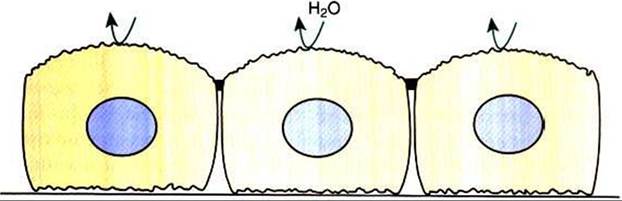
FIGURE 43-5 Collecting duct epithelium in the absence of antidiuretic hormone (ADH). When ADH is absent, the apical plasma membrane is impermeable to water, and dilute urine is excreted.
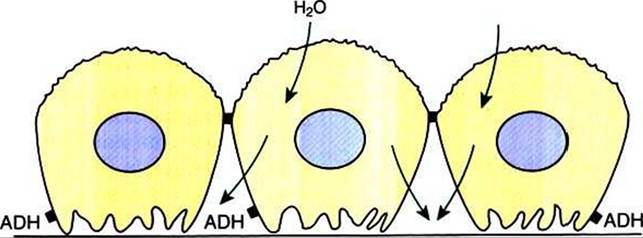
FIGURE 43-6 Water permeability of apical plasma membrane of collecting duct epithelium in the presence of antidiuretic hormone (ADH). ADH stimulates the insertion of water channels into the apical plasma membrane, which enhances its water permeability.Water rushes into the cells and across the water-permeable basolatera∣ plasma membrane into the lateral intercellular spaces, where solute concentrations are high in relation to the tubule fluid. Morphological changes that have been observed include translocation of the membrane containing the aquaporin-2 water channels from Intracytoplasmic vesicles to the apical plasma membrane, cell swelling into the tubule lumen, and dilation of the lateral intercellular spaces.
and by decreased blood pressure as a result of systemic vasodilation, heart failure, or isosmotic volume depletion from vomiting, diarrhea, or hemorrhage. In these circumstances, the animal needs to reduce the plasma osmolality to normal or to restore fluid volume or blood pressure.
ADH acutely regulates the water permeability of the collecting duct by regulating the location of the water-channel protein aquaporin-2 (AQP2) in collecting duct cells. When ADH is absent, AQP2 is contained in cytoplasmic vesicles in principal cells and IMCD cells. ADH secretion stimulates the insertion of AQP2 into the apical plasma membrane of these cells, and water freely passes through these channels. In addition, ADH may activate AQP2 already present in the plasma membrane. Chronic ADH stimulation leads to an overall increase in the amount of AQP2 in the collecting duct. Forms of the clinical condition known as nephrogenic diabetes insipidus, which is characterized by renal unresponsiveness to ADH, are caused by either abnormalities in or a deficiency of AQP2 proteins. Another water channel, aquaporin-3, is present in the basolateral plasma membrane of collecting duct cells, regardless of ADH status, and allows the movement of water from inside the cell to the interstitial space.
Thus, when ADH is present, water flows from the dilute tubule fluid into the interstitium down the concentration gradient, producing structural alterations that include cell swelling and dilation of the intercellular spaces (Figure 43-6). As the now water-permeable collecting duct traverses the inner medulla through regions of progressively higher interstitial fluid osmolality, the tubule fluid equilibrates by diffusion of water into the interstitium, and a highly concentrated urine is eliminated.
In birds, salt and water reabsorption occurs distal to the collecting ducts. Birds lack a urinary bladder; urine travels from the kidneys via the ureters to the cloaca, where both salt and water are reabsorbed. Furthermore, cloacal urine passes retrograde into the digestive tract, where additional salt and water are reabsorbed.