Antifungals, sensitivity tests and treatment
Currently, yeast mycoses have increased substantially, and it can be considered an important public health problem, especially in systemic clinical conditions and hospital infections.
The antifungal drugs used in human and veterinary medicine have special characteristics regarding the chemical structure and the mechanism of action, interfering directly or indirectly in the fungal cell, with fungistatic or fungicidal actions [34].Among the existing antifungal drugs, the most widely used and known are polyenic, imidazolic, pyrimidine, sulfamide, benzofurenic and other compounds with varying degrees of success, such as iodides, thiosulfates, sulfides and tolnaftates. In the treatment of invasive fungal infections, classes of polyene antifungals (amphotericin B), azoles (fluconazole, voriconazole, ketoconazole, itraconazole, posaconazole), pyrimidines (5-fluorocytosine) and echinocandin, caspofungin, micafungin) are mainly used [35]. The increasing incidence of yeast infections, such as those present in the oral mucosa, has been a target of constant concern in the search for increasingly effective treatments and safer drugs. The use in the treatment and prophylaxis of antifungals such as fewer toxic azoles, especially fluconazole, has given rise to cases of resistance among susceptible yeast species.
The resistance of fungi to antifungal agents can be classified into clinical and microbiological resistance. The concept of clinical resistance is defined when there is a persistence or progression of a fungal infection even with the administration of the drug chosen as appropriate. In this case, “in vitro” tests may indicate the sensitivity of the agent to the antifungal. Usually, the occurrence of clinical resistance is associated with host, iatrogenic, pharmacological factors and factors related to the fungus virulence [36]. Microbiological resistance is a phenomenon in which the etiologic agent can develop in the presence of therapeutic concentrations of antifungals, a capacity verified “in vitro”.
Resistance can be intrinsic, primary or secondary, or extrinsic. This aspect is of real importance since we are increasingly faced with resistant yeasts, especially the “critical” species, highlighting C. auris and C. haemulori, whose findings should be immediately reported to the treatment team.Intrinsic resistance is so called when no member of a species is sensitive to the antifungal, being primary, when in a species normally sensitive to an antifungal we find a resistant strain (without exposure to it) or secondary or acquired, when a previously sensitive strain develops resistance after exposure to a drug, due to phenotypic or genotypic changes [37]. The mechanism of resistance to antifungals by fungi, both for clinical or microbiological resistance, is involved with cellular, biochemical and/or molecular responses.
In the cellular mechanism, strains or sensitive specimens are exchanged for resistant endogenous ones, genetic alteration, a fact that guarantees secondary resistance, transient genetic expression and alteration in the cell type. Regarding the biochemical mechanism, phenotypic changes in fungi occur, allowing the absorption of the drug to be slower, altering the target site and increasing the excretion of the drug. The changes from the molecular point of view causing a genetic amplification to occur, mutations, among other modifications in the gene involved in the defense against the antifungal. In addition to these changes, another molecular alternative of resistance is the ability to form biofilms, an efficient physical barrier [36].
The greater phenotypic variability of Candida species, for example, together with the increased resistance of strains to antifungals, has assumed a prominent role as a clinical problem [9]. The different species of this yeast vary in sensitivity to antifungals on the market, a fact that shows the great importance of identifying and determining the minimum inhibitory concentration (MIC) [38].
Due to this aspect, the development of standardized methods of sensitivity “in vitro” is of vital importance and serve as guide to indicate the therapeutic choice, monitor the effectiveness of the antifungal and decrease the formation of resistant strains [39].
The appropriate choice of antifungal agent is, therefore, decisive in the therapeutic response of the animal. To this end, research that aims at determining the antifungal profile of the main yeasts isolated from dogs is of great therapeutic value [9].The most used parameter for determining sensitivity to antifungals is the minimum inhibitory concentration (MIC), defined as the lowest concentration of an antifungal agent that inhibits the growth of the fungus [40]. From the MIC value, the yeast sample is classified according to the breakpoints established by international committees, which allows the fungus to be characterized as sensitive, intermediate, dose-dependent and resistant sensitivity [38]. For the detection of sensitivity/resistance to antifungals, highlight of use in therapeutic failures, we can count on several techniques, being “Gold standard” the method recommended by CLSI, the microdilution test.
The determination of the sensitivity of a fungus to antifungals can also be determined by commercial methods compatible with the tests recommended by CLSI [17, 37]. Sensitivity tests using a solid medium, such as the commercial method “E-test”, are of real interest in several studies and in the laboratory routine. It is an excellent technique for determining the sensitivity to antifungals “in vitro”, simple, easy to perform, with fast results, without the need for expensive or specialized equipment [41]. “E-test” is based on a combination of dilution and diffusion test concepts that directly quantify antifungal sensitivity. It consists of tapes containing pre-established concentrations of the antifungal agent, which are placed in a solid medium and with the yeast sample. When the tape is applied to the plate, immediate drug release occurs, thus the MIC is determined by the intersection of the inhibitory hyperbole formed by the growth of yeast in the plate (Figure 18).
Because the MIC values of “E-test” are directly proportional to the values referenced by the dilution CLSI, this method has a good correlation with this test.
However, it may still present differences inherent to the process.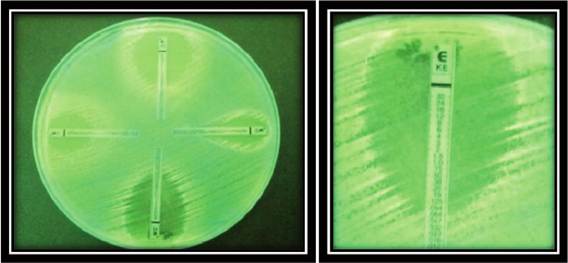
Figure 18.
“E-test” commercial method. MIC is determined by the intersection of the inhibitory area formed by yeast growth.
| Antifungals | S (μg∕mL) | SDD (μg⅛L) | R (μg⅛L) |
| Miconazol* | " 8 | 8-16 | ≥ 16 |
| Cetoconazol | κ 16 | — | ≥ 16 |
| Fluconazol | ≤ 8 | 16-32 | ≥ 64 |
| Itraconazol | " 0,25 | 0.25-0.5 | ≥ 1 |
| Voriconazol | ≤ 1 | 2 | ≥ 4 |
| Caspofungina | ≤ 2 | — | > 2 |
S: sensitive; SDD: dose dependent sensitivity; R: resistant; NS: not sensitive [38, 42].
Table 1.
Interpretation of the behavior of yeast strains against the concentration of antifungals (μg∕ml).
The classification by this method determines the isolate as sensitive, dosedependent and resistant (Table 1).
For tests to determine the antifungal profile, source control strains of the “American Type Culture Collection” (ATCC) are always used under identification, such as, for example, ATCC64548 (C. albicans) and ATCC777 (C. dubliniensis).
In the treatment of invasive fungal infections, classes of polyene antifungals (amphotericin B), azoles (fluconazole, voriconazole, ketoconazole, itraconazole, posaconazole), pyrimidines (5-fluorocytosine) and echinocandin, (caspofungin, caspofungin, micafungin) are mainly used [35].
For the systemic treatment of yeasts, we can use Amphotericin B, in the most varied forms (liposomal, suspension of lipid complexes). Nystatin can be used orally or in suspension, ointments and creams (as for example, in cases of oral candidiasis). In animals, the use of each of these antifungals is quite varied and their recommendation and dose will depend a lot on the etiological agent in question and the side effects that can be generated.
When analyzing the profile of sensitivity to antifungals compared to isolates from the oral cavity of dogs (mucosa that has greater transmissibility to humans), the best active antifungals found in the veterinary are ketoconazole and voriconazole. Ketoconazole is still widely used in clinics and pet shops, mainly, topically. For the treatment of candidiasis in small animal clinics, ketoconazole is one of the most frequently used drugs, as it has a broad spectrum of activity, encompassing several species of Candida spp. and dermatophytes. From isolates from the oral cavity of dogs it shows high sensitivity between yeasts and has several presentations for veterinary use, representing an economically viable alternative, however, due to its toxicity, the trend is disuse [9, 17].
Voriconazole has a broad spectrum of activity and a potent “in vitro” action. Its mechanism of action is like other azole antifungals, inhibiting the enzyme 14 alpha-demethylase, dependent on cytochrome P-450, essential for the ergosterol biosynthesis. It can be indicated as a good alternative to replace ketoconazole, however its cost is high. This drug is also used for the treatment of systemic mycoses, mainly in candidiasis, aspergillosis and cryptococcosis in debilitated, immunosuppressed patients or in cases of resistance to another antifungal [43]. The antifungals fluconazole, itraconazole and miconazole are also routinely applied in the veterinary clinic, used indiscriminately in the treatment of mycosis suggestively diagnosed. However, resistance to these drugs has increased, so their use should be more cautious.
Candida zeylanoides, for example, is a relatively rare yeast in humans and animals. In humans it has been reported from skin, nails and blood isolation, considered an opportunistic pathogen, also involved in cases of endocarditis in an HIV-positive patient [44]. Samples of this yeast were isolated for the first time in the oral cavity of stray dogs and demonstrated significant resistance to the antifungal fluconazole. In addition to this species, Candida krusei also obtained partial results of resistance to this antifungal, as well as yeasts of the genus Trichosporon spp. [9].
Itraconazole is a synthetic triazole derivative with a wide spectrum of action, widely used in the treatment of superficial mycoses by candidiasis, malasseziosis and in systemic mycoses. When used orally right after a meal, its bioavailability is maximum, with biphasic elimination. This antifungal has also been used successfully in dogs with mycotic rhinitis and in systemic mycoses, such as blastomycosis. However, its use in dogs can lead to skin rashes and, in high dosages, it can cause anorexia and increased plasma concentration of alkaline phosphatase and aminotransferase enzymes [43].
In addition, species isolated from the oral cavity of dogs (especially Candida albicans and C. tropicalis) have shown dose-dependent sensitivity to itraconazole. Yeasts of the genus Trichosporon also isolated from this active site, show medium resistance to fluconazole and significant resistance to itraconazole, which reveals concern about the use of these drugs in the treatment of candidiasis and triconosporoses in dogs [9, 19].
In the veterinary medical clinic, miconazole is commonly indicated for the treatment of dermatophytosis, malasseziosis and candidiasis. However, yeasts of the genus Trichosporon and Malassezia pachydermatis isolated from the oral cavity of dogs show important resistance to this antifungal. Different for Candida yeasts, in which the antifungal profile demonstrates sensitivity to miconazole [9, 19].
Caspofungin is an antifungal with an inhibitory action on the cell wall of the echinocandin group, important in human medicine as an alternative for the treatment of isolates resistant to fluconazole [45]. Against yeasts isolated from the oral cavity of dogs, yeasts of the genus Trichosporon and of the genus Malassezia demonstrate significant resistance to this antifungal, resistance also demonstrated to a lesser extent by the species Candida parapsilosis [9, 19].
In cases of systemic infections, affecting different species of animals, the use of amphotericin B, a drug that acts on the fungal cell membrane, has efficiency against strains of Candida spp. However, due to the high cost and serious side effects, such as hepatotoxicity, nephrotoxicity, myelotoxicity and cardiotoxicity, this medication is seldom used [17].
Due to the great similarity between the fungal cell and the host cell, the action of antifungals presents relatively high toxicity. Thus, there is a need for research for the best choice of antifungal, based on the most appropriate therapeutic response and on the sensitivity profile of yeast against antifungal floodgates, seeking as well to minimize the side effects that can be generated with the use of more drugs needed in cases of therapeutic failure [43].
When information is obtained that a street animal, which in general is a dog that, has never received therapeutic treatment based on antifungal, presents positive isolation for resistant yeasts, it is assumed that environmental yeasts are undergoing an important primary resistance or that the ecological niche in which that animal lives is contaminated by resistant microorganisms originating from direct or indirect human contamination.
Corroborating this fact, we must consider the excessive use of pesticides in the environment and mycoherbicides (placed in plantations, vegetable gardens, and in the soil itself), have a chemical constitution like azoles, thus representing a strong selective pressure for the emergence of strains resistant. This question of possible environmental contamination and fungal resistance is already discussed for other yeast species, such as Cryptococcus spp. and medical mycology becomes an important issue.
The growing data on increased resistance of fungi against antifungal drugs have been causing great concern for human and veterinary doctors. Although data on resistance to antifungals from yeasts isolated from dogs are scarce, their importance is notorious, directly associated with the therapeutic success of these animals particularly important for society and human health (physical and mental).
Therefore, the ideal therapeutic choice, for both humans and animals, should be based on prior identification of the agent and, if possible, the use of techniques for determining the sensitivity profile of the etiologic agent against antifungals.
9.