Epidemiological markers
As we have already pointed out, yeasts (especially those of the genus Candida) have emerged as important pathogens in humans and animals and the interrelation between both is of great relevance, gaining prominence today.
Several markers can be used to detect new yeast species as well as their genotype. Based on the data, we can determine the presence of these microorganisms, the same species/genotype, in one or more anatomical areas of the host, as well as of different ecological niches.
Confirming the colonization/infection area has often been an arduous task. Therefore, the use of these markers shows to be of great importance for the epidemiological study of yeasts.
Among the phenotypic markers, we can highlight those based on colony morphology (morphotyping), enzyme production (enzyme typing), sensitivity to “Killer” toxins and antifungal agents. They are simple and easy to perform techniques.
Genotypic markers are more sophisticated and safer; however, they require more elaborate techniques. The technique is based on short sequential repetition of bases throughout the yeast genome and its reading is performed on a specific sequencing apparatus. The patterns of the visualized DNA bands function as true “fingerprints” of the microorganism, leading us to the recognition of the colonization/infection area of the host. This technique can be used both for use in clinical isolates and for environmental samples (Figure 17).
With increasingly interconnected ties between man and his dog, the use of these markers is a valuable technique for detecting epidemiological transmission between
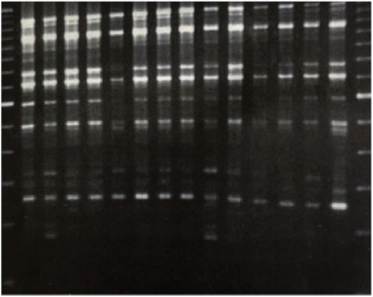
Figure 17.
Chromosomal bands of yeasts obtained by electrophoresis pulsed field - PFGE.
these species and a facilitator for taking therapeutic actions based on the microbiological analysis of the agents transmitter [33].
8.