Antigens (or Immunogens) Stimulate Immune Cells to Induce an Immune Response
An antigen, or immunogen, is defined as any substance that is capable of stimulating immune cells (T and B cells) to induce an immune response. Antigens can be broadly divided into two large categories: (1) infectious (microbial) and (2) noninfectious (Figure 54-1).
Infectious antigens include components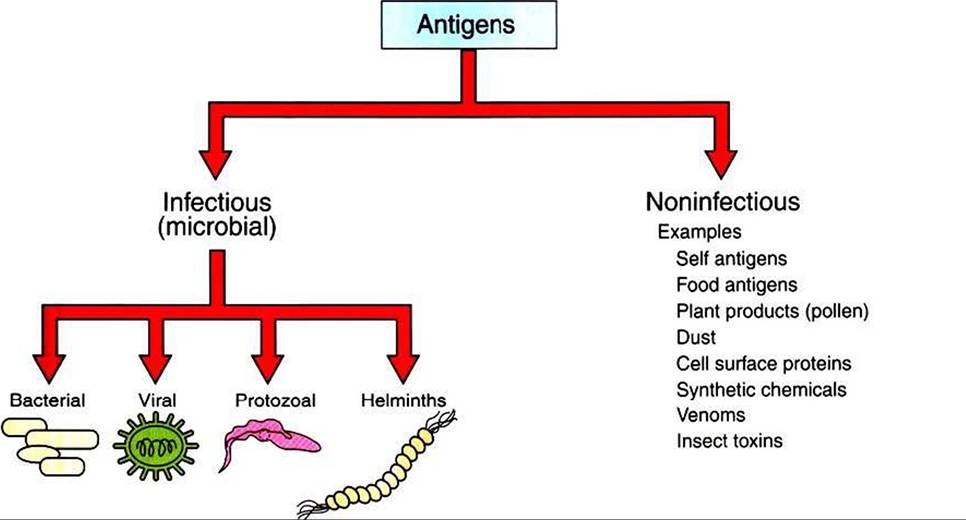
FIGURE 54-1 Classification of antigens.
that are derived from bacteria, viruses, protozoa, and helminths. Noninfectious antigens include those derived from “self” (autoantigens), food, plants, dust, or insect and animal venoms, as well as synthetic and cell surface proteins.
An antigen is composed of many molecular units to which an antibody binds. I hese small units on an antigen are called antigenic epitopes, or antigenic determinants. Thus a single antigen may be composed of many antigenic epitopes. In the strictest sense, antibodies bind to an antigenic epitope of an antigen. Some of these antigenic epitopes are shared among different bacteria (e.g., epitopes on Brucella and Yersinia) or between a bacteria and host cells (e.g., Mycobacterium heat shock proteins and synovial tissue; Mycoplasma and lung tissue). These types of antigenic epitopes are called cross- reactive epitopes.
Figure 54-2 shows the following antigenic structures of bacteria:
1. Bacterial cell wall. Cell walls of gram-positive bacteria differ from those of gram-negative bacteria. Gram-positive bacteria are composed of a thick layer of short chains of amino acids or peptides and carbohydrates (peptidoglycans). The cell wall of gram-negative bacteria has a thin layer of peptidoglycan and is largely composed of lipopolysaccharides, which are potent endotoxins.
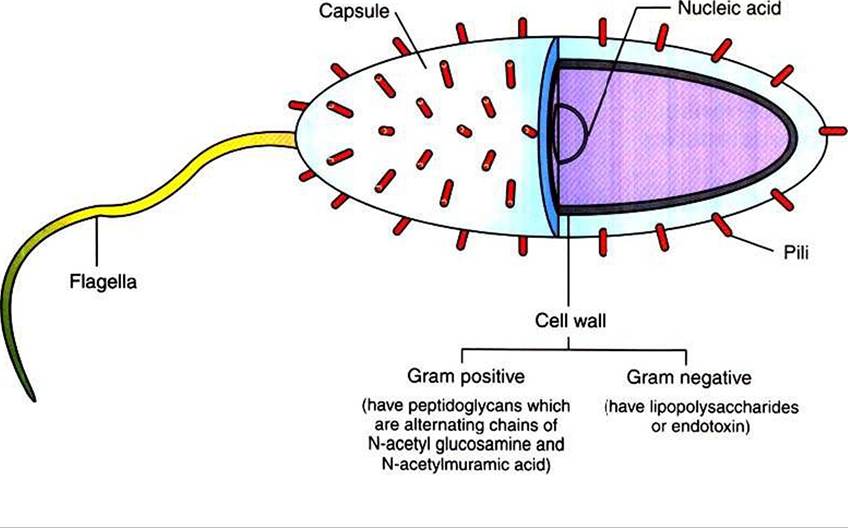
FIGURE 54-2
Antigenic structures of bacteria (not all bacteria have all these structures).
2.
Capsule. Certain bacteria produce a protective outer covering called a capsule, which is composed of polysaccharides.3. Pili. These small, hairlike protein structures on some bacteria enable the bacteria to adhere to target host cells and transfer genetic information from one bacterium to another.
4. Flagella. Some bacteria possess flagella for mobility. Flagella contain a protein called flagellin1 which can be antigenic.
5. Nucleic acids. Nucleic acids, such as bacterial deoxyribonucleic acid (DNA), tend to be antigenic because of differences in methylation compared with mammalian DNA. The antibodies against bacterial DNA tend to cross-react with the host’s DNA.
Viruses have nucleic acids (ribonucleic acid [RNA] or DNA), surrounded by a protein coat called a capsid. Some viruses have an envelope, a lipid membrane-like structure covering the capsid. On the envelope are glycoprotein projections that the viruses use to attach to the host target cells. All these components may be antigenic.
External structures of protozoa and helminths tend to be antigenic. Similarly, fungal spores are antigenic. Pollens, glycoproteins of certain foods, the unique biochemical structure of synthetic chemicals, insect saliva, and venoms are all good antigens. It is beyond the scope of this chapter to discuss each of these antigens in detail.
The immune system is exposed to and tolerates “self” antigens found on all of its own tissues. These antigens can be cell surface antigens (e.g., thyroglobulin, myelin peptides) or internal antigens (e.g., cardiolipin, nucleic acids, histones). In certain individuals who are allergic, antigens derived from food (e.g., peanuts, strawberries, fish) or plants (e.g., pollen, spores) induce an immediate and potent immune reaction. Many synthetic chemicals and drugs are minute in size and tend to be adsorbed onto cell surface antigens to create a new antigenic epitope. With ever-increasing synthesis of chemicals (pesticides, agricultural chemicals, drugs, and consumer products, to name a few), it is likely that synthetic chemicals may become an important class of antigens in the future.