Arteriovenous Anastomoses
Direct connections between small arteries and veins exist in many parts of the body where they are used to short circuit the capillary bed (Fig. 7.31). One purpose of such connections is to shunt blood away from tissues of intermittent activity when they are resting; good examples are supplied by the thyroid gland and the gastric mucosa.
Arteriovenous anastomoses are also concerned with temperature regulation and are plentiful in the digits, external ears, and nose. Paradoxically, they appear to be used in two ways. They open in a cold environment to prevent local overchilling of the appendages. The anastomoses also promote heat loss by increasing the throughput of blood close to the body's surface in overheated animals. The panting dog uses the circulation of blood through the many arteriovenous anastomoses within the tongue to promote the evaporation of saliva from the surface, which compensates to some degree for the restricted distribution of sweat glands in canine skin.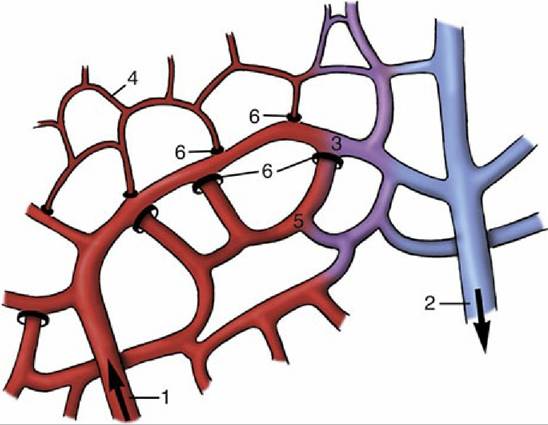
FIG. 7.30 Schematic drawing of a capillary plexus. 1, Arteriole; 2, venule; 3, communicating (low- resistance) channel; 4, closed capillaries; 5, open capillaries; 6, precapillary sphincters. Arrows indicate direction of blood flow.
In the pig, up to 30% of the total cardiac output sometimes passes through arteriovenous anastomoses. The structure of these interconnecting channels is not uniform. Some are distinguished by having very muscular walls, and in others the muscle cells take on a peculiar epithelioid character; these epithelioid cells are believed to swell in response to specific chemical stimuli, thereby closing the channel.