Axis
The axis is characterized by its length and its enormous spinous process, which overhangs both the dorsal arch of the atlas and the laminae of the third vertebra and carries the caudal articular processes.
The cranial extent of the spinous process matches that of the dens, which rests on the dorsal surface of the ventral arch of the atlas (see Figs. 2.7 and 2.8). The dens, the displaced body of the atlas, is the pivot around which the atlas and thus the head rotates. The atlantoaxial joint is enclosed by a single joint capsule. The two bones are held in apposition by a thin median ligament (ligamentum apicis dentis), which connects the tip of the dens with the ventral border of the foramen magnum (see Fig. 2.13), and paired (alar) ligaments, which pass obliquely from the dens to the ventrolateral borders of the foramen. The dens is further secured by a transverse ligament connecting the inner walls of the ventral arch of the atlas across its dorsal surface. This transverse ligament allows rotations but prevents impingement of the dens on the spinal cord. The dens plays an important role in stability of the atlantoaxial joint, and aberrant development of the growth plate (early fusion, partial fusion, or nonfusion), seen in miniature breeds (Chihuahua, Toy Pomeranian, Pekingese, and Toy Poodle), leads to instability.FIG. 12.6
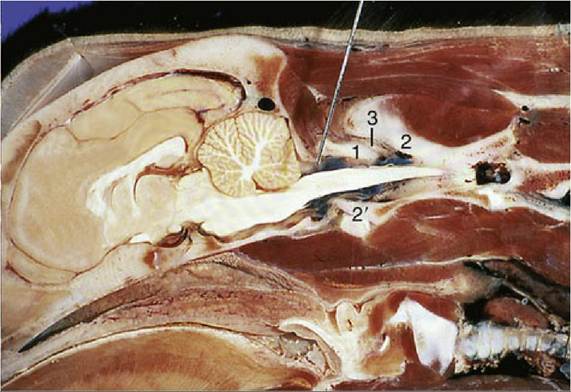
Median section of head and neck (dog); the needle penetrates the atlanto-occipital membrane
to enter the subarachnoid cerebellomedullary cistern. 1, Dorsal arch of atlas; 2, spinous process of axis;
2', dens; 3, dorsal atlantoaxial ligament.
The atlantoaxial membrane closes the interarcuate space; its median part is thickened by elastic fibers that connect the cranial tip of the spine of the axis with the tubercle on the dorsal arch of the atlas (dorsal atlantoaxial ligament) (Fig. 12.6/3).
More on the topic Axis:
-
Veterinarian -