Behaviour and emotion
Normal behaviour in animals depends on complex interactions involving many areas of the brain. The limbic system is the area most commonly associated with behaviour. Phylogenetically, it is part of the archipallium of the cerebrum, which represents a primitive part of the brain.
The limbic system is associated with the nonolfactory portion of rhinencephalon (paleopallium). This region originally functioned to correlate olfactory input with other sensory information. During evolution the archipallium has acquired other functions, such as behaviour.The limbic system curves dorsally around the medial side of the cerebral hemispheres at their borders with the diencephalon. There is no generally accepted classification of its components but it is commonly thought to include the limbic lobe comprising the telencephalic structures such as the hippocampus, parahippocampal, cingulate, subcallosal and dentate gyri, the amygdaloid complex and septal nuclei (Figs. 11.1, A4-6, A13-18). Other components include subcortical, diencephalic structures, such as the mammillary bodies, epithalamus, rostral thalamic area and the interpeduncular nucleus in the midbrain. It receives, and associates, olfactory, visceral, oral, sexual, optic and auditory impulses. It projects to the hypothalamus and the brainstem, especially to those structures influencing visceral activity.
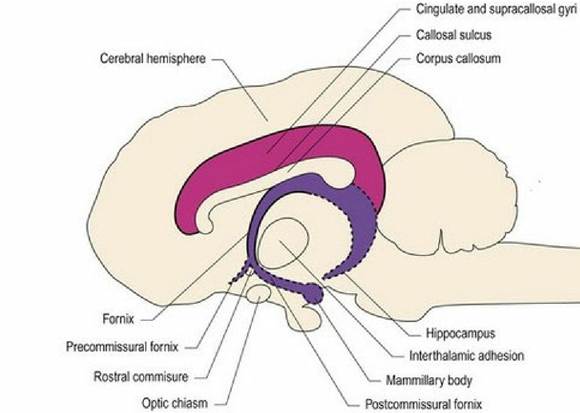
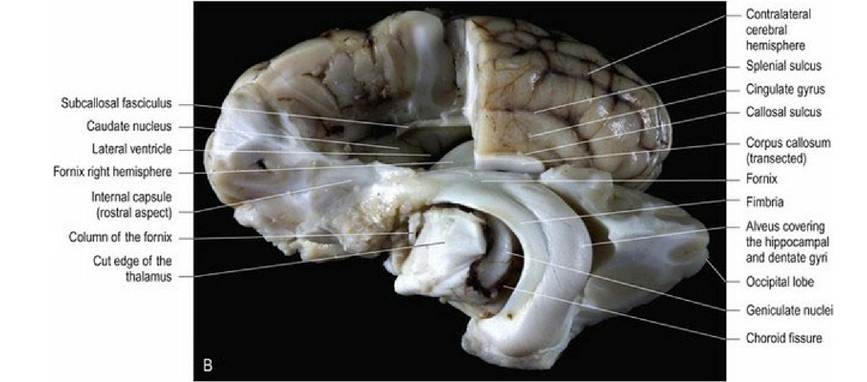
Fig. 11.1 (A) Median aspect of the canine brain, depicting the main components of the limbic system. Components that are off the midline have a dashed outline. (B) Ovine brain, lateral aspect, dissected to display some of the structures of the limbic system. See Appendix glossary for information about limbic system structures.
The limbic system includes those regions of the forebrain associated with affective (emotional) behaviour. In humans, this includes emotional experiences, fear, pleasure, memory and sexual activity. Emotional drive ensures that the animal will exert sufficient effort to ensure its own survival and that of its species. Emotion has a major impact on learning and memory and involves autonomic (visceral) responses. The limbic system correlates emotion and behaviour with the autonomic nervous system. This leads to the concept of the visceral brain; that is emotion produces a visceral reaction. In humans it is the part of the brain that is associated with how an individual is feeling - the ‘gut reaction’.
Lesions in the limbic system in humans and animals can cause alterations in level of aggression such that docile, or wild animals, may become the opposite. This is the region of the brain specifically targeted by the rabies virus, resulting in behaviour changes in affected animals that are classically described as a ‘dumb form’ and a ‘furious form’. Other signs of limbic lesions include altered cognition, sexual aberrations or altered use of sensory systems, for example, use of oral and olfactory input rather than visual input.