BLOOD PRESSURE
1. Why does blood flow continuously rather than intermittently, considering that the ventricles contract intermittently?
2. Define diastolic, systolic, pulse, and mean blood pressure.
Blood is under pressure within its closed system, and the pressure varies in different parts of the circulatory system. Pressure differences can be observed when vessels are cut. Blood from the central end of a cut artery is under high pressure and it spurts; blood from the peripheral end of a cut vein may be rapid but is under low pressure and is without pulsation. Accordingly, blood is under high pressure in arteries, moderate pressure in capillaries, and low pressure in veins. The unqualified term blood pressure usually refers to arterial pressure.
Pressure Generation and Flow2
Blood pressure has been mentioned briefly without regard to its dynamic aspects. Because there is a pressure gradient within the circulation (highest in the aorta and lowest in venae cavae), the blood flows from the left ventricle, through the vessels, and back to the right atrium. The greatest pressure develops within the aorta when the left ventricle contracts. The ventricle relaxes completely after contraction, but blood pressure in the aorta does not diminish entirely. The large arteries contain a higher number of elastic connective tissue fibers than muscle fibers. These elastic fibers permit expansion when blood advances into them from the left ventricle, and stretched elastic fibers have a rebound tendency that exerts pressure on the blood in the large vessels after the heart ceases to exert the pressure (Figure 9-28). The continuous pressure in the arteries permits a continuous rather than an intermittent blood flow through the body.
.Go to__________________________ to view a related video.
U √
Systolic and Diastolic Pressures
The high point of the arterial pressure obtained at the peak of left ventricular contraction (systole) is called the systolic blood pressure.
The lowest pressure in the arteries occurs while the left ventricle is relaxed (diastole) and before it begins its next contraction. The low point of pressure is called the diastolic pressure. Blood pressure measurements are often given as two values, one over the other (e.g., 130/70). The upper value is the systolic pressure and the lower value is the diastolic pressure. The term pulse pressure refers to the,difference between the systolic and the diastolic pressures; in the previous example it would be 60. The appropriate unit for expressing blood pressure values is millimeters of mercury (mm Hg) or torr. The mean blood pressure is not a value halfway between the systolic and diastolic blood pressures; it usually tends to be the diastolic pressure plus about one-third of the pulse pressure. Therefore, in the previous example, the mean blood pressure would be about 90 mm Hg. Mean blood pressure determines the average rate at which blood flows through the systemic vessels. It is closer to diastolic pressure than systolic pressure because, during each pressure cycle, the pressure usually remains at systolic levels for a shorter time than it remains at diastolic levels.Measurements
The conformation of the body parts of animals has not been conducive to blood pressure being measured by the same noninvasive sphygmomanometric means used in humans. Instruments have been developed in recent years that now allow noninvasive means for measuring blood pressure in animals. The Doppler flow method emits an ultrasonic beam into the blood vessel; the ultrasound reflected from the moving blood changes its frequency (Doppler effect) and, by proper calibration, blood pressure is being measured. Another instrument is the oscillometer, which detects oscillations of the blood flow. It can be calibrated to measure systolic, mean, and diastolic pressures. Both of these instruments require the fixation of a transducer or cuff at appropriate locations on the fore- or hindlimbs or tail.
The most accurate method in animals would involve cannulation of arteries and measuring the pressure electronically with appropriate transducers. A blood pressure measurement taken from the carotid artery in a dog is illustrated in Figure 9-29. The systolic, diastolic, mean, and pulse pressures are also shown, as well as correlation with the ECG.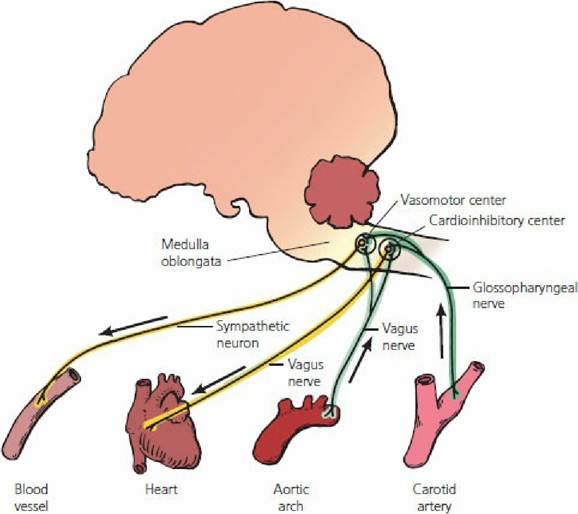
■ FIGURE 9-27 The reflexes controlling blood pressure involve receptors in the aortic and carotid sinuses and centers in the medulla oblongata. To lower blood pressure the vasomotor center is inhibited, resulting in vasodilatation, and the cardioinhibitory center is stimulated, resulting in diminished heart activity.
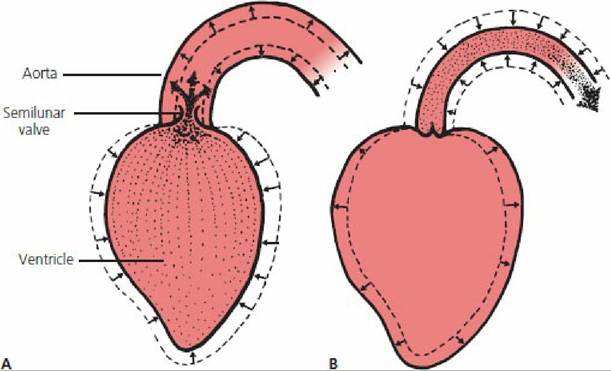
■ FIGURE 9-28 Generation of systemic blood pressure during left ventricular systole and maintenance of blood flow and pressure during diastole. A. Contraction of ventricle and stretch of elastic aorta (arrowheads show direction of contraction and stretch). B. This is followed by retention of systemic blood in vessels by the closed aortic semilunar valve. Continued blood flow is provided by the elastic recoil of the aorta. Solid lines in A represent ventricular and aortic size at the end of systole. Solid lines in B represent ventricular and aortic size at the end of diastole. The stippling in the ventricle and aorta represents blood. The dotted lines indicate the would-be size before and after contraction and/or stretch.
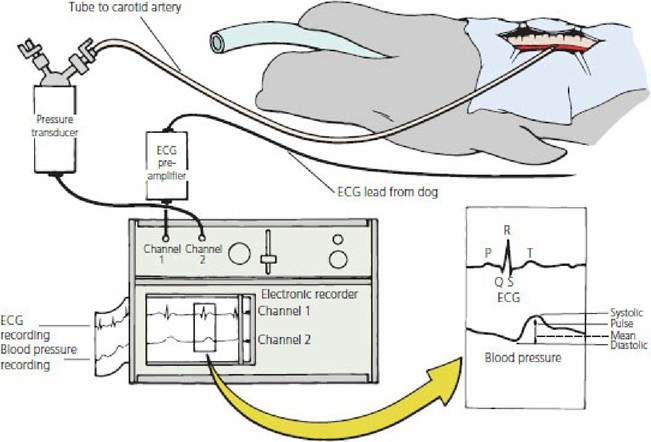
■ FIGURE 9-29 Recording blood pressure from a surgically placed cannula and an electrocardiogram from lead II in an anesthetized dog. Note the increase in pressure that follows the QRS waves (depolarization of ventricles and subsequent contraction). Pulse pressure is represented by the double arrow between diastolic and systolic blood pressure.
Values for characteristic blood pressures in several animals are given in Table 9-2
| TABLE 9-2 CHARACTERISTIC BLOOD PRESSURES IN ADULT RESTING ANIMALS | ||
| SPECIES | SYSTOLIC/DIASTOLIC (mm Hg) | MEAN.(mm Hg) |
| Giraffe | 260/160 | 219 |
| Horse | 130/95 | 115 |
| Cow | 140/95 | 120 |
| Swine | 140/80 | 110 |
| Sheep | 140/90 | 114 |
| Human | 120/70 | 100 |
| Dog | 120/70 | 100 |
| Cat | 140/90 | 110 |
| Rabbit | 120/80 | 100 |
| Guinea pig | 100/60 | 80 |
| Rat | 110/70 | 90 |
| Mouse | 111/80 | 100 |
| Turkey | 250/170 | 190 |
| Chicken | 175/145 | 160 |
| Canary | 220/150 | 185 |
| From Detweiler DK. Control mechanisms of the circulatory system. In: Swenson MJ, Reece WO, eds. Dukes' Physiology of Domestic Animals. 11th edn. Ithaca, NY: Cornell University Press, 1993. Used by permission of the publisher, Cornell University Press. | ||
■