Body Design
Birds are clearly distinct from domestic mammals in the overall construction of their bodies (Fig. 30-1); the thoracic limb of all birds, whether capable of flight or not, is modified into a non-weight-bearing wing.
Additionally, all birds, even relatively poor flyers, have skeletal, cardiopulmonary, and muscular modifications that reflect their common ancestry in a flighted progenitor. The body cavity has no muscular diaphragm, being instead incompletely partitioned into a number of compartments by connective tissue sheets. These are typically perforated by a number of natural apertures that allow communication between the compartments and with peripheral air sacs.Bones of birds are higher in mineral concentration than are mammals, and the medullary cavities of many long bones and some flat bones are variably displaced by air-filled spaces that make the bones lightweight for their size and strength. Bones modified in this way are called pneumatic bones. Because of the role of the thoracic limb as a wing, the thoracic girdle is extremely well developed, providing rigid scaffolding for the muscles of flight. The pelvic limbs are very strong for the size of the animal and brought craniad toward the body’s center of gravity (Fig. 30-1). Both of these characteristics reflect the fact that the pelvic limbs in birds have assumed all the responsibility of supporting the body weight when the bird is not in flight. overall, the skeleton shows a tendency toward fusion between small bones that in mammals constitute complex joints (e.g., carpus and tarsus).
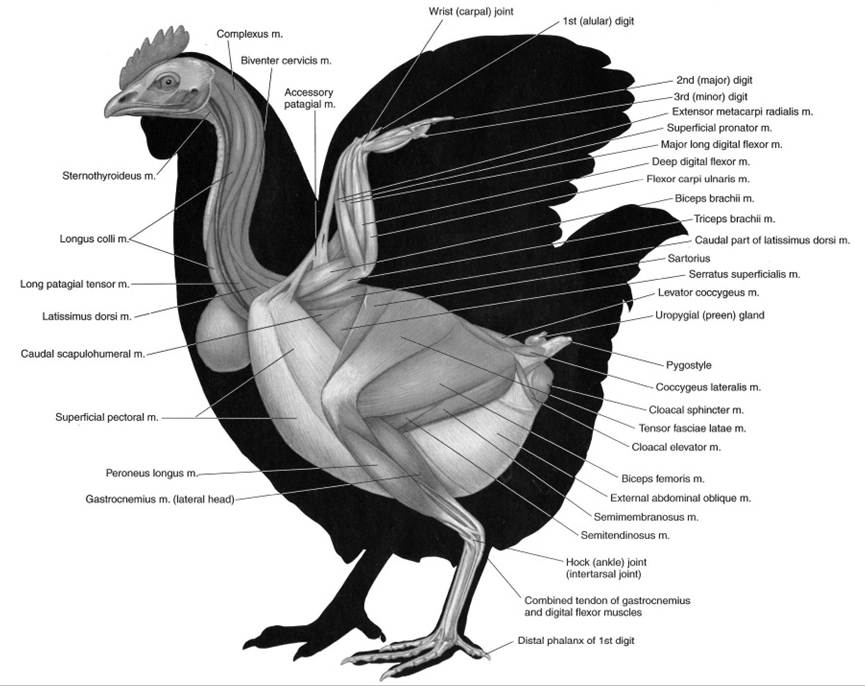
Figure 30-1. The muscular system of the chicken. (Reprinted with permission of Wiley-Blackwell from McCracken, T.O., Kainer, R.A., and Spurgeon, T.S. Spurgeon’s Color Atlas of Large Animal Anatomy. Baltimore: Lippincott Williams & Wilkins, 1999.)