Skeleton and Bone
The avian vertebral column comprises vertebrae divided into cervical, thoracic, lumbar, sacral, and caudal divisions as in mammals, but vertebrae in the thoracic region are partially fused into the notarium, and in the lumbosacral region 14 to 15 vertebrae are fused into the synsacrum.
The last few caudal vertebrae are fused into the pygostyle, which provides a solid mass for stability of the tail feathers. Cervical vertebrae are increased in number relative to mammals, accounting for the remarkable flexibility of the avian neck; chickens, turkeys, and ducks have 14 and geese 17 cervical vertebrae (See Fig. 30-2.)Each thoracic limb possesses a bony attachment to the axial skeleton (in contrast to the muscular synsarcosis of the mammalian thoracic limb). This shoulder girdle comprises the scapula, the coracoid (which is a bridge between the shoulder joint and the sternum), and the clavicle. The right and left clavicles in birds are fused into a single bone, commonly called the wishbone but in anatomical terms is called the furcula. The furcula acts as a bony strut to maintain distance between the two shoulders.
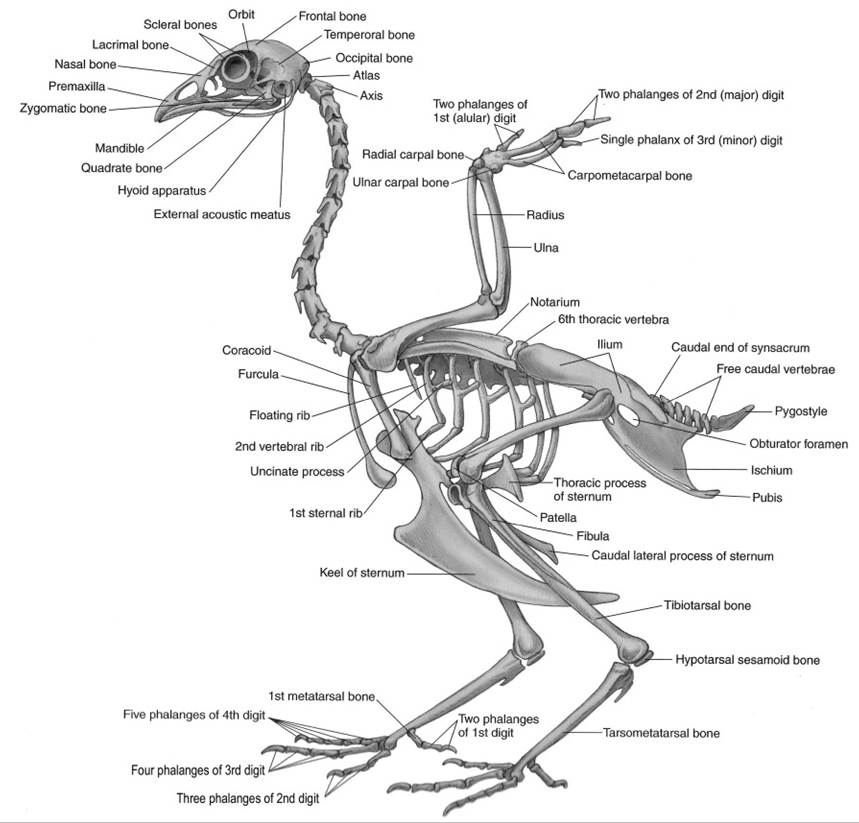
Figure 30-2. The skeleton of the chicken. (Reprinted with permission of Wiley-Blackwell from McCracken, T.O., Kainer, R.A., and Spurgeon, T.S. Spurgeon’s Color Atlas of Large Animal Anatomy. Baltimore: Lippincott Williams & Wilkins, 1999.)
In the antebrachium, the radius is considerably smaller than the ulna. These bones articulate with the two bones of the carpus. The distal row of carpal bones have become fused with the proximal end of the metacarpals, and so these long bones of the metacarpal region are known as carpometacarpal bones, of which there are three. There are three digits. The first is often called the pollux and like the “thumb” of mammals possesses two phalanges.
Digit two is robust, with two well-developed phalanges and one vestigial phalanx. The third digit is very small and comprises only a single phalanx.There is considerable diversity in the appearance of the pelvis in birds, but like the mammalian pelvis, three bones (ilium, ischium, and pubis) contribute to its construction. Like the thoracic limb, the pelvic limb shows a reduction in the number of individual bones of the tarsus. Fusion of the proximal row of tarsal bones with the tibia creates the tibiotarsus. The fibula is fused with the tibiotarsus in its distal half. The distal tarsal bones are fused to a single weight-bearing metatarsal bone; this is therefore correctly referred to as the tarsometatar- sus in birds. Poultry possess four digits; digit one projects in a medioplantar direction. The other three toes fan out in a forward direction. Digit one has two phalanges, digit two has three, digit three has four, and digit four has five.
The sternum of domestic poultry is dramatically modified for flight. As the pectoral muscles of birds are massively developed, the sternum (their primary attachment site) is correspondingly enlarged. The large, shieldlike mass of the sternum is further increased for muscle attachment by the presence of a large midline keel or sternal crest. The cranial sternum, especially, is adorned with projections that serve as articulating processes and sites for muscle attachment.
Ten to 14 days prior to the beginning of a laying period, chickens develop a type of bony tissue unique to birds and crocodilians in the shaft of long bones such as the femur. This medullary bone consists of interlacing bony spicules, with blood sinuses and marrow between the spicules. Medullary bone may replace up to 75% of the hematopoietic tissue in laying hens, but it is absent in non-laying hens and males. Medullary bone formation is stimulated by the effects of estrogen on osteoblasts, and just prior to the beginning of an egg production period, estrogen levels are relatively high as ovarian follicles mature and begin secreting estrogen. Medullary bone provides a ready source of calcium that can be mobilized later for use in eggshell production. Eggshell formation and calcium metabolism will be discussed in more detail in a later section of this chapter.