BODY TEMPERATURE
1. What factors can influence body temperature?
2. What is meant by core temperature?
3. Does a rectal temperature reading represent the temperature throughout the body?
4.
What is meant by diurnal temperature?5. Give an example of heat storage in an animal. What advantage is served by heat storage?
6. What is an approximate value for rectal temperature in common domestic animals?
An average body temperature is associated with each domestic animal species. These temperatures are shown in Table 13-1, along with their commonly observed ranges. The temperatures were obtained by rectal insertion of a thermometer in resting animals. A number of conditions can influence body temperature, including exercise, time of day, environmental temperature, digestion, and drinking of water.
| TABLE 13-1 AVERAGE RECTAL TEMPERATURES OF VARIOUS SPECIES | ||||
| AVERAGE | RANGE | |||
| ANIMAL | °C | °F | °C | °F |
| Stallion | 37.6 | 99.7 | 37.2-38.1 | 99.0-100.6 |
| Mare | 37.8 | 100 | 37.3-38.2 | 99.1-100.8 |
| Donkey | 37.4 | 99.3 | 36.4-38.4 | 97.5-101.1 |
| Camel | 37.5 | 99.5 | 34.2-40.7 | 93.6-105.3 |
| Beef cow | 38.3 | 101 | 36.7-39.1 | 98.0-102.4 |
| Dairy cow | 38.6 | 101.5 | 38.0-39.3 | 100.4-102.8 |
| Sheep | 39.1 | 102.3 | 38.3-39.9 | 100.9-103.8 |
| Goat | 39.1 | 102.3 | 38.5-39.7 | 101.3-103.5 |
| Pig | 39.2 | 102.5 | 38.7-39.8 | 101.6-103.6 |
| Dog | 38.9 | 102 | 37.9-39.9 | 100.2-103.8 |
| Cat | 38.6 | 101.5 | 38.1-39.2 | 100.5-102.5 |
| Rabbit | 39.5 | 103.1 | 38.6-40.1 | 101.5-104.2 |
| Chicken (daylight) | 41.7 | 107.1 | 40.6-43.0 | 105.0-109.4 |
| From Andersson BE, Jonasson H. Temperature regulation and environmental physiology. In: Swenson MJ, Reece WO, eds. Dukes’ Physiology of Domestic Animals. 11th Ed. Ithaca, NY: Cornell University Press, 1993. Used by permission of the publisher, Cornell University Press. | ||||
Gradients of Temperature
Different parts of the body can differ in temperature because of differences in metabolic rate, blood flow, or distance from the surface. For example, the liver and the brain can have a temperature that is higher than that of the blood and they are therefore cooled by blood circulation. The deep body temperature, or core temperature, is higher than the temperature of the limbs or even higher than the temperature observed rectally. However, rectal temperature represents a true steady state of temperature because it reaches equilibrium more slowly.
Diurnal Temperature
Variations in temperature related to the time of day are designated as diurnal temperatures.
Animals that are active during the day and sleep at night have body temperatures that are lower in the morning than in the afternoon. The opposite is true for nocturnal (night-active) animals. Also, as a water conservation measure, the body temperature of the camel is permitted to increase during the day so that the excess heat can be dissipated at night when the desert air is cool; this is known as heat storage. The temperature of a normal camel, watered every day and fully hydrated, varies by less than 2 °C, between about 36 °C and 38 °C (more water available for evaporation and less need for heat storage). When the camel is deprived of drinking water, however, its morning temperature can be as low as 34 °C and its highest temperature, in the late afternoon, can be nearly 41 °C (Figure 13-1).
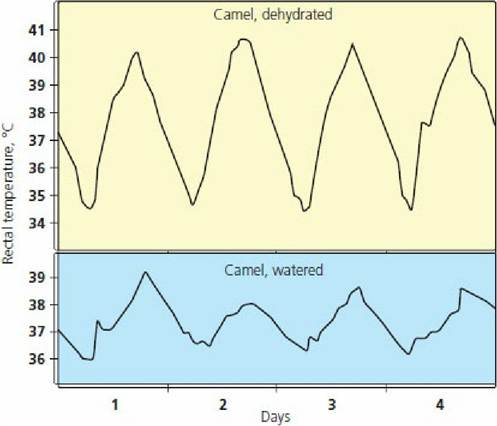
■ FIGURE 13-1 Diurnal temperatures in the watered and dehydrated camel. The rectal temperature elevations (heat storage) occur during the day and the reductions occur at night. (From Schmidt-Nielsen K. Osmotic regulation in higher vertebrates. In: The Harvey Lectures, 1962-1963, Series 58. London: Academic Press, 1963.)
■