Brainstem Upper Motor Neuron Pathways Are the Source of All Descending Motor System Input to the Spinal Cord, Except for One Other Major Pathway
Four major axon tracts originate in the brainstem and descend to the spinal cord to influence spinal lower motor neurons: the vestibulospinal tract, the reticulospinal tract, the tectospinal tract, and the rubrospinal tract (Figure 10-3).
Collectively, the first three are involved in the involuntary maintenance and adjustment of posture and in reflex orientation of the head. Therefore they are principally involved in the control of axial and proximal musculature. The rubrospinal tract is mainly involved in control of distal Iimb musculature of the type that mediates voluntary skilled movements. These four tracts (often along with components of the basal ganglia and cerebellum) are sometimes referred to as the “extrapyramidal” motor system. This is in contrast to the “pyramidal” motor system that originates in the cerebral cortex, the other major descending motor pathway to the spinal cord, as discussed later. Because the term “extrapyramidal” can encompass such a diverse group of structures, and because it is often applied inconsistently, it is being used less frequently. The four tracts from brainstem to spinal cord are collectively referred to here as the descending brainstem motor pathways.The brainstem, like the spinal cord, contains lower motor neurons that can Synaptically activate skeletal muscles, in this case the face and head muscles (see Figure 10-1). The cell bodies of these Ct motor neurons reside in various cranial nerve nuclei (e.g., facial motor, hypoglossal, oculomotor). The brainstem also receives direct input from sensory organs in the face and head (e.g., eye, vestibular apparatus). Therefore, as in the spinal cord, some fairly simple segmental reflexes can be organized at the brainstem level without significant control from other levels of the motor system. Because the brainstem also contains the descending motor pathways to the spinal cord previously noted, however, the brainstem also provides a means by which input from sensory organs in the face and head can reach and control lower motor neurons of the spinal cord that operate muscles of the trunk and limbs (see Figure 10-3).
Some of the descending brainstem motor pathways also provide a means by which more rostral regions of the motor system (e.g., motor cortex) can indirectly influence spinal lower motor neurons.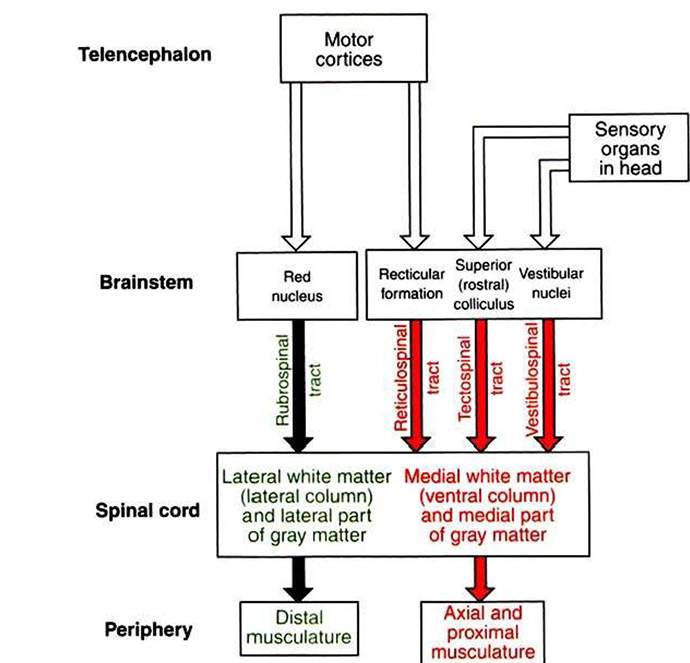
FIGURE 10-3 Organization of the descending brainstem motor pathways to the spinal cord.The medial brainstem motor pathways are the reticulospinal, vestibulospinal, and tectospinal tracts.They travel in more medial regions of the spinal cord white matter and synapse within more medial regions of the spinal cord gray matter controlling the axial and proximal musculature.The rubrospinal tract is a lateral brainstem motor pathway that travels in more lateral regions of the spinal white matter and synapses within more lateral regions of the spinal gray matter controlling the distal limb musculature. Crossing of some of the pathways is not represented.