Breeding programs and strategies
The general actions to be taken in a program for the genetic improvement within a breed should include: 1) genomic identification and characterization of individuals, highlighting their potential in terms of their contribution to maintaining biodiversity, aptitude and use 2) monitoring of demographic parameters and assessment of the risk of reduced genetic variability 3) characterization and evaluation of the intra-breed genetic variability for proper management activities.
Modern molecular techniques can be helpful for the improvement of management strategies, even for small breeds and for qualitative traits. The current hypothesis is to add molecular data to classical schemes (assisted selection) to improve their accuracy. The first step in planning an improvement program consists of: 1) a clear definition of the objectives 2) identification of the traits to be recorded 3) evaluation of the gene effect of the characters to be selected 4) estimate of the effect of the environment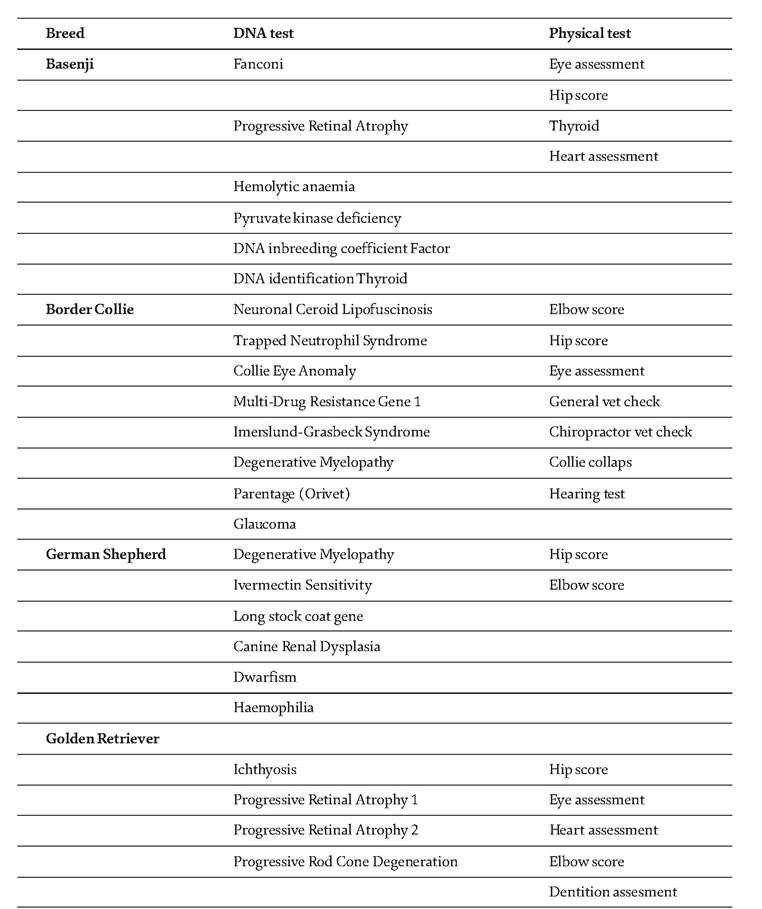
Table 1.
Genetic and physical testing used in genetic programs of common dog breeds.
(epigenetic effect) on the characters to be selected. In Table 1 are reported the genetic and physical testing used in genetic programs of several dog breeds [11].
5. Genetic diseases and molecular diagnosis
In general, genetic diseases result from a mutation in a gene. In most cases, the mutations are traits that follow a simple Mendelian inheritance model (autosomal recessive, autosomal dominant or sex chromosome-linked character). Other hereditary diseases can be more complex and show reduced penetrance or multiple loci (multigenic disease). Genetic disorders can result from new mutations, but in most cases they result from old mutations passed on from one generation to the next.
Mutated alleles can persist within a population for many reasons: 1. they can confer particular advantages in the state of heterozygotes; 2. the symptomatological signs can appear late 3. the mutation can be a recessive trait and therefore the defective allele can be spread in the population by healthy carriers. Without a mutation screening program, the carrier status can become evident only after the production of sick offspring.The canine genome contains approximately 19,000 genes spread over 39 pairs of chromosomes (38 homologous chromosomes and 2 sex chromosomes). To date, nearly 400 hereditary diseases have been recognized in dogs. However, the precise ways in which these diseases are inherited are known for only about a third of them. In most cases, they are linked to autosomal recessive mutations. Bellumori et al. [12] report the prevalence of major genetic diseases in the United States for pure and mixed breeds. Pure breeds show more markedly some diseases including elbow dysplasia, cardiomyopathy, hypothyroidism and cataracts. The identification of the carriers can be implemented with the aid of two types of information: by pedigree or from a progeny test. In the first case, an animal showing the dominant phenotype (dominant phenotype) is known to be a carrier if one of the parents has the homozygous recessive genotype. In the second case, the farmer uses the information obtained from the offspring for the determination of the animal’s genotype. Let us admit that a male is believed to be carrying a recessive allele. Special methods are required for the identification (and rejection) of carriers of the gene (suspected). This requires a reproduction test (test cross or progeny test) to determine whether the individual is dominant (suspected) or heterozygous. The genetic study of a hereditary diseases can follow additional strategies. Several genetic tests are now available for the identification of some hereditary disease [13]. The DNA-based diagnostic technique can be used to uniquely distinguish between sick and healthy subjects. These techniques allow the exclusion from reproduction of the carriers of frequent hereditary pathologies and they are a useful tool in validating the genealogical data reported in the pedigree.
6.