Carriage and Transfer of CO2 by Blood
17.3.2.3 Tidal Volume of CO2
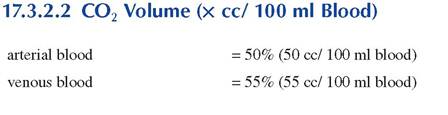
= Volume of CO2 added by the tissues to every 100 ml arterial blood.
= CO2 of venous blood - CO2 of arterial blood.= 5%.
17.3.2.4 Forms of CO2 in Arterial Blood
(I) In physical solution (5%)
(II) In chemical combination (95%)
Free CO2 gas dissolved in plasma.
H2CO3 or its dissociation products
(HCO3- and H+)
(89%)
NaHCO3 in plasma and KHCO3 in RBCs., in a ratio of 3:1
(6%)
In direct combination with hemoglobin forming carbaminohemoglobin and with plasma proteins forming carbaminoproteins.
17.3.2.5 Carriage of Tidal CO2
1. In physical solution = 5%
2. In chemical combination = 95%
a) buffered by plasma = 10%:
- Proteins: Na proteinate (basic) + H2CO3 → NaHCO3+H Proteinate (Proteinic acid)
- Phosphates: Na2HPO4 (basic) + H2CO3 → NaHCO3 + NaH2PO4.
b) buffered by Hb = 85%
a. 40% of tidal CO2 is buffered through indirect reaction with K+ released from KHbO2 At the tissue level: CO2 produced as a result of tissue activity diffuses into plasma with water then into RBCs via its semi-permeable membrane.
- Bicarbonate formation CO2 + H2O2 → H2CO3 → HCO3- + H+.
17.3.2.6 Inside RBCs
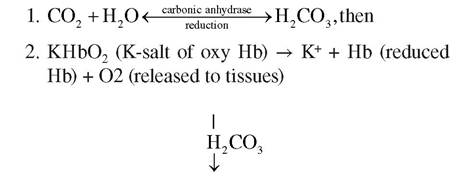
KHCO3 + H+, then
Hb (reduced Hb) combines with H+ → H.Hb (very weak acid)
N.B.:
• Reduced Hb (= Hb) and oxy Hb (=HbO2) act as weak acids in the alkaline pH of blood. They combine with K+ to form K salts.
• HbO2 is a stronger acid (holds more K+) than Hb. So, on reduction of HbO2 at the tissue level, Hb cannot hold all K+ of HbO2; consequently, K+ combines with the already formed H2CO3 inside RBCs to form KHCO3.
a) 25% of tidal CO2 is buffered by the direct reaction between H2CO3 and K salts of Hb acids inside RBCs:
• K. Hb (very weak acid) + H2CO3 → H HbO2 + KHCO3
• KHbO2 (stronger acid than reduced Hb) + H2CO3 → HHb + KHCO3
b) 20% of tidal CO2 combines directly with the free amino group of the Hb molecule to form carbamino Hb. (= Hb. NH.COOH):
Hb. NH2 + CO2 → Hb. NH. COOH Hb's affinity to carry CO2 as carbamino Hb is double that of HbO2.
17.3.3