Oxygen Transport
17.3.1.1 In the Lung
If there is a mixture of gases above a liquid, the amount of each gas dissolved in the liquid will depend directly upon the partial pressure of the gas, i.e., upon the pressure exerted by the given gas.
The partial pressure of a gas in a mixture can be calculated if the total pressure and the percentage composition of the mixture are known.
Partial pressure (P.P) of a gas in a mixture of gases =
% of a gas in a mixture ? Total pressure of the mixture.
17.3.1.2 InspiredAir
Barometric pressure of dry atmospheric air (at sea level) = 760 mm Hg.
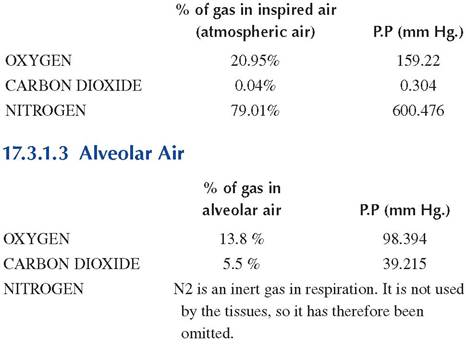
N.B.: Total pressure of alveolar air = atmospheric pressure (760 mm Hg) - pressure of water vapour present in the respiratory tract (47 mm Hg) = 713 mm Hg.
17.3.1.4 Venous Blood
| % of gas in venous blood entering lungs | P.P (mm Hg.) | |
| OXYGEN | 12.5 | 40 |
| CARBON | 56 | 46 |
| DIOXIDE |
• CO2 pressure is high → CO2 moves from venous blood to alveolar air (6 volumes % given up by blood).
• O2 pressure is high → O2 moves from alveolar air to blood (about 6.5% of volume % taken by blood).
17.3.1.5 Arterial Blood

17.3.1.6 In the Tissues
% of gas the
tissues P.P (mm Hg.)
OXYGEN 0-40
CARBON DIOXIDE 50-60
• O2 pressure is low → O2 moves from arterial blood to tissues (6.5 volumes% given up by blood).
• CO2 pressure is high → CO2 moves from tissues to blood (6 volumes % taken up by blood).
N.B.: Concentrations of the gases and therefore the pressures exerted by them vary in the tissues depending on the metabolic activity of the particular tissue at any one time.
17.3.1.7 ExpiredAir
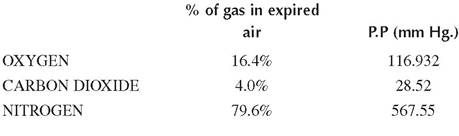
Expired air is laden with water vapour exerting a pressure of 47 mm Hg.
In conclusion:
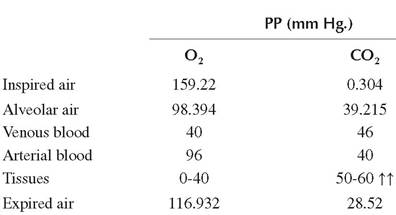
The diffusion of a gas across membranes occurs from the higher tension to the lower tension. Therefore, O2 passes from alveoli to venous blood and from arterial blood to tissues. On the other hand, CO2 passes from tissues to venous blood and from venous blood to alveoli, as seen in the following table and figure.
Significance:
• This amount is not enough at all for tissue oxygenation, which is 250 ml/minute at rest.
• O2 in physical solution is very important in determining the direction and rate of diffusion of O2 from or to the blood.
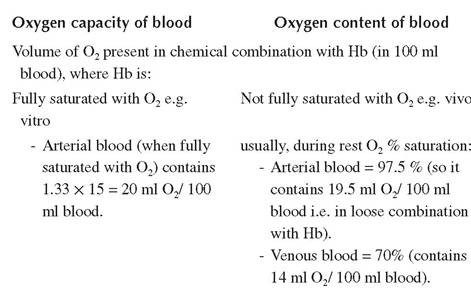
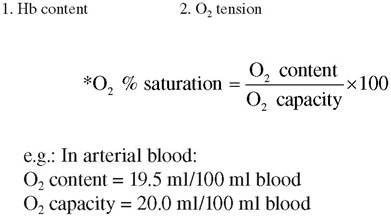
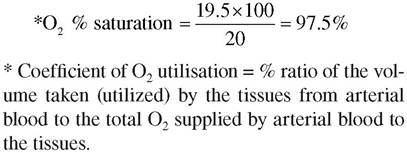
N.B.:* O2 content of blood varies between zero and 20 ml depending on:
17.3.1.8 Carriage and Transfer of O2 by Blood
(I) In physical solution: (II) In chemical combination:
17.3.1.8.1 In Physical Solution
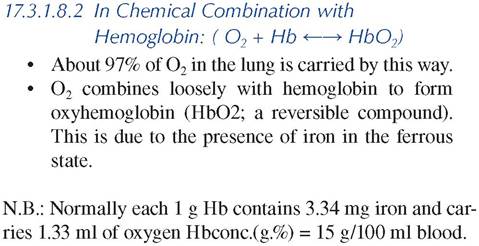
• About 3% of O2 in the lung (alveolar air) is carried this way; 0.3 ml/100 ml blood is dissolved in plasma.
id="Picutre 72" class="lazyload" data-src="/files/uch_group31/uch_pgroup304/uch_uch7235/image/image072.jpg">
17.3.1.9 O2 - Dissociation Curve
• It is the relationship between O2 tension and O2% saturation of Hb.
The curve takes an S-shape represented by:
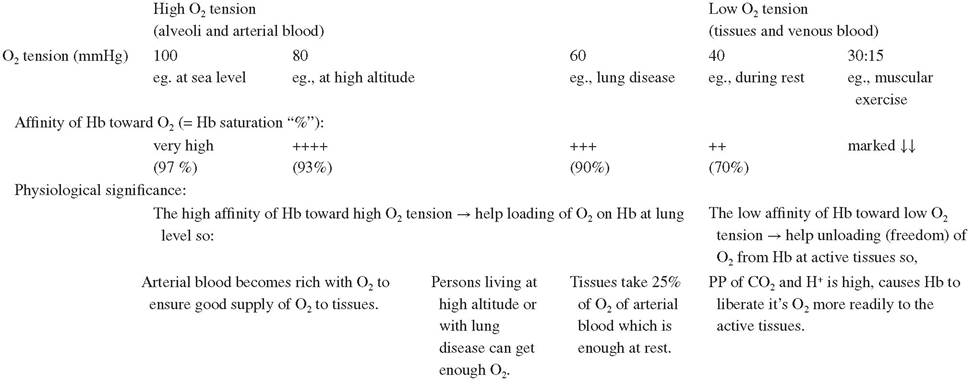
• Upper (horizontal) segment where affinity of Hb towards high O2 tension is high.
• Lower (vertical) segment where affinity of Hb towards low O2 tension is low
17.3.1.10 Physiological Significance of the S-shape of O2 - Dissociation Curve
17.3.1.11 Causes of S-shape of O2 Dissociation Curve of Blood Hb
1. Saturation of blood Hb occurs in steps, forming intermediate compounds:
(Hb4)O2 → (Hb4)O4 → (Hb4)O6 → (Hb4)O8
(N.B.: Hb is made up of 4 subunits)
2. If all Hb is (Hb4)O2, the curve will be a rectangular hyperbola (like that of myo Hb).
17.3.1.12 Factors Affecting O2 Dissociation Curve
| Right Factors shifting the curve to → Left | ||
| CO2 tension | increase (e.g. muscular exercise). | decrease (e.g. during sleep) |
| H+ | increase (e.g. diabetes mellitus) | decrease (e.g. high altitude) |
| blood temp. | increase (e.g. fever) | decrease (e.g. during sleep) |
| Hb conc. | increase (e.g. polycythaemia) | decrease (e.g. anaemia) |
17.3.1.13 O2 Dissociation Curve of
Myoglobin "(Hb4) O2"
Differences between:
Blood Hb Muscle Hb
It has four iron atoms, each It has one iron atom which can combine can combine with one O2 with one O2 molecule → (Hb1)O2
molecule (2 oxygen atoms)
→ (Hb4)Os
Shape of O2 dissociation curve of myo Hb: Rectangular hyperbola, i.e.
1. Remains horizontal (at high O2 tension) → myo Hb does not give up its O2 easily.
2. Then, suddenly descends vertically (at very low O2 tension, e.g., severe muscular exercise) → myo Hb gives its O2 easily (as blood Hb has given most of its O2).
N.B.: After muscular exercise, myoglobin (myo Hb) absorbs O2 from blood to replenish O2 store again.
17.3.2