Changes in Ventilation Can Rapidly Change Carbon Dioxide Tension and Therefore Alter pH
As blood flows through the tissues, CO2 diffuses into the plasma and the erythrocytes (red blood cells), where carbonic acid forms and then dissociates into hydrogen and bicarbonate ions:

Because the initial concentration of HCOf in the blood is greater than that of H2CO3, the relative increase in the concentration of H2CO3 is greater than the increase in the concentration of HCOf, and thus the [ HCO3-]/] H2CO3] ratio (i.e., ∣HCOf∕0.03 ∙ Pco2]) is decreased; consequently, pH decreases.
In the lungs, CO2 leaves the blood, and the pH increases again. For these reasons, venous blood is more acidic than arterial blood. Normally, the lungs eliminate CO2 as fast as the tissues produce it, so the Paco2 and pH of arterial blood remain relatively constant.The lungs can cause rapid changes in blood pH by increasing or decreasing the elimination of CO2. When ventilation increases in relation to CO2 production (hyperventilation), Paco2 decreases, the ∣HCOf∕0.03 ∙ Pa< o2∣ ratio increases, and pH increases. Conversely, when ventilation decreases in relation to CO2 production (hypoventilation), PaCO2 increases, IHCO370.03 ∙ Paco2] decreases, and pH decreases. Figure 52-3
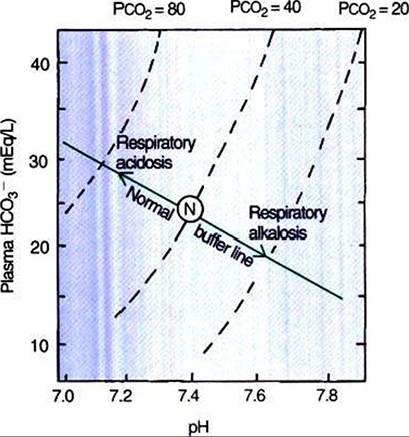
FIGURE 52-3 A pH-bicarbonate diagram showing the effect of increasing and decreasing carbon dioxide tension (Pco2) on pH and bicarbonate (HCO3 ) concentration. As Pco2 increases or decreases, the changes in pH and bicarbonate concentration are predicted by the normal buffer line.
/V, Normal arterial blood composition.
shows how the concentration of HCO3 and the pH change as the Pco2 of the blood increases or decreases.