CHARACTERISTICS OF RUMINANT DIGESTION
1. What are the four phases of the rumination cycle?
2. How is regurgitation accomplished?
3. How many chews might be associated with remastication of a roughage bolus?
4.
How does diet influence rumination time?5. What are the two principal gases produced during ruminant fermentation? Which one predominates? What is the rate of gas production?
6. What is the stimulus for eructation and where are the receptors located for its detection?
7. What are the two types of bloat and how are they differentiated?
8. How are the eructation receptors related to the condition known as bloat?
9. Is all of the eructated gas expelled into the environment? If not, how is it directed elsewhere?
0. How do off-flavors occur in milk?
In addition to the mechanical activities of the ruminant stomach described above, fermentation and the digestive process are facilitated by rumination and eructation.
Rumination
The process of bringing food material back from the ruminant stomach to the mouth for further mastication is known as rumination. Rumination is a cycle of activity composed of four phases: (1) regurgitation, (2) remastication, (3) resalivation, and (4) redeglutition. It is a reflex initiated by mechanical stimulation of receptors in the mucosa of the reticulum and rumen in the area of the cardia.
The rumination cycle begins with regurgitation of a food mass bolus. Regurgitation is accomplished by taking a breath (inspiration) with a closed glottis (opening to the trachea). The thoracic cavity enlarges without lung inflation and the intrapleural pressure decreases. The lowered intrapleural pressure is accompanied by a similar lowering of pressure in the mediastinal space and in the organs located within it (e.g., the esophagus, as it relates to regurgitation). The cardia (submerged in mixed rumen content) opens and, because of the lower pressure within the esophagus, the rumen content is drawn into the esophagus.
Reverse peristalsis is initiated in the esophagus and the food mass bolus is quickly carried to the mouth. The passage of the food bolus can be observed on the left side of the neck. The reticulum contracts just before regurgitation to ensure a rumen mixture in the region of the cardia. It also aids in clearing the cardia of recently swallowed boluses.Immediately after the regurgitated bolus arrives in the mouth, the liquid is squeezed from it and swallowed. Remastication and resalivation occur simultaneously, and remastication is thorough and deliberate. The number of chews given to each bolus varies depending on diet. For example, an allroughage diet is remasticated more thoroughly and can be chewed 100 or more times before swallowing. A cow can secrete from 100 to 200 L (25 to 50 gal) of saliva per 24 hours. During remastication, saliva might be swallowed two or three times. Redeglutition (reswallowing of a bolus) occurs at an appropriate time and the next cycle of rumination begins in about,5 seconds. Actual tracings showing the sequence of several regurgitation events are shown in Figure 12-41.
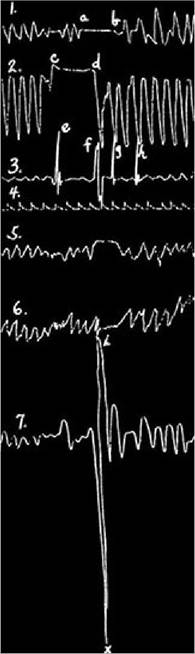
■ FIGURE 12-41 Tracings showing the mechanism of regurgitation in rumination. The writing points were vertically placed. The cow regurgitated at X. 1. Movements of air in the nostrils. Note closure of the glottis from a to b. 2. Movements of the jaw in mastication. Note the pause from c to d. 3. Movements of boluses in the cervical part of the esophagus: e, the masticated bolus; f, the regurgitated bolus; g, h, the swallowed liquid pressed out of the regurgitated bolus. 4. Time tracing showing 1-second intervals. 5. Movements of the thoracic wall. 6. Rectal pressure. It is not elevated during regurgitation. 7. Pressure changes in the trachea. A sharp decrease coincident with regurgitation is seen. The increase in pressure as it is caused by the momentum of the liquid (bromoform) used in the recording manometer.
(From Bergman HD, Dukes HH. An experimental study of the mechanism of regurgitation in rumination. J Am Vet Med Assoc. 1926; 69: 600.)The time spent in rumination each day varies with species and diet. Generally, the coarseness of the ration influences the time for rumination - cattle on a hay diet average about 8 h/day. All of the rumination is not done at one time, but is spread out into periods (e.g., up to 14 periods/24 h), with the periods being distributed rather evenly. Rumination time in sheep can be reduced from 9 to 5 h/day by changing the ration from long or chopped dried grass to ground dried grass. When only concentrates are fed, rumination time in sheep can be reduced to about 2½ h/day.
Gas Production and Eructation
The gases produced in the rumen as a result of fermentation are mainly carbon dioxide and methane. Nitrogen, oxygen, and hydrogen might be present in trace amounts, but only briefly, because they are intermediaries for other reactions. Carbon dioxide is produced during the fermentation of carbohydrates and the deamination of amino acids. Carbon dioxide can also be produced from salivary bicarbonate when it neutralizes the fatty acids produced from microbial fermentation of lipids. Methane is formed by the reduction of carbon dioxide by methane-producing bacteria. In cattle, carbon dioxide composes about 60% to 70% of the rumen gas and methane composes about 30% to 40%. The volume of gas produced in the ruminoreticulum of a dairy cow is about 0.5 to 1 L/min. It is not known how much gas is absorbed into the blood and lymph across the wall of the rumen and reticulum, but it is thought that most of the carbon dioxide and methane produced in the stomach is eliminated by eructation.
Eructation is the process by which gas from the forestomach is removed by way of the esophagus to the pharynx. Eructation occurs about once each minute. An eructation center exists in the medulla that receives afferent fibers from mechanoreceptors located in the dorsal sac of the rumen and around the cardia.
The primary stimulus for eructation is the presence of gas in the dorsal sac. If gas is artificially placed into the dorsal rumen, the frequency and volume of eructation increases.The normal occurrence of eructation requires that the cardia be clear of any ingesta. The cardia is reflexively closed when in contact with liquid rumen contents. Conditions that clear the cardia occur when the dorsally located gas bubble is moved cranially and ventrally toward the cardia by simultaneous contractions in the rumen of the dorsal sac, cranial pillar, and caudal pillar. At the same time, the reticulum relaxes to accommodate the forward-moving rumen content (see Figure 12-37).
A similar expulsion of gas from the stomach in humans produces a sound; the process is characteristically referred to as a belch. Such a sound does not accompany eructation in ruminants. This might have evolved as a protective measure for ruminants in their natural environment so that their whereabouts would be less readily discovered by predators. The force of evacuation is lessened because a nasopharyngeal sphincter (in the pharynx) contracts, which assists in directing part of the eructated gas into the trachea. Subsequent inspiration moves eructated gas into the lungs. It is thought that over half of the eructated gas is directed into the lungs rather than being expelled through the nose to the outside. The inhaled carbon dioxide and methane provide a source of carbon to be reused in biochemical reactions. Labeled carbon in the form of 14CO2 that was inhaled in this manner has been found to appear in plasma and other body fluids (Figure 12-42).
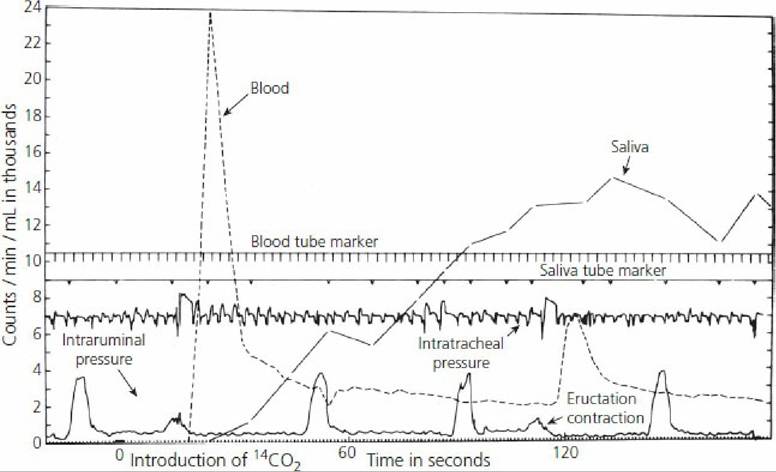
■ FIGURE 12-42 Radioactivity in blood and saliva of the goat after intraruminal insufflation with CO2. (From Dougherty RW, Mullinax CH, Allison MJ. Physiological disposition of 14C-labeled rumen gas in sheep and goats. Am J Physiol. 1964; 207: 1185.)
Flavors that appear in milk from certain foods (e.g., wild onion, beet tops) are sometimes called off- flavors. They arise as volatile substances from rumen fermentation and become part of the eructated gas. The characteristic flavors get into the milk only if they are inhaled when eructated. When the eructated gas containing the off-flavor is experimentally directed away from the pharynx by a tracheal fistula, its inhalation is prevented and the off-flavor in milk does not occur.
■