Chemical Senses
Chemical senses are those that detect particular molecules in the external or internal environment. Chemical senses that detect molecules outside the body include gustation (taste) and olfaction (smell).
Within the body, the chemical senses include the detection of blood pH and carbon dioxide concentration. These latter afferents are associated with autonomic reflexes and do not project to the cerebral cortex for perception.Gustation
Taste, or gustation, is the modality associated with dissolved substances contacting specialized receptor cells on the tongue and throat region. The receptors, simply called taste cells, are arranged in a group with supporting cells, a cluster that constitutes the taste bud (Fig. 11-4). Taste buds are not distributed evenly on the surface of the tongue; they are confined to specific forms of papillae (tiny projections), the vallate, foliate, and fungiform papillae, which are found on the tongue (the greatest number), soft palate, parts of the pharynx, and epiglottis of the larynx.
sensory nerve fibers subserving taste are distributed to the rostral two-thirds of the tongue by a branch of the facial nerve, the chorda tympani. Taste in the caudal third of the tongue is conveyed by fibers of the glossopharyngeal nerve. somatic sensations (heat, cold, touch, pain) from the tongue are conveyed by branches
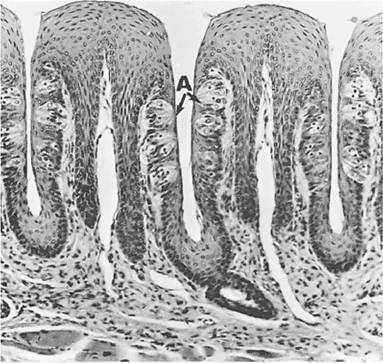
Figure 11-4. Photomicrograph of a taste bud. Individual cells include taste cells and other non-neural supportive cells. (Micrograph courtesy of Dr. sue Kinnamon, Colorado state University, Fort Collins, CO.)
of the trigeminal and glossopharyngeal nerves. It is likely that taste buds on areas other than the tongue are innervated by the vagus nerve.
Traditionally, four basic taste sensations have been identified.
These are sweet, salt, bitter, and sour. Individual taste cells have membrane receptor physiology designed to detect the chemical substances associated with these tastes. The more complex sensory experiences that we normally associate with taste (for example, the flavors that we detect when we distinguish between an apple and a carrot) are created primarily from stimulation of olfactory (smell) receptors in combination with the basic taste modalities. For them to stimulate taste cells, chemicals must be in solution. Dissolution of substances so that they can be tasted is an important function of saliva.In addition to the four basic tastes, a fifth taste modality with its own specific taste cell receptor has been identified. This taste, experienced when the amino acid glutamate is present, imparts a savory quality to foodstuffs. Because this taste modality was first described by Japanese researchers, it is known by the Japanese word for savory or delicious: umami. It is the presence of the umami taste receptor that explains the enhanced flavor of foods when monosodium glutamate (MSG) is added.
Olfaction
Olfaction is the sense of smell. Olfactory sensory neurons are scattered among supporting cells throughout the olfactory mucosa in the dorsocaudal part of the nasal cavity (Fig. 11-5). The apex of each olfactory neuron bears a single dendrite with a tuft of several fine hairlike projections, which bear the chemical receptors for the sense of smell. An axon from each olfactory neuron passes through the cribriform plate of the ethmoid bone; the mass of fine fibers thus entering the cranial vault collectively constitutes the olfactory nerve. These fibers synapse within the olfactory bulb on neurons whose central processes make up the olfactory tracts of the brain.
Neural connections within the olfactory parts of the brain are complex. Olfaction is the only sensory modality that is not routed through the thalamus before reaching conscious perception at a primary sensory cortex.
Olfaction is also known to have profound connections to the limbic lobe, the part of the brain that generates emotional and autonomic behaviors. Smells, therefore, are uniquely capable of eliciting emotions and behaviors.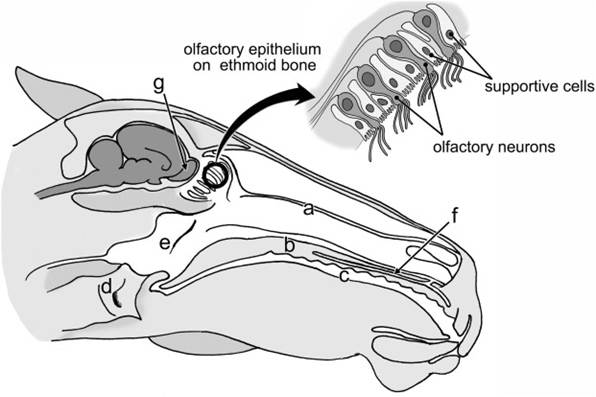
Figure 11-5. Olfactory system. The view is of the equine head in sagittal section. Inset shows a microscopic view of the olfactory epithelium, which covers the ethmoid bone within the caudodorsal nasal cavity. a, nasal cavity; b, palate; c, oral cavity; d, larynx; e, pharynx; f, vomeronasal organ; g, olfactory bulb of brain.
There is a subset of olfactory sensory neurons outside the olfactory epithelium that innervate the mucosa of the vomeronasal organ, a diverticulum of the nasal cavity in the hard palate. These olfactory neurons appear to be receptors for pheromones, chemical substances that can influence the behavior of other individuals. Pheromones are likely especially important in reproductive behaviors. in spite of vigorous research efforts, no human pheromones have yet been unequivocally identified.