Clinical Conditions
Amongst the domestic animals there are two examples of clinical conditions that primarily affect the autonomic nervous system; they are called dysautonomias. In the horse the disease became known as grass sickness due to the apparent association with
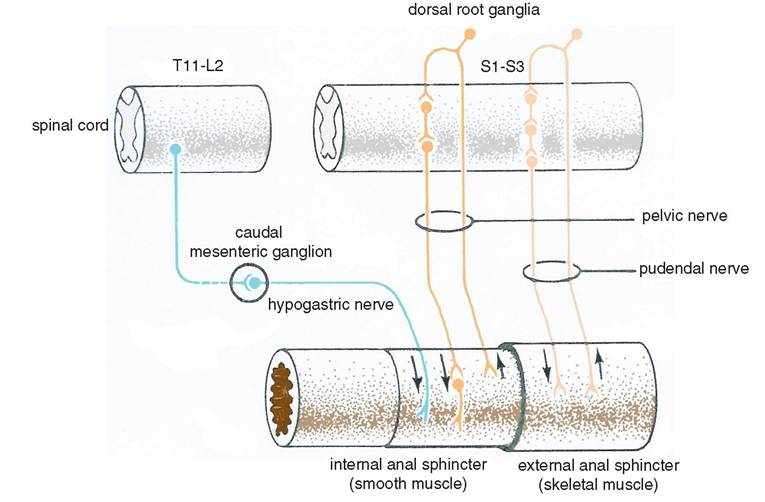
Figure 11.7 Diagram of the reflexive innervation of the anal sphincters of the dog.
The internal sphincter consists of smooth muscle. The external sphincter is skeletal muscle.grazing on lush grass in Spring or Autumn. It is a serious disease with a high mortality rate. The clinical signs include abdominal pain and distension, salivation, inappetance and tachycardia.
Dysautonomia in cats, also known as Key-Gaskell syndrome, is characterised by widespread degeneration of both pre- and postganglionic neurons of the sympathetic and parasympathetic systems. The clinical signs in affected cats include anorexia, constipation, abdominal distension, pupillary dilatation, reduced tear secretion, protrusion of the third eyelid, atony of the urinary bladder, regulation of smooth muscle and secretion of glands. Dysautonomia has recently been reported in a number of species including young dogs but occurs primarily in cats.
In the domestic animals the principal clinical situation that involves the nerves of the abdominal/pelvic organs belongs to the lumbosacral spinal cord. In addition, the species most likely to suffer such a such a disorder are the dog and cat. From the T11 to the S1 vertebrae there is a possibility of a protrusion of an intervertebral disc. Chondrodystrophoid dog breeds (e.g. Dachshund, Basset Hound and Corgi) are particularly prone to this condition because their discs undergo premature degeneration. The clinical signs of a disc protrusion usually involve disturbance of the GSA and GSE pathways especially supplying the hindlimbs. It is perhaps surprising that the sympathetic pathways do not show more evidence of their inevitable involvement.
Vagus indigestion in ruminants was originally thought to be the result of lesions actually involving the vagus nerve. However, this chronic ruminoreticular distention is now established not to involve the vagus nerve directly. Any cause of ruminoreticular distention can develop the clinical signs of vagal indigestion although actual damage of the vagus nerve is rarely present.
11.5