To coordinate posture and locomotion, the brain needs to know not only what movement it intends to command, but also the orientation of the body and what movement the body is actually performing.
Chapter 8 describes the muscle spindle, an important source of information for the brain about body position and movement. Another important source of information is the vestibular system.
This bilateral receptor system is located in the inner ear and informs the brain about the position and motion of the head in space.The vestibular system provides the organism with its sense of equilibrium or balance. It supplies information about the body’s orientation or tilt with respect to gravity and about acceleration of the body through space. It does this by detecting (1) static tilt of the head (e.g., the head is held stationary at 5 degrees from vertical), (2) linear acceleration of the head (e.g., the head accelerates in a straight line as an organism begins to run or as your elevator begins to rise), and (3) rotary acceleration of the head (e.g., the head accelerates in a circular fashion as an organism begins to turn its head toward a target or as someone begins to spin you in an office chair). This information is used most often to make automatic, unconscious postural adjustments to keep the organism from falling over as a result of self-imposed or environmentally imposed changes in body orientation. The vestibular system also helps to keep the eyes fixated on a relevant target in the face of such changes in body orientation.
The vestibular system is a common site of pathological lesions. In most veterinary species, lesions of the vestibular system cause a syndrome characterized by head tilt, compulsive rotary movements such as circling or rolling, and spontaneous nystagmus, which is an oscillating movement of the eyes.
To understand how such clinical signs arise and the importance of the vestibular system to the physiology of movement, you need to study its anatomy and function first.
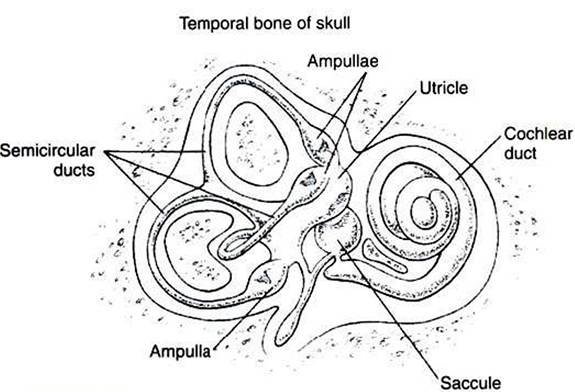
FIGURE 11-1 - The bilateral inner ear contains receptor systems for hearing (cochlea) and for detecting the orientation and acceleration/deceleration of the head (vestibular system).The peripheral vestibular apparatus on each side of the head contains a utricle, a saccule, and three semicircular ducts, each with an ampulla at one end.