A Countercurrent, Osmotic-Multiplier System May Increase the Osmolality of Blood at the Tips of the Villi, Further Promoting Absorption of Water into the Blood
The villous vascular system consists of an arteriole rising up the central portion of the villi and dividing at the tip into many capillaries, which course down the outer portion of the villous stroma between the mucosa and artery.
This arrangement provides for direct countercurrent flow of blood; that is, blood coming down the venules passes close to blood flowing in the opposite direction up the arteriole. Because blood in the venules contains absorbed nutrients, its osmolarity could be expected to be slightly higher than that of blood entering the villi in the arteriole. This slight difference in osmolarity can be multiplied and perpetuated by the countercurrent flow characteristics of the arterial and venous blood supplies. These conditions create a potential for the creation of an osmotic gradient along the villi; some researchers calculate osmolalities near the tips of the villi to be as high as 600 mθsm, approximately twice that of blood entering the base of the villi. (The characteristics of a countercurrent osmotic multiplier are further explained in Chapter 43 in reference to the renal loop of Henle.) The existence of the villous counter-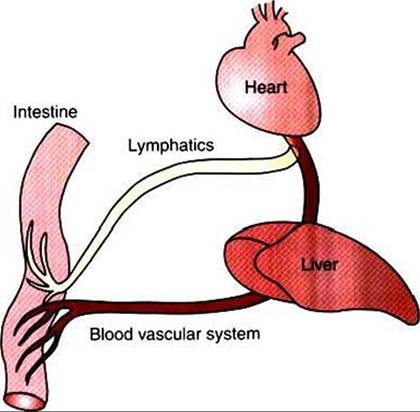
FlGURE 30-23 All blood exiting the gut flows through the liver before returning to the heart. Lymphatic drainage from the gut bypasses the liver, entering the bloodstream through the thoracic duct.
current osmotic multiplier is still somewhat controversial, and its presence may depend on the species in question. The effect of this osmotic-multiplier system would be to accentuate all the osmotic forces that result in the movement of water from lumen to lateral spaces and from lateral spaces to capillaries.
More on the topic A Countercurrent, Osmotic-Multiplier System May Increase the Osmolality of Blood at the Tips of the Villi, Further Promoting Absorption of Water into the Blood:
-
Veterinarian -