Descent of the Testis
In both male and female fetuses, the gonads develop in the sublumbar region immediately caudal to the kidneys. In the female animal, the ovaries remain in the abdominal cavity near their origin; but in the male animal, the testes travel (descend) a considerable distance from their point of origin to the scrotum.
The environment of the scrotum features a temperature a few degrees lower than that of the normal body temperature; this lower temperature is favorable to spermatogenesis.The descent of the testis normally is complete by birth or soon after (Fig. 24-6). It is guided on its journey by the fibrous gubernaculum, a cordlike structure that initially extends from the testis through the inguinal canal to the skin in the region that will become the scrotum. As the fetus grows, the gubernaculum guides the testis from the abdominal cavity into the scrotum. The gubernaculum lacks contractile elements, so it does not in fact “pull” the testis into the scrotum. Rather, the rapid and dramatic growth of the fetus ultimately displaces the tethered testis from the abdomen to its extra-abdominal location.
The testis begins its development covered (as are all abdominal organs) with peritoneum. As it descends into the scrotum, it pushes the parietal peritoneum ahead of it, thus acquiring a second layer of serosa. This second outer layer of peritoneum (the parietal layer of the vaginal tunic) is continuous with the parietal peritoneum at the internal inguinal ring and lies deep to the deep fascia of the scrotum, with which it blends (Fig. 24-5). The testis itself is invested with a second layer, the visceral layer of the vaginal tunic. The mesorchium is a delicate double layer of peritoneum connecting the visceral and parietal layers of tunica vaginalis, just as mesentery connects parietal and visceral
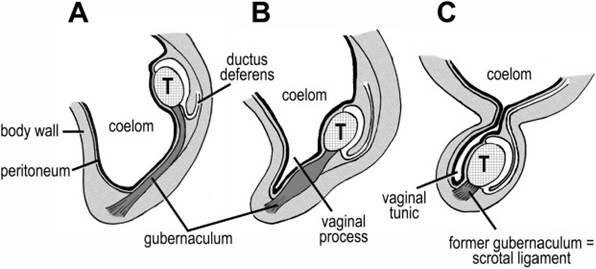
Figure 24-6.
Descent of the testis. The embryonic coelom will become the abdominal and pelvic cavities.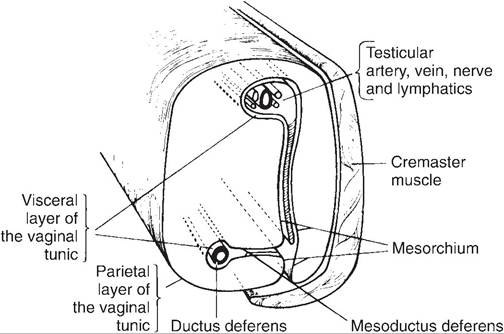
Figure 24-7. cross-section of the spermatic cord.
layers of abdominal peritoneum. It gives off an additional reflection of serosa, the mesoductus deferens that surrounds the ductus deferens within the spermatic cord (Fig. 24-7).
A testis that fails to descend into the scrotum is called a cryptorchid testis, and the animal with such a condition is called a cryptorchid (Greek crypt, hidden; orcho, testicle). In most species, the testes descend into the scrotum by birth or shortly thereafter. An animal in which the testis descends into the inguinal canal but not into the scrotum is called a “high flanker.” A cryptorchid with both testes retained in the abdominal cavity is likely to be sterile, since spermatogenesis does not occur normally unless the testis is cooler than core body temperature, a condition provided by the scrotum. However, the relatively high temperature of the abdomen does not interfere with the production of testosterone, so the cryptorchid has all the behaviors and appearance of a normal male, except that no testes are evident and no normal spermatozoa are produced. A unilateral cryptorchid (one testis retained, one descended) is fertile insofar as the descended testis produces normal spermatozoa; however, the tendency toward cryptorchidism is likely heritable. Additionally, testes retained in the abdomen develop testicular tumors at a higher rate than scrotal testes. For these reasons, it is recommended that cryptorchid animals be castrated, including removal of the retained testicle or testicles.
Table 24-1. Common Terms for Male Animals
| Species | Intact Adult Male | Castrated Male |
| Horse | Stallion | Gelding |
| Ox | Bull | Steer |
| Pig | Boar | Barrow |
| Sheep | Ram | Wether |
| Goat | Buck (billy) | Wether |
| Chicken | Rooster | Capon |