Inguinal Canal
The inguinal canal is a passage from the abdominal cavity to the exterior of the body that extends from the deep inguinal ring to the superficial inguinal ring (Fig. 24-5). The deep (internal) inguinal ring is a space or potential space between the caudal border of the internal abdominal oblique muscle and the deep face of the aponeurosis (flat tendon) of the external abdominal oblique muscle.
The superficial (external) inguinal ring is merely a slit in the aponeurosis of the external abdominal oblique muscle. in addition to the spermatic cord, the canal allows passage of the external pudendal artery and a sensory nerve that serves the inguinal region of the abdominal wall. This accounts for the existence of the inguinal canal in female animals.The inguinal canal is normally a potential space, large enough only to permit passage of the spermatic cord and inguinal vessels and nerves. If the internal ring and canal are too capacious, a loop of intestine may pass through the canal into the scrotum, producing an inguinal hernia.
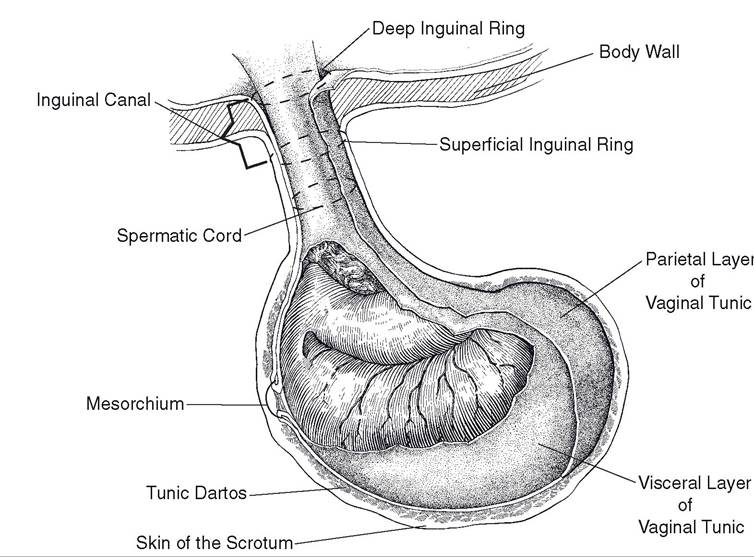
Figure 24-5. Relation of testis to peritoneal investments. The spermatic cord, comprising ductus deferens, blood vessels, and nerves, passes through the abdominal body wall via the inguinal canal. It, the canal, and the testis are lined with extensions of the peritoneum.