DIGESTIVE SYSTEM
The reptile digestive tract is much shorter than that in birds and mammals and can vary from the simple tract of carnivorous species to the larger colons and cecum of herbivores.
Carnivores use primarily fats and protein as food sources while herbivores utilize soluble carbohydrate and fermented fiber. Omnivores require a mix of fat, protein, and carbohydrate.Dentition
Reptiles
27
Like mammals, reptile teeth are composed of enamel, dentine, and cement but lack a periodontal membrane. Three types of teeth exist, depending on feeding habits of the reptile: acrodont, pleurodont and thecodont (Table 2.2) (Fig. 2.9). Acrodonts, found in such lizards as water dragons and chameleons, have teeth attached to the crest of the bone. Pleurodonts have an eroded lingual side and are attached to a higher sided labial wall. (This is common in snakes and lizards like iguanas). Thecodonts are teeth embedded in a deep bony socket but, unlike in mammals, there is no periodontal membrane. This type is restricted only to crocodiles (Edmund 1970; King 1996a).
Reptile teeth are resorbed and replaced at a rapid rate throughout life. This is calledpolyphyodonty and is essential as their simple structure means frequent replacement is necessary to keep them sharp. In many cases the new tooth lies lingual to the old tooth and replacement occurs in a wave-like pattern from the back to the front. However, many acrodont reptiles cease producing new teeth after a
| Table 2.2 Reptile dentition (Edmund 1970) | ||
| Type of dentition | Site of attachment | Examples |
| Acrodont | Crest of bone | Some lizards (water dragon, chameleons) |
| Pleurodont | Labial wall | Snakes, some lizards (iguanas) |
| Thecodont | Deep bony socket (no periodontal membrane) | Crocodiles |
(See Fig.
2.9 for illustrations)
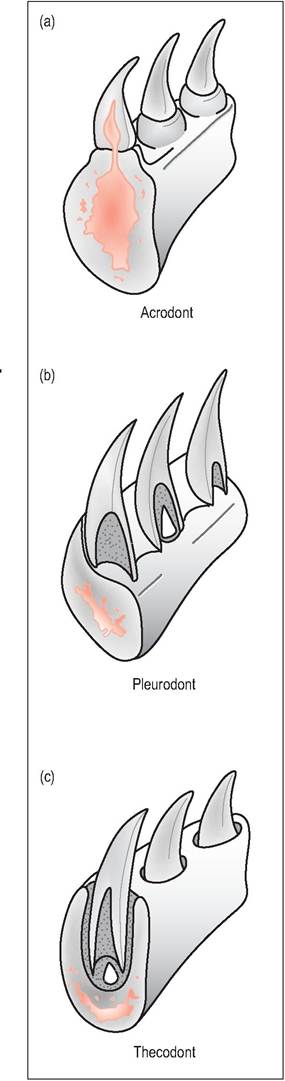
Figure 2.9 • Reptile dentition.
(a) Acrodont
(b) Pleurodont
(c) Thecodont
certain time, using the remaining teeth and jaw margins after these have been worn away (Edmund 1970).
Egg tooth
In snakes and lizards the egg tooth is modified from the normal teeth of the premaxilla and serves to rupture the embryonic membranes and shell in oviparous reptiles. In chelonians and crocodiles this is composed only of horny tissue and is called the egg caruncle.
Gastrointestinal tract
The absence of lips or flexible forelimbs, as in birds, means that reptiles rely on their jaw, and sometimes the tongue, to apprehend food. Mastication varies between species but is far less than in mammals. Reptiles have also evolved a complex system of oral secretory glands (e.g., palatine, sublingual, mandibular) to help them lubricate their prey. Many snake species have modified these glands into venom glands like Duvernoy 's gland to help immobilize the prey and prevent damage to the delicate skull.
The stomach is small and contains hydrochloric acid, which prevents putrefaction, kills live prey, and aids digestion by decalcifying bone (Skoczylas 1978). Gastroliths are often seen on radiographs but, except in crocodiles, these may be accidentally ingested and play no role in normal digestion (Barten 1996). The liver is fairly large and in snakes it is very elongated. A gall bladder is usually present. Biliverdin is the main bile pigment; reptiles lack the enzyme biliverdin reductase which produces bilirubin. A cecum is prominent in herbivorous reptiles like the tortoise but is absent in most snakes. Reptiles do not have subcutaneous fat but store fat as “fat bodies” in the caudal celom or in the tail.
Cloaca
The rectum ends in a pouch called the cloaca (the Latin word for sewer). This consists of the anterior chamber called the copradeum, that collects the feces, a middle chamber called the urodeum where the ureters and reproductive system enter, and a posterior chamber called the proctodeum where all the wastes collect prior to excretion. These cloacal chambers are partially separated by transverse mucosal folds.
In desert species the cloaca plays an important part in water conservation. Food is often held in the lower gut for a minimum period for essential water absorption from excreta and urinary waste in the colon or cloaca. The final feces voided contains only the indigestible material like fur, hair, beaks, claws, eggshells, chitin remnants, and partially digested grasses (Bellairs 1969c).
Digestion of chitin
The exoskeleton of insects is composed of hard chitin, which is a polymer of acetylglucosamine and quite resistant to many chemicals. Insectivorous reptiles however have chitinolytic enzymes. Chitinase is secreted by the stomach and pancreas and occurs only in chitin eating species. This is the most important enzyme as it breaks open the exoskeleton and hydrolyzes it firstly into chitobiose and chitotriose (Skoczylas 1978). This in turn is acted on by the enzyme chitobiase, which breaks it into free acetylglucosamine. As this enzyme is not present in all insectivores it may play a lesser role in digestion. The rate of digestion will depend on the hardness of the exoskeleton (Skoczylas 1978).
Digestion of plants
Plants contain a lot of indigestible material like cellulose and lignin and are less susceptible to normal digestive juices. Hence, other methods like mechanical breakdown and symbiotic microorganisms have to be used. Herbivores use their teeth and jaw to mechanically grind their food and have microorganisms in their large intestine to ferment the food and break it down into volatile fatty acids. To facilitate this process they have a larger colon (in both length and volume) with a longer transit time than carnivorous species (King 1996c; Lichtenbelt 1992; Troyer 1984). Fiber is essential in the diet for gut motility. Herbivorous species also tend to be larger than equivalent carnivorous species and often show preference for young growing foliage, which has higher protein content and is more digestible. Digestive efficiency is, however, much lower than in carnivores (King 1996b).
CLINICAL NOTE
Gut transit time is slower in herbivores (King 1996c) and even slower in immunocompromised or sick animals. This is because the food is not masticated as well as in herbivorous mammals and the large colonic area slows the passage of ingesta down. The oral route of medication may therefore not be successful in very debilitated reptiles.
Feeding frequency
Unlike endotherms, which need to provide energy for body temperature maintenance, reptiles can survive on a fraction of the food input of birds and mammals (Bennett & Nagy 1977). Their low metabolic rate and high food conversion efficiency means they need much longer periods between feeds. Factors influencing feeding rates are temperature, size, reproductive status, health and season. Large carnivores such as pythons can last months between each feed. Reptiles undergoing ecdysis become anorexic before and during the shed.
Rate of digestion
The rate of digestion is related to temperature and low temperatures slow down gastrointestinal motility, secretion of digestive juices and metabolism (King 1996c). Digestion is sluggish between 10 and 15° C and stops at temperatures below 7° C. Transit time also depends on the composition of food, the length and activity of the gut, and the physical health of the animal. Herbivorous reptiles have longer gut transit times, often taking several days to digest food (King 1996c).
CLINICAL NOTE
At low temperatures, putrefaction and not digestion will take place. This is why hibernating species must be fasted before hibernating. As regurgitation is also the safety valve against putrefaction, this is why many reptiles (especially snakes) regurgitate at suboptimal temperatures. It is also important to make sure that tube-fed reptiles are kept at their PBT for digestion.