URINARY SYSTEM
The kidneys are located in the caudal celom. They are termed metanephric because they derive from the posterior embryo. Only chelonians and some lizards have a urinary bladder, and this is connected to the cloaca by a short urethra.
Urine flows from the ureters into the cloaca and then into the bladder. Species with no bladder reflux the urine into the distal colon for water absorption (Davis et al. 1976). The bladder is often a reservoir of fluid in tortoises and, being osmotically permeable, substantial water can be reabsorbed from it in times of drought. Aquatic turtles use their bladder to help reabsorb sodium and as a buoyancy aid (Bentley 1976; Fox 1977; Minnich 1982).Reptile kidneys lack a loop of Henle, pelvis, and pyramids. The reptile nephron consists of a glomerulus, a long, thick proximal convoluted tubule, a short, thin intermediate segment, and a shorter distal tubule. In male snakes and lizards the terminal segment of the kidney has become a sexual segment. This regresses after castration and is therefore under androgen control (Palmer et al. 1997).
Osmoregulation
Reptiles gain water mainly by consuming food and water; unlike amphibians, most reptiles do drink. Tortoises and snakes suck up fluids whereas lizards can lap with their tongues. There is also some minor absorption of water through the skin and by condensation in the nasal passages.
Water is lost from the body mainly by evaporation through the skin and mucous membranes but also by respiration, urine and feces. Cutaneous water loss will depend on the amount of skin keratinization and the size of scales. It is more common in desert species where there are high temperatures and low water saturation in the air. Shedding of skin (ecdysis) is also associated with an increased rate of water loss (Bentley 1976; Minnich 1982).
The reptile body mass is 70% water, which is similar to mammals but lower than amphibians’ 75-80% (Bentley 1976).
Total sodium and potassium are also similar to mammals but vary between species and habitat. The reptile kidney removes excess water, salts, and metabolic wastes. The lack of loops of Henle means that reptiles are unable to concentrate urine beyond the osmotic values of blood plasma. This could mean that excretion of solutes could draw copious amounts of water; however, the following methods are used by reptiles to conserve water.METHODS OF WATER CONSERVATION IN REPTILES
• Uric acid
• Cloacal resorption
• Decrease in glomerular filtration rate
• Salt glands
• Renal portal system
Uric acid
Aquatic reptiles excrete ammonia and urea and relatively small amounts of uric acid, as water loss is not crucial. Terrestrial species need to conserve water so they excrete uric acid, which precipitates from solution in the bladder or cloaca to form pasty, white urates. These urates are either potassium or sodium salts depending on whether they are produced by herbivores or carnivores, respectively (Bentley 1976; Dantzler 1976; Minnich 1982).
The advantage of uric acid is that, being insoluble, it can be excreted with minimal water loss. The disadvantage, however, is that unlike humans, reptiles excrete uric acid through the kidney tubules, so dehydration does not stop uric acid excretion. If this builds up in the bloodstream of a reptile with dehydration or renal problems it easily causes gout. Gout results when insoluble uric acid accumulates and precipitates into urate crystals (tophi) that deposit in joints or visceral organs such as the pericardium, liver, and kidney. In can also occur when herbivorous animals like tortoises are fed animal proteins, leading to excess uric acid production and hyperuricemia (Mader 1996) (Fig. 2.10).
CLINICAL NOTE
More than 60% of renal function must be lost in order to get a rise in plasma uric acid, so this is not a very sensitive parameter of renal function. Uric acid levels are also higher post prandially in carnivorous reptiles so fasting is important when testing the blood of such species.
Cloacal/colonic absorption
The cloaca, colon, and urinary bladder of reptiles play an important role in modifying urine produced by the kidneys. Active transport of ions and passive water absorption occurs through the colonic wall. The bladder also actively absorbs sodium but secretes potassium and urates (Bentley 1976; Minnich 1982).
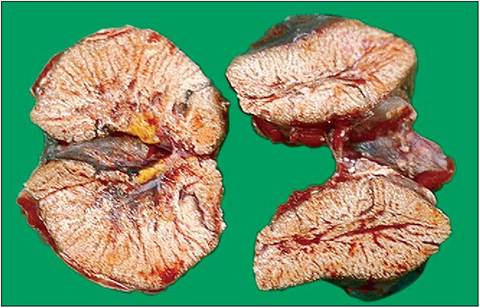
Figure 2.10 • Section of tortoise kidney showing renal gout. Reptiles being uricotelic easily develop gout when dehydrated. Hyperuricemia causes uric acid to precipitate into crystals or tophi in joints or visceral organs, like the kidneys.
CLINICAL NOTE
Collecting a voided or cloacal urine sample is not a true reflection of kidney function, owing to urine from the ureter being modified by cloacal reabsorption. Marine, desert, and most herbivorous reptiles also use salt glands, so even ureteral urine is not a true reflection of their osmoregulation.
Reduction in glomerular filtration rate
When a reptile is dehydrated or has a high salt load arginine vasotocin (reptile antidiuretic hormone) acts to constrict the afferent glomerular arterioles and decrease the glomerular filtration rate (Dantzler 1976). This causes decreased excretion of nitrogenous wastes and sodium, which in species lacking a salt gland leads to problems. Many desert species, however, have incredible abilities to tolerate severe dehydration together with a massive salt load. They can tolerate the elevated osmotic concentration and some lizards can even withstand a loss of water equivalent to 50% body weight (Bentley 1976). The Chuckwalla (Sauromalus obesus) from North Mexico survives without drinking, obtaining water from desert plants. It loses some water by evaporation and via cellulose in the feces and has salt glands to excrete potassium salts.
Salt glands
Reptiles do not have sweat glands or any method of losing salts through the skin. However, many reptiles have an extra renal salt gland to actively excrete potassium and sodium and conserve water. These vary in location but are usually found near the eye or nasal passages. With the exception of tortoises most herbivorous reptiles have salt glands from which they excrete more potassium than sodium. The Galapagos marine iguana (Amblyrhynchus cristatus) has one of the most active salt glands and this enables it to survive on a diet of marine algae (Bentley 1976; Dunson 1976; Minnich 1982).
CLINICAL NOTE