As discussed in Chapter 54, innate immunity offers effective defense against a wide range of pathogens. Key features of innate immunity include (1) rapid response against invading pathogens, (2) nonspecificity, and (3) physical, chemical, and cellular (phagocytic cells, NK cells) barriers.
The response of the innate immune system, however, is not long-lasting and does not induce immunological memory (i.e., ability to recall previous exposure to antigens and respond to these effectively and specifically).
For long-lasting immunity, another arm of the immune system must be activated. This is referred to as acquired immunity, which involves activation of T and B lymphocytes. Antigen- presenting cells (APCs), a part of the innate immune system, play a central role in activating lymphocytes. Activated T lymphocytes (T cells) secrete cytokines that are essential for defense against intracellular pathogens, activation of other cells, and coordination of immune responses. B lymphocytes (B cells) have two main functions: (1) secreting antibodies that bind specifically to the antigen that induced the antibody response and (2) acting as APCs.Before discussing how antigens are presented to specific lymphocytes, it is important to understand the different types
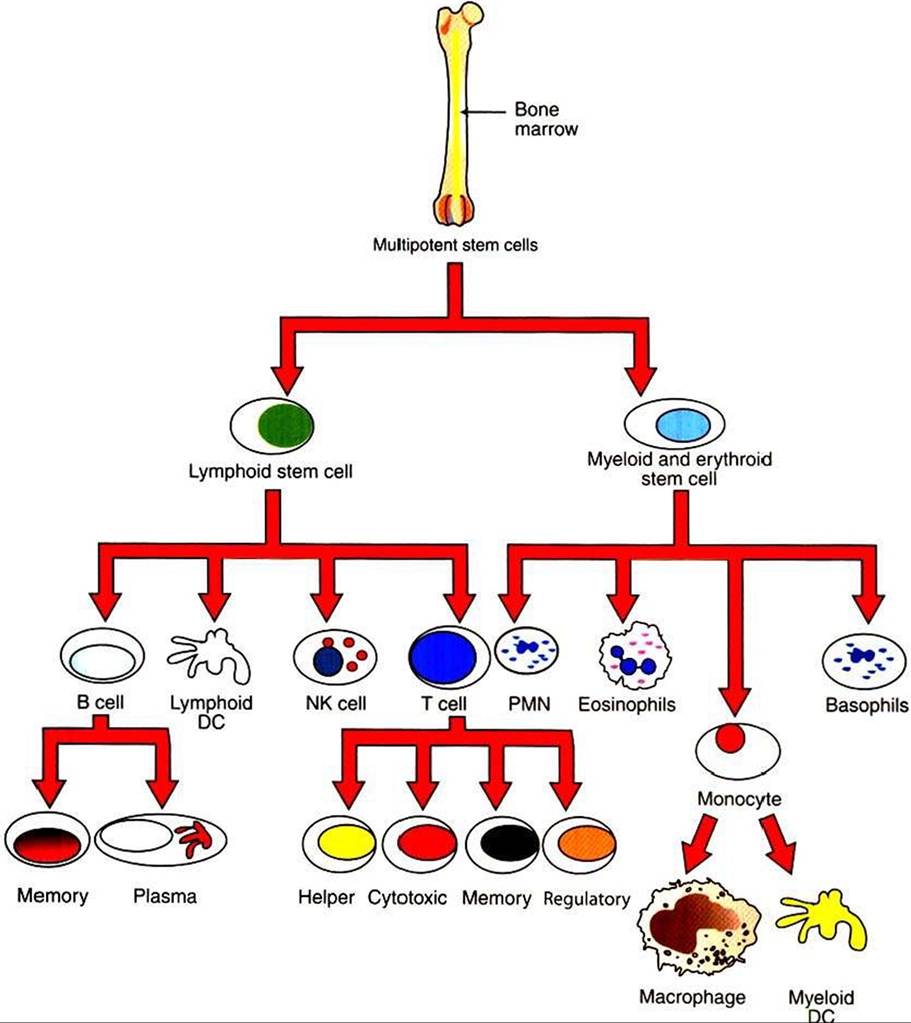
FIGURE 55-1 Lymphopoiesis: development of various types of lymphocytes. DC, Dendritic cell; NK, natural killer; PMN, polymorphonuclear neutrophil leukocytes.
of immune cells (Figure 55-1). Λ1I cells of the immune system are derived from multipotent stem cells that are located primarily in the marrow of long bones. These multipotent stem cells subsequently give rise to primordial stem cells, such as lymphoid stem cells or myeloid stem cells. Myeloid stem cells give rise to monocytes, which mature in tissues to become macrophages or dendritic cells. Lymphoid stem cells give rise to T, B, natural killer (NK),and Iymphoid dendritic cells. Mature cells are found circulating throughout the body but concentrate in the peripheral Iymphoid organs (e.g., lymph nodes, spleen) and gut-associated lymphoid tissues, where most of the complex interactions with antigens take place.
Birds, unlike mammals, have a unique lymphoid organ called the bursa OfFabricius where B cells develop. This round, sac-shaped organ is located above the cloaca. Analogous to the thymus, the bursa consists of lymphocytes embedded in epithelial tissues. Mammals have no precise lymphoid organ that is equivalent to this bursa. Bone marrow and ileal Peyer’s patches are thought to be the principal mammalian organs where B cells develop.