DISTRIBUTION OF BODY WATER
1. How do water and fluid differ from each other?
2. What percent of the body weight is water?
3. What are the two major body water compartments and what percent of the body weight is represented by each?
4.
Define interstitial fluid. What space does it occupy?5. What substance gives interstitial water the characteristics of a gel?
6. Are intravascular fluid and plasma synonymous? Why would plasma volume have a greater value than plasma water?
Total Body Water and Fluid Compartments
The terms “water” and “fluid” are nearly the same but do differ inasmuch as a fluid, as found in the body, contains not only water but also solutes. The measurement of a compartment’s volume usually includes the entire space occupied by the water and solutes. For example, blood plasma is a fluid, but its volume is slightly larger than the space occupied by the water it contains. For practical purposes, the compartments are referred to as fluid compartments because the fluid volume rather than water volume is that which is usually measured.
Total body water (TBW) is the sum of the water contained in arbitrary divisions of its distribution among the intracellular and extracellular compartments. The extracellular compartment can be further divided into interstitial, intravascular, and transcellular compartments.
TBW is variable and depends mostly on the amount of fat in the body. Fat tissue is exceptional in its low water content (10% or less), thus, the total water content of a fat animal will be lower than that of a lean animal. In very lean cattle, about 70% of body weight is water, while in very fat animals, TBW may account for only 40%. The average animal (neither fat nor lean) probably has water equivalent to 60% of its body weight.
Intracellular and Extracellular Fluid
About two-thirds of the body water is found within cells, which is the intracellular fluid (ICF).
The amounts given for percentage of body weight are average values and can vary. All water that is not in cells is considered to be extracellular fluid (ECF), or outside the cells. This includes the interstitial fluid (ISF), intravascular fluid (IVF), and transcellular fluid (TCF). Intravascular fluid is most often referred to as plasma volume (PV). About 92% of the plasma volume is water and the remaining 8% is mostly protein. The divisions of TBW among the compartments are shown in Figure 2-7.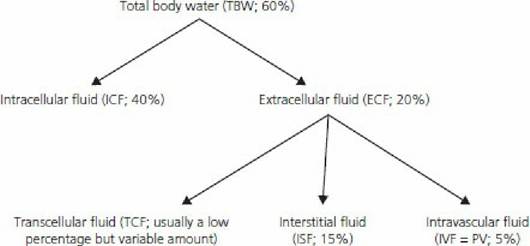
■ FIGURE 2-7 Total body water and its distribution among the fluid compartments.
Interstitial fluid is fluid outside capillaries that immediately surrounds the cells. It is the environment of the cells. It occupies the intercellular space (also called interstitial space and interstitium) along with a number of intercellular substances (e.g., collagen and elastic fibers, fibroblasts, and plasma cells and mast cells). It is important to visualize the location of the interstitial space (Figure 2-8) relative to blood capillaries and body cells, particularly as it relates.to edema (see Chapter 9). In addition to elastic and collagen fibers of the intercellular substance, an amorphous (without definite form or shape) ground substance is present; its principal component is hyaluronic acid. Hyaluronic acid is a highly hydrated gel that holds tissue fluid in its interstices. Because of the gel form, fluid is not observed to flow and accumulate in lower body parts; nor does fluid flow from a cut surface.
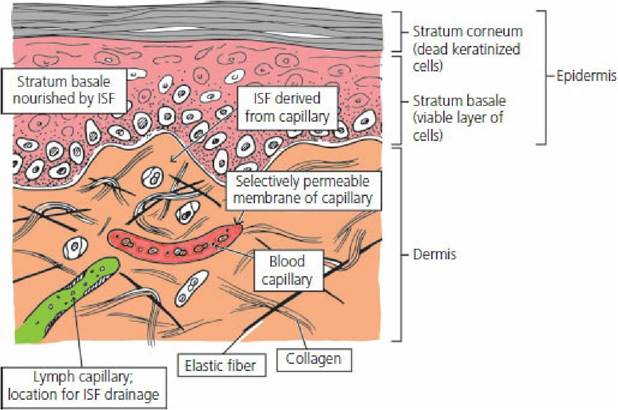
■ FIGURE 2-8 Schematic representation of the outer part of skin from a pig with special emphasis on the interstitial space, the space outside of the capillaries and cells. The fluid of the interstitial space is interstitial fluid (ISF). Hyaluronic acid of the amorphous ground substance gives ISF the characteristics of a gel.
An abnormal increase of ISF in this location is evident in a condition known as edema.Transcellular fluid is the fluid found in body cavities. It includes intraocular fluid, cerebrospinal fluid, synovial fluid, bile, and fluids of the digestive tract. The most plentiful TCF is in the digestive tract, and its amount is greatest in ruminants because of the stomach compartments associated with fermentation.
Water Movement between Fluid Compartments
Water molecules can rapidly penetrate most cell membranes. If an osmotic or hydrostatic pressure gradient exists between body fluid compartments, a shift of water will occur. If no appreciable hydrostatic pressure is involved, the result of water movement will be to equalize the osmoconcentration of the fluid compartments.
The response to an intravascular infusion of water would be to decrease the osmoconcentration of all compartments. This would happen with the intravascular infusion of any hypotonic solution having a lesser effective osmotic pressure than the ICF. Water would diffuse into the ICF compartment causing cellular overhydration. Infusion of a large volume could disrupt normal metabolic function and the condition of overhydration is known as water intoxication.
The infusion of an isotonic solution would become evenly distributed throughout the extracellular and intracellular compartments because no osmoconcentation differences would exist. The infusion of a hypertonic solution would present a greater effective osmotic pressure in the extracellular compartment than in the intracellular compartment and water would diffuse from the cells to the extracellular compartment. The infusion of a hypertonic solution has been useful in the treatment of head injuries to reduce the swelling (volume) often associated with head injuries.
■