ENERGY PRODUCTION
1. What substance is formed from the catabolism of carbohydrates, lipids, and proteins to begin the aerobic stage of energy production via the citric acid cycle?
2. What are the cofactors involved in the transfer of electrons from the citric acid cycle to the electron transport chain?
3.
Where are the electron receptors of the electron transport chain located?4. What is the energy substance produced by oxidative phosphorylation?
5. What is metabolic water?
6. What is the location for oxygen consumption by the body?
Within mitochondria, energy is released from molecules by controlled metabolic oxidation. The aerobic (occurring in the presence of oxygen) stage in the catabolism of carbohydrates, lipids, and proteins begins after the formation of acetyl-Co A from respective glucose, fatty acids, and some amino acids (Figure 1-2). The acetyl-Co A that has been formed undergoes oxidation via the citric acid cycle within the mitochondrial matrix. Oxidation of acetyl groups involves the abstraction of electrons and their transfer to the cofactors nicotinamide adenine dinucleotide (NAD) and flavin adenine dinucleotide (FAD), wherein the cofactors are reduced to NADH and FADH2. The electrons carried by NADH and FADH2 are funneled to the electron transfer chain, a chain of electron acceptors that are an integral part of the inner membrane (the shelf membrane) of the mitochondrion. In the electron flow that follows, adenosine triphosphate (ATP), a high-energy substance, is synthesized from adenosine diphosphate (ADP) in the process of oxidative phosphorylation. Also, NADH and FADH2 are reoxidized and hydrogen ions (H+) combine with oxygen (O2) to form water (H2O). About 90% of the total ATP formed by glucose metabolism is formed during oxidative phosphorylation, described above. The water formed at this location is referred to as metabolic water (see Chapter 2), and oxygen consumption for the body also occurs at this location (see Chapter 10).
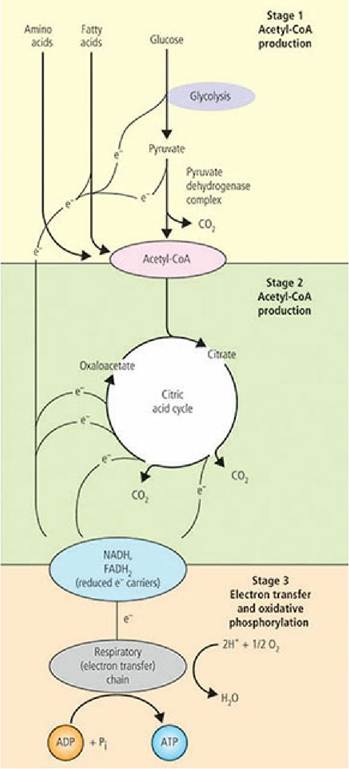
■ FIGURE 1-2 Catabolism of proteins, fats, and carbohydrates resulting in the release of energy.. Stage 3, via the electron transfer chain, provides for the oxidative phosphorylation of adenosine diphosphate (ADP) and the production of a high-energy substance, adenosine triphosphate (ATP). This is the location of oxygen consumption by the body and production of metabolic water. (Adapted from Nelson DL, Cox MM. Lehninger Principles of Biochemistry. 3rd edn. New York: Worth Publishers, 2000.)
■