ESTROUS CYCLE AND RELATED FACTORS
1. How is an estrous cycle interval defined?
2. Know the stages of the estrous cycle and their relationships to ovarian activity.
3. Which steroid hormone predominates during the follicular periods?
4.
Which stage of the estrous cycle is characterized by sexual receptivity?5. Review photoperiod influence on the cat, horse, sheep, and goat. What does “turnon” and “turn-off” time relate to?
6. How is nutrition related to puberty and postparturient resumption of ovarian activity?
7. Note species characteristics associated with their estrous cycles: cow - postestrus ovulation; ewe - short estrous cycle interval; bitch - vaginal cytologic changes and classical pseudopregnancy; queen - reflex ovulation, signs of estrus, coital behavior.
The term estrous cycle refers to the rhythmic phenomenon observed in all mammals involving regular but limited periods of sexual receptivity (estrus) that occur at intervals characteristic of a species. One cycle interval is defined as the time from the onset of one period of sexual receptivity to the next (the ovulatory interval).
Animals are usually classified as monestrous or polyestrous. Monestrous animals are characterized by experiencing estrus once each year. Most wild carnivorous mammals are monestrous and, with some variation, the bitch is usually considered to be monestrous. Polyestrous animals, including most domestic species, have more than one period of estrus in a year. A seasonally polyestrous animal is one that has repeated estrous cycles within a physiologic breeding season (some part of a year), followed by a period of anestrus until the next breeding season.
Stages of Estrous Cycle
The estrous cycle can be divided into several stages according to behavioral or ovarian changes.
1. Estrus: the time of sexual receptivity, sometimes referred to as heat. Ovulation usually, but not always, occurs at the end of estrus.
2. Metestrus: the early postovulatory period, during which the CL begins development.
3. Diestrus: the period of mature luteal activity, which begins about 4 days after ovulation and ends with regression of the CL.
4. Proestrus: the period beginning after CL regression and ending at the onset of estrus. During proestrus, rapid follicle development leads to ovulation and to the onset of sexual receptivity.
The follicular periods (proestrus and estrus) are characterized by estrogen dominance. From the behavioral standpoint, the estrus/sexually receptive period encompasses estrus and the diestrus/sexually nonreceptive period includes metestrus, diestrus, and proestrus.
Photoperiod
Among the domestic animals the seasonal breeders are considered to be the queen, doe, ewe, and mare. These animals are sexually inactive during certain times of the year. The resumption of sexual activity is correlated with conception, so that birth occurs when environmental conditions are more conducive to survival of the young.
The most important factor associated with seasonal breeding is photoperiod (relative lengths of alternating periods of lightness and darkness). Both the queen and mare become anestrous (without estrous cycles) late in the fall (“turn-off time”) because of decreasing light, and ovarian cycles are resumed in late winter or early spring (“turn-on time”) by increasing light. The phenomenon in the ewe and doe is opposite to that of the queen and mare, in that the ovarian cycle has a turn-on time associated with a decrease in daylight and a turn-off time associated with an increase in daylight.
Not only do differences in photoperiod response among species exist, but so do those within species as a result of genetic (breed) differences. Intraspecies difference is most apparent among sheep breeds and probably relates to their origin and related environmental differences. A representation of photoperiod influence on ovarian activity is shown for the queen, mare, ewe, and doe in Figure 15-18.
Approximate dates of turn-on and turn-off vary according to distance from the equator and associated differences in photoperiods.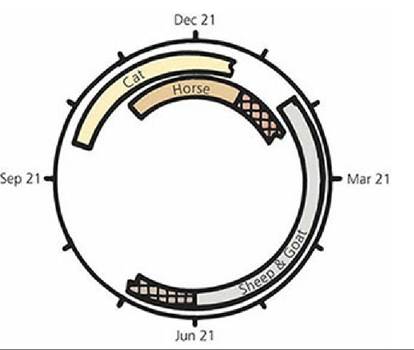
■ FIGURE 15-18 Effects of photoperiod on ovarian activity in the cat, horse, sheep, and goat at a latitude of 38.5° north (California). The open bars represent periods of ovarian inactivity (anestrus). The transition from anestrus to estrus (often erratic) is shown by the cross-hatched portion of the bars for the horse, sheep, and goat. (From Stabenfeldt GH, Edqvist L. Female reproductive processes. In: Swenson MJ, Reece WO, eds. Dukes’ Physiology of Domestic Animals. 13th edn. Ames, IA: Wiley-Blackwell, 2015.)
Nutrition
The influence of nutrition on the estrous cycle is most apparent at puberty and on reestablishment of the estrous cycle after parturition. Animals ingesting sound nutritional regimens reach puberty at an earlier age than nutritionally deprived animals. Consequently, breeding seasons can be delayed if calves are deprived of adequate nutrition. After parturition and during early lactation, cows can have a negative metabolic balance, which can result in an increased interval between parturition and resumption of ovarian activity.
Species Characteristics
Whereas the general pattern of the estrous cycle is similar among the domestic species, differences are noted in duration, not only for the cycle but also for stages within the cycle. Duration of the cycle and for estrus is shown in Table 15-1 for domestic animals. The age of puberty onset also varies, and for some species it is affected by the breeding season for that species.
Cow
Smaller breeds of cows usually reach puberty at an earlier age than larger breeds (Jersey, 8 months; Holstein, 11 months). Behavioral changes associated with estrus include restlessness, mounting activity, standing to be mounted, being more alert to other animals, and decreased appetite.
At the same time decreased milk production, mucus discharge from the vulva, and redness and relaxation of the vulva are noted. It is important to detect estrus so that the correct time for artificial insemination can be determined.Most domestic animals ovulate toward the end of estrus, but the cow ovulates 12 to 14 hours after estrus. The most successful artificial insemination occurs when it is performed about 10 to 12 hours after the beginning of estrus. In the cow, therefore, insemination precedes ovulation, and optimum fertilization is coupled with expected spermatozoon and oocyte life and with capacitation. Capacitation refers to a modification of ejaculated or inseminated spermatozoa within the female reproductive tract, enabling the spermatozoa to fertilize oocytes. The fertile life for bovine spermatozoa (time in female genitalia) is 30 to 48 hours and for bovine oocytes (after ovulation) is 20 to 24 hours. The effect of time of insemination on,conception rate in cattle is shown in Figure
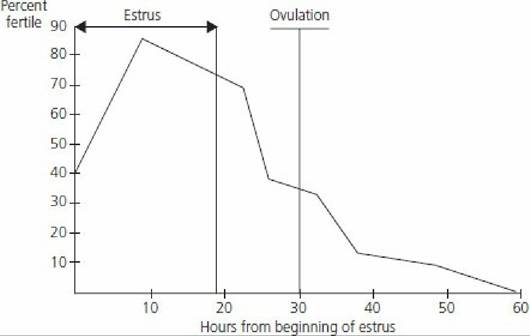
■ FIGURE 15-19 The effect of time of insemination on conception rate in cattle. Conception rate is best when inseminated about 10 to 12 hours from beginning of estrus. (From Stabenfeldt GH, Edqvist L. Female reproductive processes. In: Swenson MJ, Reece WO, eds. Dukes’ Physiology of Domestic Animals. 13th edn. Ames, IO: Wiley-Blackwell, 2015.)
Mare
The onset of puberty in the mare occurs during the breeding season after birth. If the interval between birth and the next breeding season is short (e.g., summer birth), puberty can be delayed for 12 months. A wide range of age for puberty is seen in the mare, from 12 to 18 months.
The transition from winter anestrus to estrus in late winter or early spring is often erratic, in that follicles might be grown but not ovulated. This results in prolonged estrous periods. After the first ovulation, the length of the estrous cycle stabilizes and the duration of estrus is 5-6 days.
Ovulation occurs about 24 hours before the end of estrus and causes the end of estrus, which is a good indication that ovulation has occurred. Signs of estrus in the mare are elevation of the tail, standing with the hind legs apart, squatting and urinating, and rhythmically erecting the clitoris.
Ewe
Where lambs are normally born between December and March (in the northern hemisphere), puberty onset occurs the next fall, at about 8 to 9 months of age.
The estrous cycle in sheep is shorter than in the other domestic species because the antral phase of follicle growth is 3 to 4 days shorter. The physiologic breeding season lasts 6 to 7 months, during which repeated estrous cycles are observed in the absence of pregnancy.
A prominent sign of estrus is fluttering of the tail. Also, females separated from males by a barrier often assume a close proximity to the barrier.
Sow
Pigs born at any time of the year reach puberty at 6 to 7 months of age. Ovulation rates are more pronounced at the third estrus after puberty.
Signs of estrus include swelling of the vulva, restlessness, and decreased appetite. Application of pressure on the sow’s back during estrus brings forth the rigidity reflex that occurs during natural mating with a boar.
Ovulation occurs from both ovaries, and 14 to 16 oocytes can be released. Because of the large number of follicles or corpora lutea at any one time, the sow ovaries often appear to be lobulated (see Figure 15-4).
Doe
The breeding season and gestation periods are similar for goats and sheep, and puberty is reached at about the same age (8 to 9 months). Breeding is often delayed, however, until the next breeding season.
Signs of estrus in the doe are similar to those in the ewe. When mating occurs, intromission and ejaculation are accomplished rapidly, usually within several seconds.
Pseudopregnancy is a condition in which a female has most signs of pregnancy but is not pregnant. Enlargement of the uterus occurs as a result of fluid accumulation.
This phenomenon occurs in the goat and is believed to be caused by prolongation of the CL (see section, Persistent Corpus Luteum). The injection of PGF2α results in CL regression and discharge of the accumulated uterine fluid.Bitch
The onset of puberty in the bitch occurs,2 to 3 months after she reaches adult size. Among breeds it ranges from 6 to 12 months of age.
The bitch has an unusually long period of ovarian inactivity (anestrus) that is unrelated to photoperiod or nutrition. Because of this she is sometimes considered to be monestrous. Estrous cycles are common at all times of the year. The stages of the estrous cycle are different from those of the other species in that each is longer. Proestrus and estrus are each 7 to 10 days long, and diestrus is prolonged, lasting 70 to 80 days.
The LH surge occurs at the end of proestrus, followed by ovulation in 24 to 48 hours. The bitch might be sexually attractive during proestrus but is not sexually receptive until after the LH surge. Progesterone secretion thereafter is essential for receptivity and, although the estrogen level declines, sexual receptivity is maintained for 7 to 10 days.
Vaginal cytologic changes seem to be more pronounced in bitches than in other domestic species and have been correlated with each estrous cycle stage. Vaginal smears are useful for assessing the stage of estrus and for predicting the most suitable time for breeding. The principal cytologic changes are: (1) thickening and cornification of the vaginal epithelium, (2) loss of leukocytes because of the thickened epithelium, and (3) appearance of erythrocytes from the developing vascular system of the endometrium.
Among those animals that show pseudopregnancy, it is most often seen in the bitch. In the absence of pregnancy the corpus luteum persists and, during the exaggerated diestrus, progesterone continues to be produced for 50 to 80 days. This is a normal phenomenon in bitches because the uterus is not active in CL regression (production of PGF2α). The endometrium hypertrophies and endometrial glands develop, although no fetus is present. Some bitches have no other signs of the prolonged elevation of progesterone concentration, but others have mammary gland enlargement and relaxation of the pelvis. Occasionally, a maternal attitude develops that leads to nest building. Rarely, lactation begins and the bitch shows signs of labor.
The long period of progesterone dominance (long diestrus), coupled with the relatively long period of regression of the endometrium after luteolysis of the CL, predisposes the endometrium to pyometra (pus in the uterus). Pyometra is common in older bitches.
Queen
Cats born in the spring and summer months reach puberty in the next breeding season, at about 6 to 8 months of age. Cats born in the fall and early winter have their puberty delayed for 1 year, until the next breeding season. The breeding season is considered to be January to October in the northern hemisphere.
If the queen does not have coitus, ovulation does not occur, and no luteal phase intervenes until the next cycle. However, the 8-day follicular phase is followed by an 8-day period of ovarian inactivity. If queens have coital contact but fail to conceive, a luteal phase prolongs the onset of the next proestrus, with a minimum time of 42 days between estrus. Pseudopregnancy occurs in queens if a luteal phase occurs without pregnancy. Development of the uterus, mammary glands, and abdomen is not as marked as in the bitch, and nest building and lactation seldom occur.
Signs of estrus in queens include an increase in affection, which can be shown to almost any object - humans, table legs, or other pieces of furniture. They also crawl with their thorax against the floor, roll about, and vocalize for prolonged periods.
Several coital contacts might be made, with intromission and ejaculation occupying only 10 to 15 seconds each time. A refractory period or lack of sexual receptivity occurs for 10 to 15 minutes after each intromission. During the first hour of contact, four or five intromissions and ejaculations might occur.
■