Executive management: Forebrain
Key points
■ The executive management links inputs from sensory association areas, storage areas, behaviour and emotion-generating areas with motor planning areas.
■ The output from the executive system can stimulate complex and varied patterns of motor activity and voluntary, learned tasks.
■ The variability with which an animal can respond to stimuli is determined by the degree of cerebrocortical development. In non-primates only a minority of the cerebral cortex is dedicated to the association of information.
The executive management sits at the top of the hierarchical arrangement. It has its head office located mainly in the forebrain. It talks with senior management, but not with junior management, or the workers, directly.
The executive component of the motor system hierarchy is responsible for planning motor activity. It involves diffuse regions of the forebrain and subcortical connections. It draws on brain regions used for integrating sensory information (association areas), storage of information (memory), behaviour and emotion (limbic system) and motor coordinating/regulating areas, such as the basal nuclei and cerebellum. It is the site where an appropriate output is determined, based on integration of all inputs, experience and prediction of the outcomes. The executive motor planning centres also include areas involved in abstract thought and problemsolving in animal types with those abilities. Thus the range of responses that an animal can display to a stimulus is determined by the degree of cerebrocortical development. Complex, varied responses require a high degree of neuronal connections to permit learning, memory, assessment of input, differential processing and conceptualisation. In many invertebrates, stimuli can only evoke outputs that are stereotypical or reflexive.
Outputs from the executive system are delegated to different UMN centres in the motor cortex and brainstem nuclei (senior management); these ultimately direct the worker LMNs and result in muscle activity.
Through such hierarchical organisation the simplest motor components (individual LMN function or reflex arcs) can be recruited into complex patterns of activity. This is the basis of the diverse array of complex motor functions that animals use.Thus the cerebral cortex draws on a wide range of storage, processing and integrating areas to produce an output that filters down through the hierarchical motor system and is finally expressed as a voluntary, complex, learned task, such as a dog learning to shake ‘hands’ (Fig. 4.15).
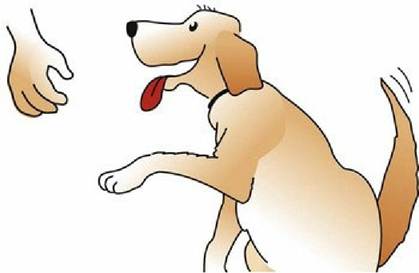
Fig. 4.15
Dog using association areas to integrate sensory inputs, memory and behaviour centres, to
produce a specific, learned motor output
The executive components of the sensory system are the association areas. Association areas integrate input from their adjacent, primary receiving area. Primary receiving areas include auditory, sensory, visual and olfactory cortices. The association area rates that input in terms of importance and compares it with previous experience by drawing on storage/memory areas. Association areas connect with executive motor areas, and their input assists with planning a suitable response and predicting the outcome. Connections are via short interneurons, which form complex patterns of circuitry linking executive sensory and motor systems, memory, emotion and behaviour centres.
In primates and humans, association areas of the brain are well developed. In cats and dogs, the projections areas (primary receiving areas and motor cortex) account for the vast majority (approximately 80%) of the cerebral cortex. The remainder of the cortex is the association area. The situation is opposite in humans in which the majority of the cortex is used for association of information (Fig. 4.16).
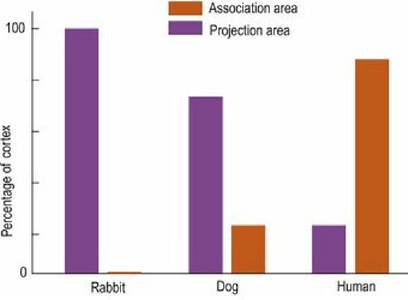
Fig. 4.16 Percentage area of cerebral cortex used for receiving or projecting information (senior management - purple columns) versus integrating information (executive management - orange columns) in different species.