FEATHERS
Feathers are keratinized epidermis, which are derived from specialized follicles in the dermis. During growth there is a healthy arterial and venous blood supply to the follicle, which degenerates when the feather matures.
Immature feathers will thus bleed if broken and are called “blood feathers” (Bauck, Orosz & Dorrestein 1997).The feathering or plumage of birds can weigh 2 to 3 times than that of their bones. They are not attached to the skin evenly but are set in feather tracts called pterylae (Bauck, Orosz & Dorrestein 1997; Spearman 1971). Apteria (featherless regions) are also present and may be used for wing and leg movements and to provide space for these appendages to be tucked in. As they are not present in penguins they are also assumed to be an outlet for heat loss. The size and number of feathers is related to the metabolic rate, temperature, and body mass of each bird.
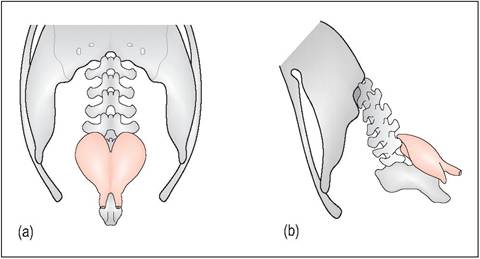
Figure 6.73 • Location of uropygial gland in relation to pygostyle.
(a) Dorsal view
(b) Lateral view
faster than the softer ventral side and this gives the claw its curved appearance (Bauck, Orosz & Dorrestein 1997; Spearman 1971; Spearman & Hardy 1985).
Patagia
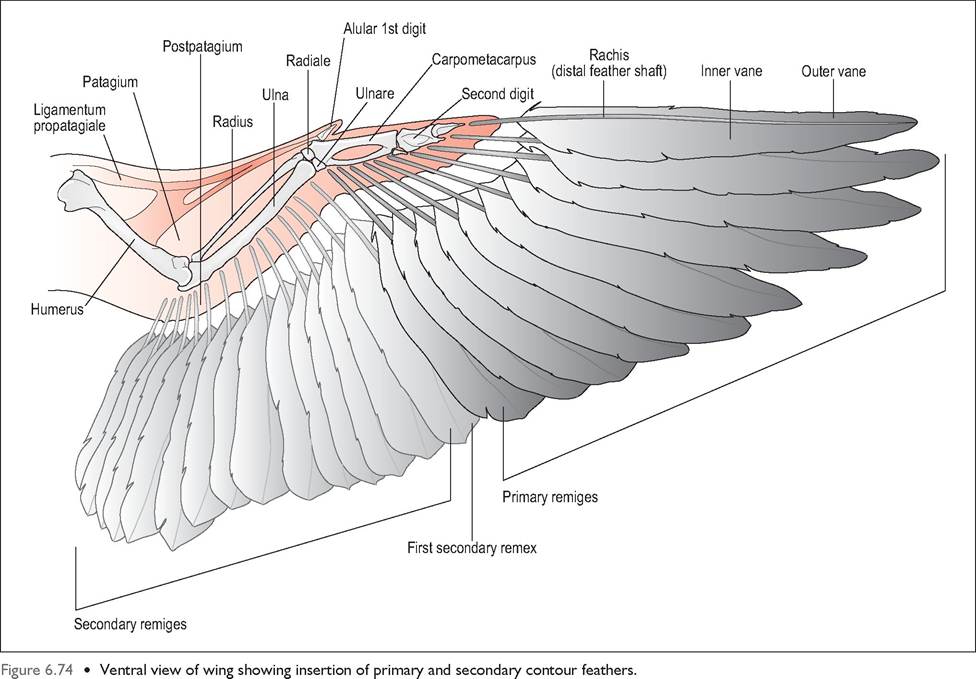
Patagia are thin membranous sheets of skin located where the wings, neck, and legs join the body. They can be a useful site for subcutaneous injections. The main patagia of the wing are the propatagium (also called the wing web) between the shoulder and carpus and the metapatagium between the thorax and wing.
Brood patch
This is a patch on the midventral chest between the caudal sternum and pubic bones. During the breeding season this
Role of feathers
Feathers play a vital role in protecting, insulating, and waterproofing the bird. They are also essential for flight and, often, courtship (Evans 1996).
Feather structure
The classic feather is the contour feather, which has a hollow shaft and feather vane. The main shaft is the rachis and the base is the calumus. The feather vane consists of a sheet of stiff filaments called barbs which extend at a 45 degree angle on either side from the rachis. Barbs have even finer filaments called barbules and these contain minute hooks that zip the feathers together, creating a smooth appearance (Evans 1996) (Fig. 6.77). Ostriches have feathers with barbules but they do not interlock, thus creating the fluffy appearance so beloved in the past as plumes for hats. Birds maintain this smooth appearance by preening, but if there is any lasting damage it can only be remedied when the feather is molted.
The rachis is grooved underneath and ends in a depression called the distal umbilicus. In some feathers a small down feather may emerge from this creating a fluffy appearance. The calamus or quill ends in the proximal umbilicus, which lies embedded in the feather follicle (Fig. 6.76).
Feather follicle
This is a tubular invagination of the epidermis with a dermal papilla at its base that projects up into the proximal umbilicus and has a rich supply of blood vessels (Fig. 6.78). After a feather becomes fully grown, germinal activity ceases at
the base of the follicle and it enters a resting stage until the next molt. This feather papilla will continue to produce feathers throughout the bird's life (Evans 1996; Spearman 1971).
Adjacent feather follicles are linked by a network of smooth muscles lying in the dermis and each muscle is attached to the follicle by an elastic tendon. These muscles can act as a unit to raise or lower feathers, draw them apart or together. This can be used for sexual display or to fluff out feathers when cold to conserve heat. This is controlled by mechanoreceptors, the Herbst corpuscles, that lie adjacent
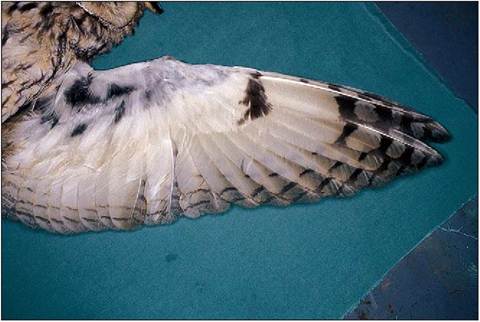
Figure 6.75 • Ventral view of wing of long eared owl (Asio otus).
to feather tracts. These are very sensitive to vibration and help to position the feathers.
Feather types
Contour feathers
These are the largest feathers and form the external appearance of adult birds. They are found on wings, tail, and body surface and are the feathers of flight. The wing feathers are called remiges (Latin for “rowers”) while tail feathers are called rectrices (Latin for “rudder”). The number of each will vary; for example, budgies have 10 primaries and 11 secondaries on each wing and 6 pairs of rectrices (Evans 1996). Covert feathers are smaller feathers which cover the remiges and rectrices dorsally and ventrally. As they are purely for covering the body and play no role in flight, they are symmetrical. Ear coverts cover the external ear orifice and may help with hearing.
Flight feathers
Wing feathers
The wing feathers or remiges are made up of approximately 10 primaries and 10 to 20 secondaries, depending on the species (Figs. 6.74 and 6.75). The primaries are strongly
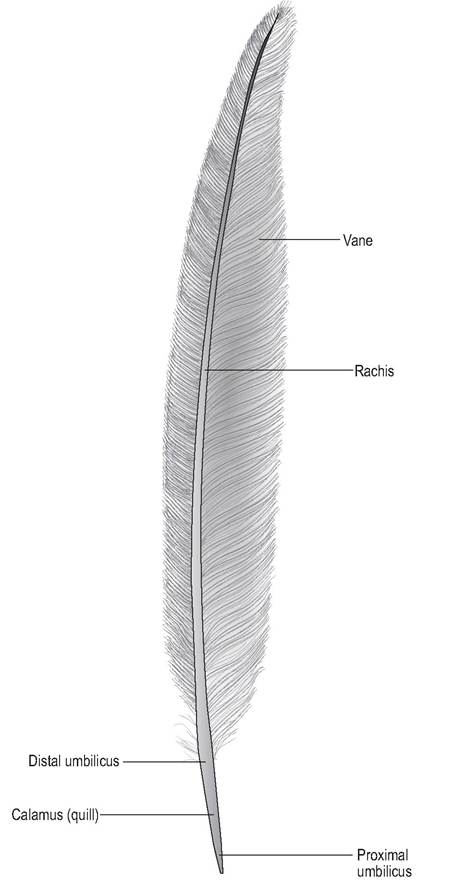
Figure 6.76 • Contour wing feather (rectrix) showing asymmetry of vane.
attached dorsally from the carpus to the phalanges and are not very movable. Each one is asymmetric to act like its own individual airfoil. The secondaries are attached along the posterior edge of ulna and form the trailing edge of the wing. These are particularly enlarged in surface area in birds that soar. The secondaries have more mobility and are covered by the wing coverts.
The vanes of the wing feathers are asymmetrical, with the external side of the vane being narrower than the internal for aerodynamic flight. In many birds the distal end is narrowed so that when the wings are spread there is no overlapping but there are slots between each feather tip. This reduces the drag effect and allows each feather to act like a propeller blade (Spearman & Hardy 1985).
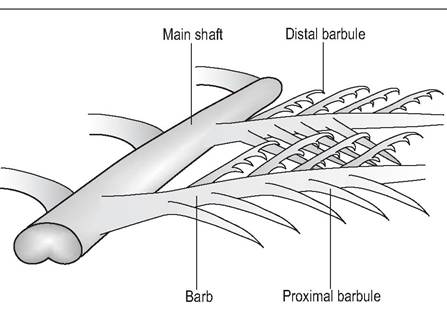
Figure 6.77 • Detail of barbs, barbules and interlocking hooklets.
CLINICAL NOTE
The main difference between a feather and a mammalian hair is that the feather follicle contains a vascular core of dermis as well as epidermis (Fig. 6.78). This is why a feather may bleed profusely when plucked out and why blood feathers should not be cut when wing clipping (Bauck, Orosz & Dorrestein 1997).
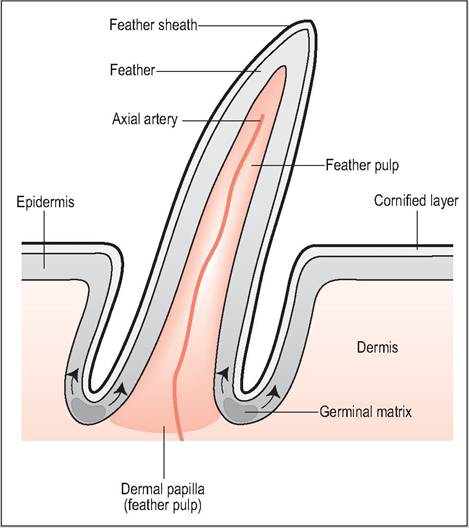
Figure 6.78 • Development of a feather.
The axial core of dermis forms the pulp with a covering of epidermis. Unlike mammalian skin the dermis of developing feathers provides a rich blood supply - hence the term blood feather.
Tail feathers
The rectrices attach to the pygostyle and are used for steering and braking during flight. There are usually 6 pairs but numbers can vary from 4 to 10 pairs depending on species (Evans 1996).
Semiplumes
These appear fluffy, with a very long rachis that is longer than the barbs (Fig. 6.79a). As there are no barbules there is no smooth effect. These can often be found alongside feather margins, are good insulators and are often used for courtship.
Filoplumes
These are the avian equivalent of mammalian whiskers and act like sensory organs. They are bristle-like, with a long calumus and a fine tuft of barbs at the tip, and are often found in association with the follicles of contour feathers (Fig. 6.79c). These have nerve endings near their follicles which may help with aerodynamic adjustments of the contour feathers. They are absent in flightless birds like penguins and ostriches (Bauck, Orosz & Dorrestein 1997).
Down feathers
These are the converse of semi plumes with a small rachis (shorter than the barbs) and non-interlocking barbules, which makes them fluffy (Fig. 6.79b). They lie next to the body under the contour feathers in adults and are what gives chicks their fluffy appearance. The loose barbules trap air next to the skin and so these are the best feathers for providing thermal insulation.
GENERAL INTEREST
In sea ducks, like the Common Eider (Somateria mollissima) down feathers form an impervious layer of very dense feathers, which covers the whole thorax and abdomen.
These insulating feathers are plucked during the breeding season to make a cosy nest for their young on rocky sea cliffs. In the past this down was much sought after for making quilts - hence the name “eiderdown” (Spearman & Hardy 1985).
Powder down
These are specialized down feathers which produce a fine powder keratin dust from the barbs. This talc-like powder is then coated over the plumage during preening. It is found in many parrots, like cockatoos and African grays, and its absence can often be the first sign of the circovirus causing Psittacine Beak and Feather Disease. In pigeons the production of powder down has been associated in humans with allergic alveolitis or “pigeon fanciers lung” (Spearman & Hardy 1985).
Hyopenna
These are called afterfeathers and protrude from the base of the rachis of contour feathers. They have a stiff rachis and almost no barbules (Fig. 6.79e).
Bristles
These have a stiff rachis and a few barbs at the proximal end (Fig. 6.79d). These are found at the base of the eyelids, nares, and mouth. They have both sensory and protective functions similar to mammalian whiskers.
Feather color
The wonderful range of avian feather color plays a major role in camouflage, courtship, and protection from heat and light. The color can be produced by pigments like melanin, carotenoids and porphyrins or the structural effects of white light on the feathers.
Melanin is what gives blackbirds and crows their black appearance and also produces gray and brown. It is the most common pigment found in birds and is synthesized from the amino acid tyrosine. Feathers containing melanin are stronger as they usually have increased amounts of keratin (Spearman 1971; Spearman & Hardy 1985; Welty 1982a).
CLINICAL NOTE
As feathers containing melanin pigment are stronger, many white birds like gulls often have blackened tips on the primary feathers to protect against wear and tear.
Carotenoids cannot be synthesized but are obtained by birds from plants in their diet. They are red, orange, and yellow pigments and are responsible for the canary yellow, cardinal red, and flamingo pink coloration. They rarely affect flight feathers but mainly affect other contour feathers, especially of the breast and back (Spearman 1971; Spearman & Hardy 1985; Welty 1982a).
GENERAL INTEREST
Flamingos are able to oxidize yellow or beta-carotene to red ketocarotenoids. Newly hatched chicks have no pigmentation but receive it from their parents in the crop milk. These yellow pigments come from plant foods in the Andean flamingo (Phoenicopterus andinus) or from algae, crustaceans, and molluscs in other flamingo species.
Porphyrins are nitrogenous pigments synthesized by birds and form green, red and some browns. They are found in owls, pigeons, and gallinaceous birds. These colors fluoresce when exposed to ultraviolet light.
Structural colors
Birds do not have a true blue pigment (Spearman & Hardy 1985). Instead, when white light is scattered by the feathers the short wavelength red end of the spectrum is absorbed while the blue end is reflected. This effect, known as Tyndall scattering, is what makes the sky blue. Although some green is produced by porphyrin pigments it is more commonly produced by a combination of yellow carotenoids and the Tyndall effect (Spearman 1971; Spearman & Hardy 1985; Welty 1982a).
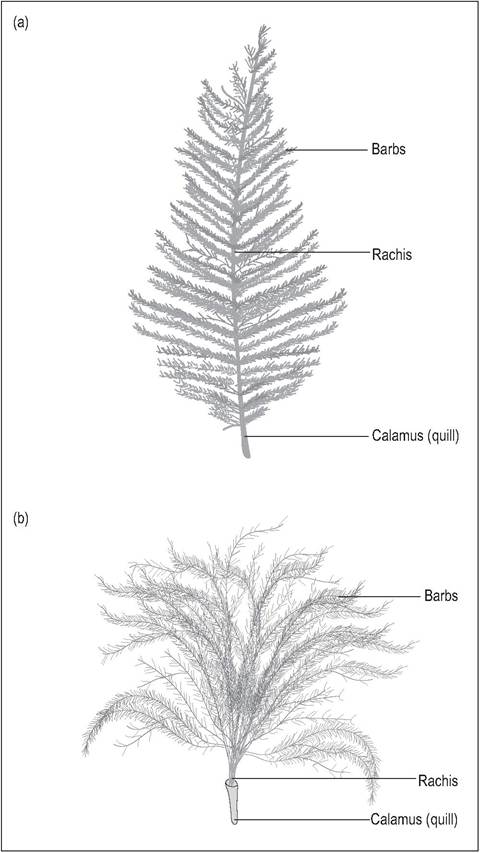
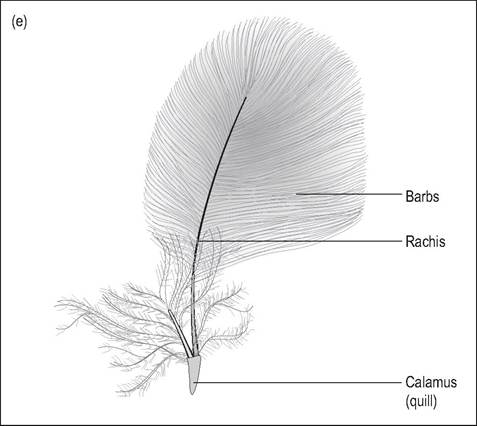
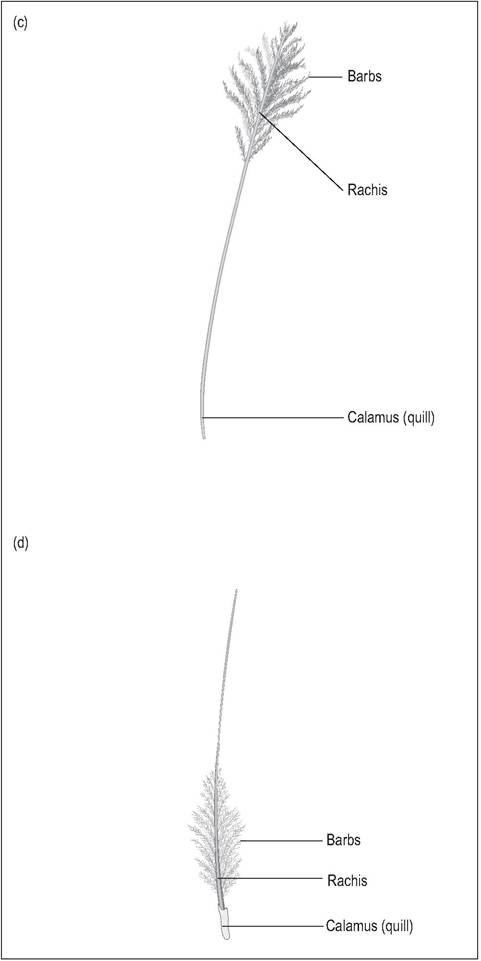
Figure 6.79 •
(a) Semiplume - the rachis is longer than the barbs and there are no barbules
(b) Down feather - the rachis is short with long barbs
(c) Filoplume - the calamus is long with a tuft of barbs at the distal end
(d) Bristle - the rachis is stiff, with barbs at proximal end
(e) Contour covert feather with afterfeather (hyopenna). These have a stiff rachis and almost no barbules and protrude from the base of the rachis of contour feathers.
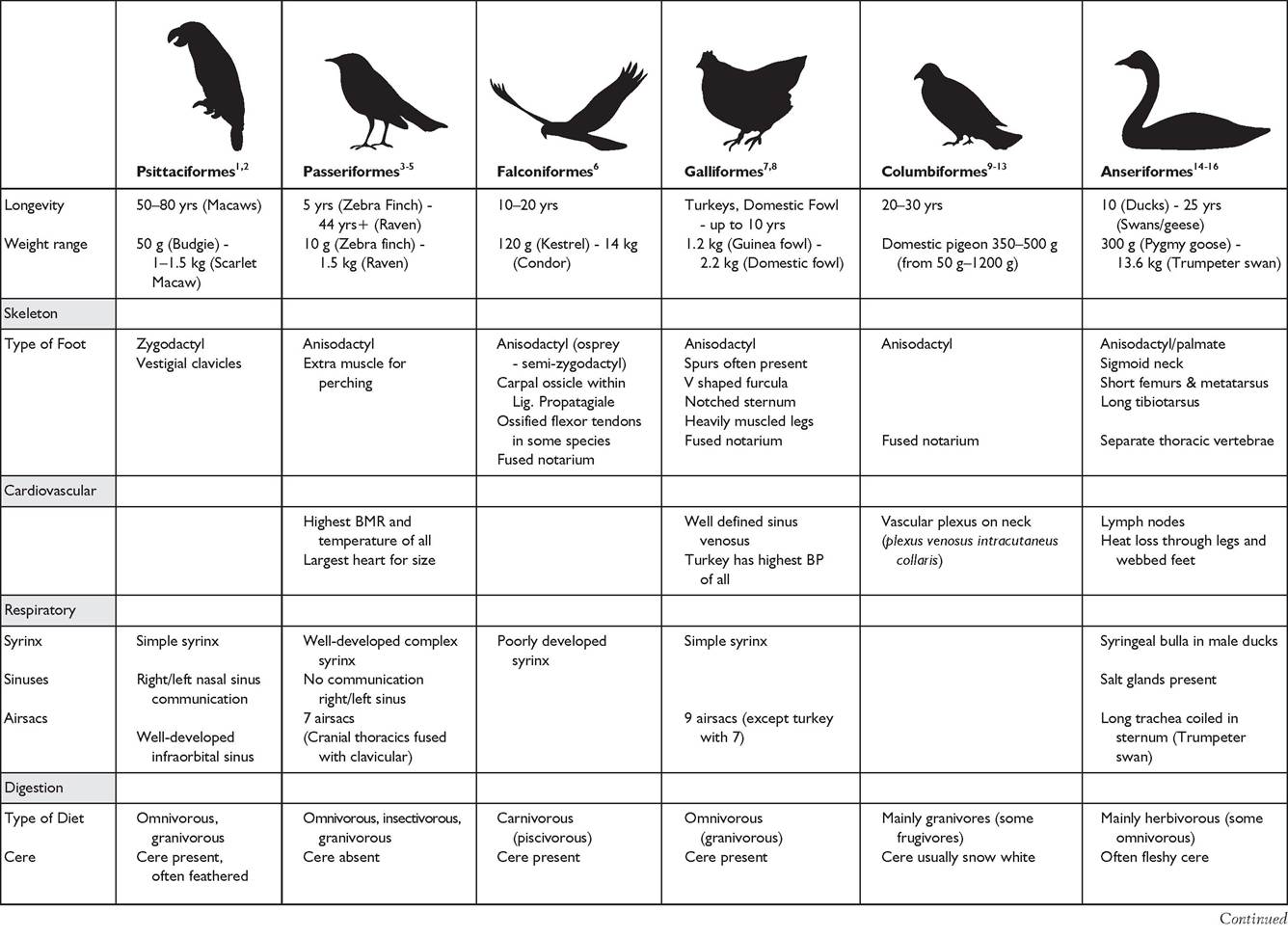
Table 6.6 Anatomical and physiological characteristics of the more common avian orders
Clinical Anatomy and Physiology of Exotic Species
Table 6.6 Anatomical and physiological characteristics of the more common avian orders—cont’d
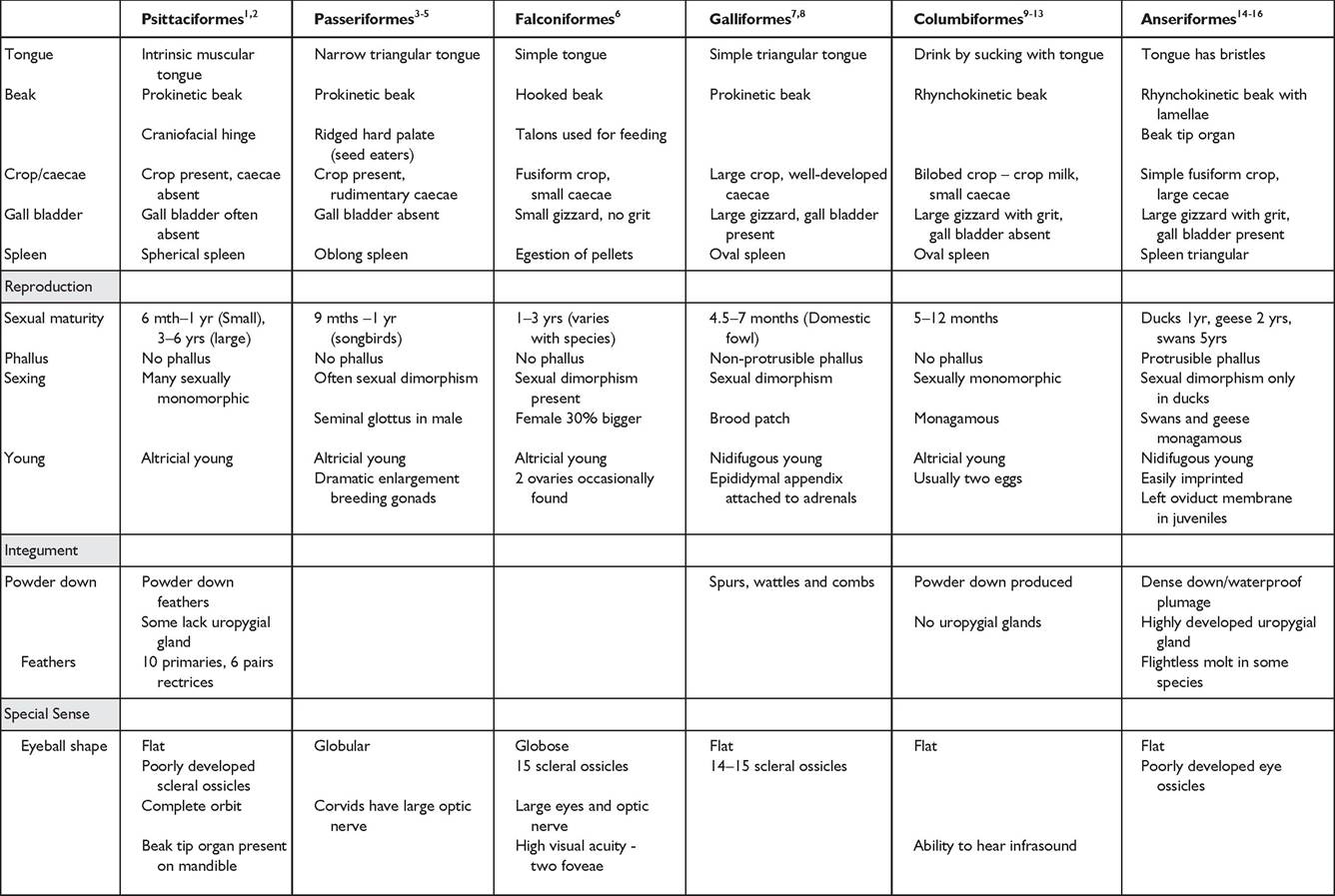
Superscript numbers in this table represent references, listed below. For full reference please see reference list
I-Evans 1996; 2-King& McLeIIan 1984; 3-Dorrestein I 997b; 4-Jones & Slater 1999; 5-King& McLeIIand 1984; 6-King & McLeIIand 1984; 7-Gerlach I 997a; 8-King & McLellan 1984; 9-Harlιn 1994; IO-Harper 1996; I I-Hooimeijer & Dorrestem 1997; I 2-Hutchinson 1999; IS-KingSMcLeIIan 1984; I4-Fowler 1986; I 5-Gerlack I 997b; I 6-King & McLeIIand 1984
Avian anatomy and physiology
Iridescence (like the rainbow coloring of an oil slick), as seen in starlings and peacocks, is a combination of melanin pigment with structural breakdown of light through the feather barbules. This effect means the color will change with the angle from which it is viewed (Welty 1982a).
Molting
This is the replacement of feathers and is a continuous process to avoid the bird becoming bald and flightless. Molting occurs because the emerging feather ejects the old feather from its follicle causing it to be shed (Spearman & Hardy 1985). Before the barbs are released they are encased in a feather sheath called a pinfeather. Birds usually molt the inside primaries first and then stagger the loss of the rest of the wing feathers(Spearman 1971).
Feathers are held in place in follicles by the action of the follicular muscle under the control of the autonomic nervous system. When a bird is frightened this may relax, causing the bird to shed feathers in what is called a “fright molt” (Bauck, Orosz & Dorrestein 1997). Cut feathers or plucked feathers do not regrow until the feather shaft is lost in the molt and the new one grows from the feather papilla.
Triggers for molting
Factors influencing molting are nutrition, reproduction, time of year, temperature, and light. It also depends on habitat and whether the bird is migratory or not. Young birds molt their juvenile feathers before they become adults and often go through a series of subadult plumages. Adult birds usually molt after breeding (post nuptial or winter plumage) when the levels of estrogen and androgens drop. Some birds keep the new set for the next 12 months while some change to a brighter nuptial or breeding plumage for courtship display in the mating season (Bauck, Orosz & Dorrestein 1997). Ducks and geese lose all their contour feathers at once and this renders them temporarily flightless.
Molting is a time of intense stress on a bird with increased demands for protein (especially amino acids lysine, cystine, and arginine), calcium, and iron. Therefore birds that lose feathers due to illness or self-mutilation have high demands for good nutrition. Heat loss is increased due to feather loss so energy intake must be increased to sustain the increased metabolic rate. In fact, the total draw of energy and protein reserves during molting can cause the metabolic rate to increase by 15 to 25%.
Control of molting
Photoperiod detected via the hypothalamus and anterior pituitary triggers the release of the thyroid and gonadal hormones. Thryoxine stimulates the feather follicles and growth of the plumage while androgen and estrogen appear to inhibit molt until after the breeding season. Progesterone prevents ovulation and induces molt by stimulating the feather papillae. Dietary deficiencies, especially low protein diets, will also inhibit molting (Spearman 1971).
KEY POINTS
• Avian skin is thin and inelastic with a bacteriostatic lipid layer.
• The patagia (skin webs) are useful sites for subcutaneous injections.
• Damaged feathers can only be replaced at the next molt.
• Good levels of nutrition are essential to aid molting and produce new healthy feathers. Extra protein, calcium and iron is important.
• Newly emerging feathers, called blood or pin feathers, are highly vascular so beware cutting these if wing clipping.