Fever Is an Elevation of Body Temperature That Results from an Increase in the Thermoregulatory Set Point
Fever, also known as pyrexiai occurs in response to the elevation of an animal’s thermoregulatory set point and most often accompanies infectious diseases. Fever is believed to be an evolutionary adaptation to fight off infection and can be induced in some of the oldest species, such as reptiles and amphibians.
Studies indicate that during infection, an increase in body temperature enhances leukocyte activity. This results in a decrease in animal morbidity and mortality from infections.The induction of fever begins with production by many cell types of small polypeptides known as pyroyens (Figure 53-9). This occurs when infectious agents, toxins, or the lipopolysaccharide complexes in gram-negative bacteria invade the body. Pyrogens include interleukin-1 (Il.-1; considered to be the most important), tumor necrosis factor (TNF), interleukin-6 (IL-6), interferon (IFN), and macrophage inflammatory protein (MIP). In addition, prostaglandins (PGs), products of the arachidonic acid cascade that arc produced by endothelial cells, are major participants in the pathogenesis of fever. When released into the blood, pyrogens reach a part of the hypothalamus called the organa vasculosum of the lamina terminalis (OVLT). This region of the hypothalamus is highly vascularized, and the blood-brain barrier here is almost nonexistent, so endogenous pyrogens and PGs enter the brain easily from the bloodstream. Once in the hypothalamus, the endogenous pyrogens act on the endothelial cells to produce additional prostaglandin E2 (PGE2) and other arachidonic acid metabolites. These PGs cause the set point to rise.
Once the set point increases, the animal initiates responses to conserve and produce heat until the body temperature reaches the new set point (Figure 53-10). Shivering, peripheral vasoconstriction, piloerection, and huddling behavior are all
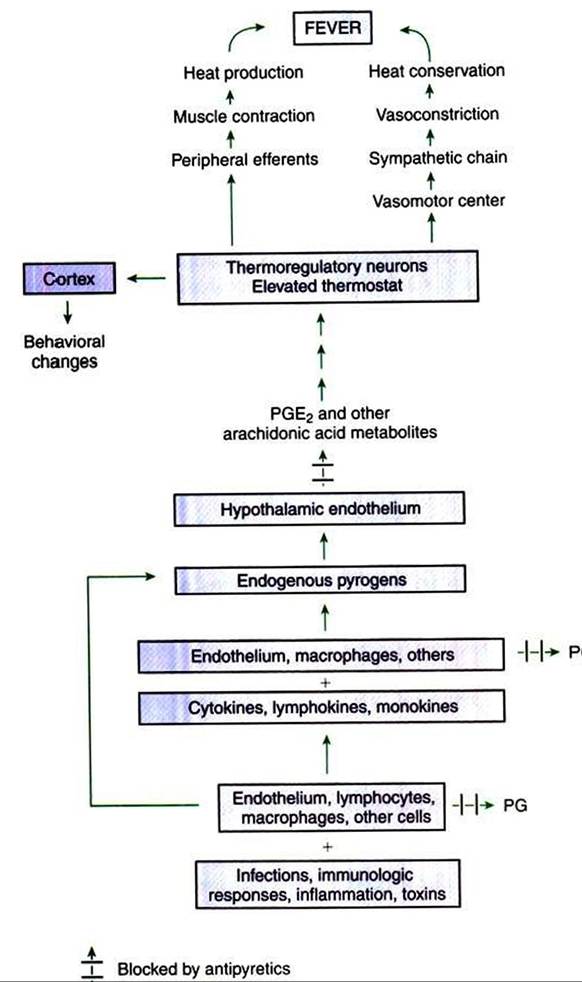
Figure 53-9 Peripheral and central mechanisms involved in the pathogenesis of fever.
PGE2, Prostaglandin E2; PG, prostaglandins.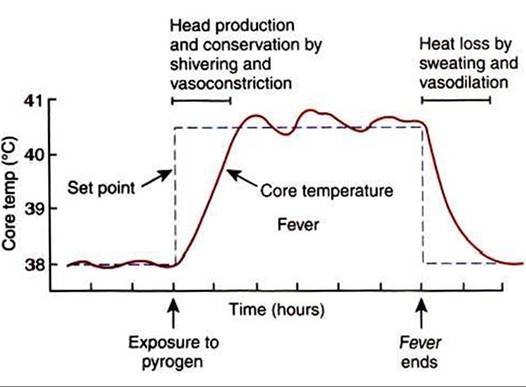
FIGURE 53-10 Events involved in fever. Exposure to a pyrogen increases the set point for the temperature-regulating system.This results in heat production and conservation to elevate body temperature, which in turn results in fever. When the fever ends, the set point decreases, and heat must be lost from the body through sweating and vasodilation.
characteristic of the onset of fever. Once the new set point is reached, the animal maintains its body at the new temperature until the pyrogen is metabolized and production ceases. When this occurs, the set point decreases back to normal, and the animal initiates heat-losing mechanisms such as vasodilation and sweating to decrease body temperature. Because the local production of PGE2 in the hypothalamus is involved in increasing the set point, nonsteroidal antiinflammatory drugs (NSAIDs; e.g., aspirin, flunixin, ibuprofen) are used to treat fever. These antipyretic drugs block the enzyme cyclooxygenase, an integral enzyme in the arachidonic acid cascade, thus blocking prostaglandin production (see Figure 53-9).