Functional Aspects
The size of the accessory glands is related to the large volume of the ejaculate, at least 200 mL. Despite their great size, the vesicular and bulbourethral glands together contribute somewhat less than half the seminal fluid; the bulk is provided by the prostate and urethral glands.
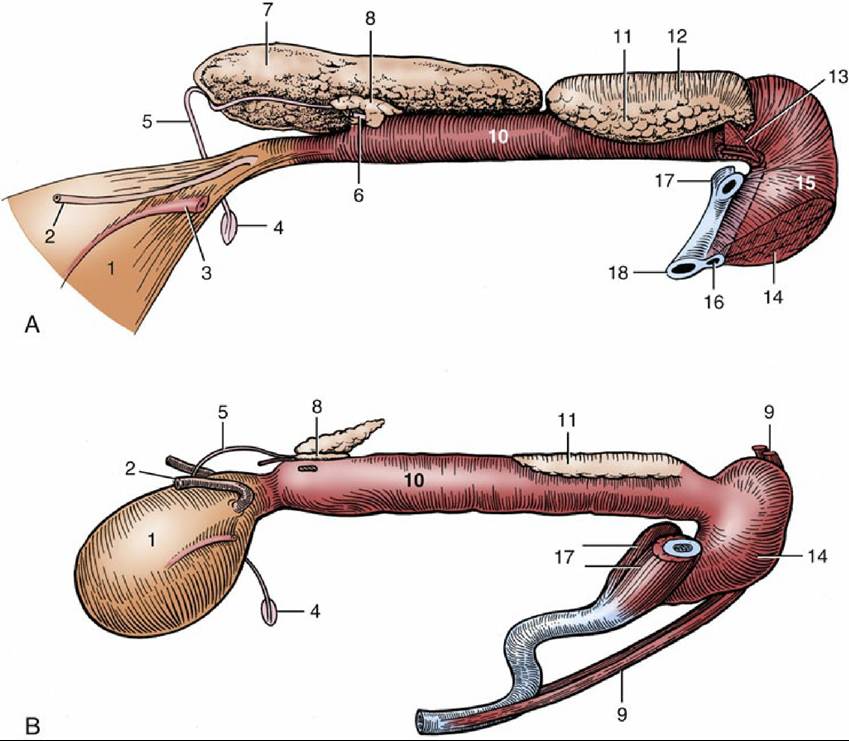
FIG. 35.8 Pelvic urethra and associated organs of (A) an 8-month-old boar and (B) a 6-month-old castrate, left lateral views. The left vesicular gland has been removed to expose the prostate. 1, Bladder; 2, left ureter; 3, left umbilical artery; 4, right vaginal ring; 5, right deferent duct; 6, left deferent duct, cut at prostate; 7, right vesicular gland; 8, body of prostate; 9, retractor penis; 10, pelvic urethra, surrounded by urethralis; 11, left bulbourethral gland; l2, bulboglandularis covering dorsal half of bulbourethral gland; 13, excretory duct of left bulbourethral gland; 14, bulbospongiosus; 15, bulb of penis; 16, urethra and corpus spongiosum; 17, right and left crura, cut; 18, corpus cavernosum.
During erection the blood pressure in the cavernous spaces rises sharply, straightening the sigmoid flexure and increasing the length of the penis by about a quarter. The single longitudinal twist of the shaft increases to six turns, while the corkscrew spiral of the free part becomes much more pronounced. During coitus, a slow process that may last for as long as 30 minutes, the boar is said to "soak" because of the absence of obvious activity on his part. However, forward and backward twisting movements of the penis do occur under the influence of the retractor muscle. There is no substance to the persistent belief that the prominences of the cervical mucosa form a canal with a left-hand thread matching that of the spiraled end of the penis. The end of the penis is considered to almost enter the uterus.