Gastrointestinal System
The complete gastrointestinal system of poultry is illustrated in Figure 30-3.
A distinguishing characteristic of the class Aves is the modification of the jaws into a beak, the shape of which is adapted to the foraging behaviors and diet of individual species.
Gallinaceous birds have pointed beaks for picking up individual food items, and Anseriformes have a flattened, spoon-shaped beak that is somewhat more flexible and is adapted for straining through water for foodstuffs. Beaks are featherless, covered by a thick keratinous epidermis.The mouth of birds differs from that of mammals in that the palate is incompletely fused; this results in a longitudinal opening between oral and nasal cavities called the choanal cleft. The tongue is variable in shape, conforming as it does to the contours of the oral cavity. in domestic species, the tongue lacks musculature and is not much more than a bone (entoglossal bone) covered with a thick, cornified mucous membrane.
The pharynx begins caudal to the tongue. The pharyngeal floor is characterized by a raised laryngeal mound, which features the aditus laryngeus (laryngeal slit). The opening into the esophagus is caudal and somewhat dorsal to this. Within the neck, the esophagus features a distensible dilation called the crop or ingluvies. it is a small fusiform enlargement in ducks and geese, but is extremely well developed in gallinaceous birds. in these birds, the crop lies on the left side of the neck cranial to the furcula, and when full of food, it is readily palpable and visible. Like the esophagus, the crop is lined by a keratinized stratified squamous epithelium.
Within the body cavity, the esophagus leads to a bipartite stomach. The first chamber is the proventriculus or glandular stomach, which
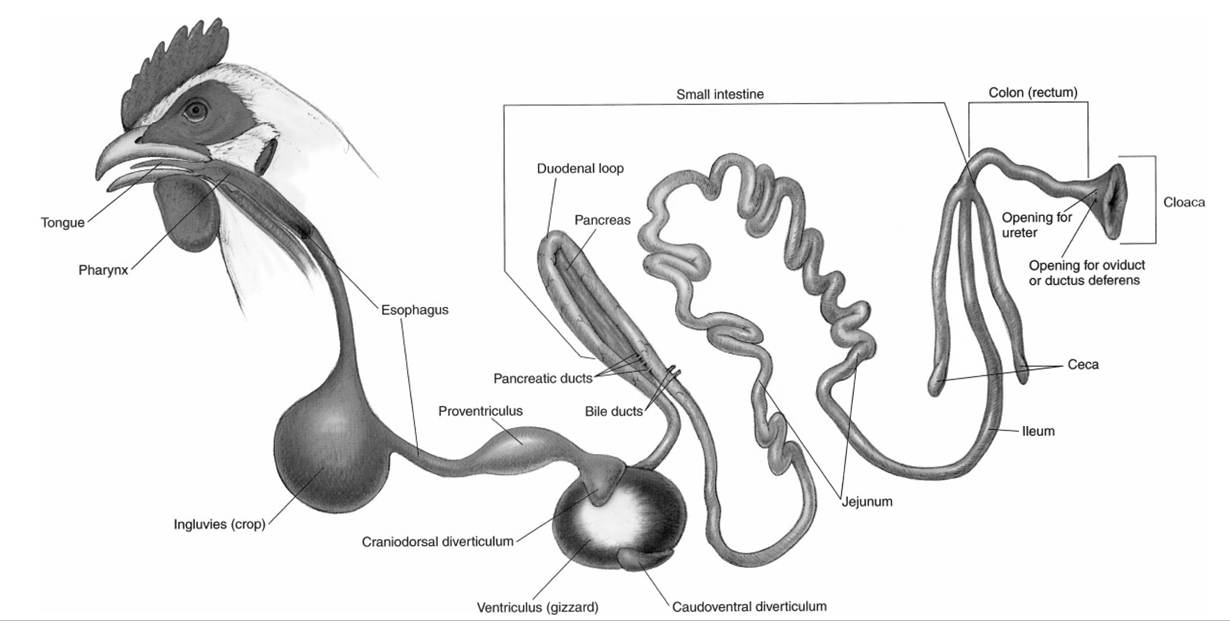
Figure 30-3.
The gastrointestinal tract of the chicken. (Reprinted with permission of Wiley-Blackwell from McCracken, T.O., Kainer, R.A., and Spurgeon, T.S. Spurgeon’s Color Atlas of Large Animal Anatomy. Baltimore: Lippincott Williams & Wilkins, 1999.)provides pepsin and hydrochloric acid for enzymatic digestion. The proventriculus is demarcated clearly by a constriction from the second chamber, the gizzard (muscular stomach or ventriculus muscularis). It largely fills the lower left of the body cavity. The highly keratinized mucosa on the inside of the gizzard, the cuticle, forms a thick, leathery sheet, which is removed during processing for human consumption.
Crops and gizzards are unique to avian digestive systems and contribute to the efficiency with which many wild and domestic birds can utilize whole, intact seeds, including grains, as part of their diet. The crop provides for temporary storage after swallowing, and the gizzard provides a muscular force to grind and crush foodstuffs so that they can be more effectively digested. Hard particles, such as grit or gravel, consumed with food contribute to the ability of the gizzard to properly grind intact seeds, and a source of such particles should be part of the diet of birds fed this diet. Grit is not necessary for diets that are finely ground or in mash form. Neither the crop nor the gizzard secretes enzymes to contribute to enzymatic digestion of foodstuffs.
The small intestine of birds is not remarkably different from that of mammals. The duodenum forms a distinctive loop with the pancreas sandwiched between descending and ascending parts. The pancreas communicates with the lumen of the ascending duodenum through three ducts in gallinaceous birds and usually via two (sometimes three) in Anseri- formes. The ascending limb of the duodenum also receives the two bile ducts. These carry bile from the liver directly (the hepatoenteric duct) and from the gall bladder (the cysticoenteric duct). The liver of domestic birds consists of two lobes, simply referred to as the right and left lobes.
These lie in the ventral body cavity against the sternum and body wall. The digestive functions of the liver, small intestine, and pancreas are similar to those for mammals.Foie gras (literally fat liver in French, pronounced fwah, grah) is a food product made from the liver of ducks or geese. It has been made uniquely creamy and (to some palates) delicious by the forced-feeding of the bird on corn. Because of the role of the liver in digestion, this force-feeding results in accumulation of fat in the liver, which becomes markedly enlarged as a result. The production of foie gras is controversial, as many people perceive that the practice produces a state of ill health for the birds, and the forcefeeding technique may result in injury or death of the bird.
As in mammals, the longest segment of the small intestine is the jejunum. in many adult domestic birds, the jejunum retains a remnant of the embryonic connection to the yolk sac, Meckel’s diverticulum, which assumes an immune function after retraction of the yolk sac before hatching.
The short ileum terminates at the large intestine, a point demarcated clearly in domestic birds by the presence of paired ceca. These blind-ended diverticula of the colon are 1025 cm in ducks, chickens, and turkeys, and 22-34 cm in geese. The paired ceca of domestic birds and wild birds that eat seeds (granivores) provide a site for the digestion of fiber by microorganisms. The resulting volatile fatty acids are absorbed from the ceca. Cecal digestion is of little importance in domestic fowl fed highly digestible feeds. The colon itself is relatively short and straight, terminating at a sphincter interposed between the large intestine and the cloaca, an expanded region that is common to the gastrointestinal and urogenital tracts.
The cloaca is partially divided into three named portions by encircling ring folds of muscle covered with mucosa. Receiving the terminus of the colon is the coprodeum, a dilated region that temporarily holds feces.
it is divided by a ring fold from the next compartment, the urodeum. The urodeum features the openings of the two ureters in the dorsal aspect of the lumen. Just lateral to these are openings for the seminal ducts in male animals. in most female domestic birds, only the left oviduct persists in development, and this oviduct opens lateral to the left ureter. Unlike for mammals, oviduct refers to the entire tubular portion of the female reproductive tract in birds.The last portion of the cloaca is the proctodeum. The unpaired bursa of Fabricius (cloacal bursa) opens into the dorsal aspect of the proctodeum. This bursa (for which the B-cells of the immune system are named) is lined by lympho- reticular tissue and is largest in the juvenile animal, gradually becoming smaller as the bird ages. In Anseriformes, the proctodeum also houses the male copulatory organ.
Absorption of water and electrolytes in the ceca, rectum, and coprodeum contribute to overall fluid and electrolyte balance. As discussed in the “Urinary System” section, birds have a limited ability to form hypertonic urine, so conservation of water and electrolytes may include absorption from the relatively dilute urine after it enters the gastrointestinal tract. Urine from the urodeum is moved through the tract to the ceca by reverse peristalsis. Water absorption appears to be secondary to the absorption of sodium, and sodium absorption is promoted by aldosterone.
The anus of the bird is often referred to as the vent. It presents as a horizontally oriented slit on the exterior of the body.