GENERAL CHARACTERISTICS
1. What are the components of the hematocrit?
2. What accounts for the color.of blood and for the color.of plasma?
3. A dog weighs 10 kg and has a packed cell volume of 42%.and a plasma volume of 500 mL.
What is its blood volume.expressed as percent of body weight?4. Why is venous blood more acidic than arterial blood?
5. If the blood pH is measured to be 7.1 and the H+ concentration has doubled, what is an approximate pH of that blood before the H+ increase? Has the blood become more alkaline or more acidic?
Hematocrit
The relative proportion of cells to plasma is a clinically useful measure that can be determined by the hematocrit (Hct). When a column of blood is centrifuged, the components are separated according to their relative specific gravity. The cellular components (erythrocytes, leukocytes, and platelets, also known as thrombocytes) occupy the lower portion and, taken together, are known as the Hct. Plasma occupies the top portion and is the liquid component of blood, within which the cells and colloids are suspended and other transported substances are dissolved (Figure 3-1).
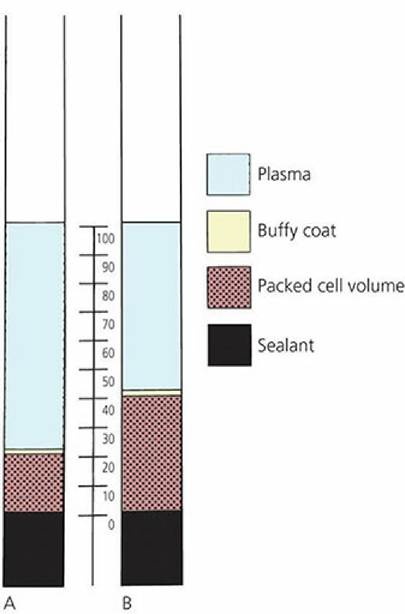
■ FIGURE 3-1 The microhematocrit as it might appear for an anemic (A) and a normal (B) animal. The buffy coat, a narrow band of leukocytes above the erythrocyte mass, occupies an insignificant volume and is not accounted for. Accordingly, in the normal hematocrit, the plasma volume would be noted as 60%.
Blood Color
The red color of blood is imparted by the hemoglobin contained within the erythrocytes. Gradations of color from bright red to bluish- purple are seen, depending on the degree of saturation of hemoglobin with oxygen. The greater the saturation, the brighter the red color. Plasma is yellow to colorless, depending on the quantity and species examined.
Plasma that is ordinarily light yellow when observed in a test tube might be almost colorless in a capillary tube. The color of plasma results principally from the presence of bilirubin, a degradation product of hemoglobin. It is a darker yellow in the cow and even darker in the horse, which has a relatively high bilirubin concentration.Blood Volume
Blood volume (BV) is a function of lean body weight and is generally 8-10% of body weight. BV cannot be measured directly because exsanguination (removal of blood) results in the loss of only about 50% of the blood; the remainder is trapped in capillaries, venous sinuses, and other vessels. Erythrocyte volume and plasma volume (PV) can be measured by various techniques. If one or the other is measured, and the Hct is known, the BV can be calculated. For example, if the PV is 600 mL and the Hct is 40%, the PV represents 60% of the BV. BV is then determined by the following relationship:
BV = PV∕(1 - Hct) = 600/0.60 = 1,000 mL
where the decimal equivalent of Hct is used. If these values were obtained from a 12.5 kg dog, the BV of 1,000 mL translates to 80 mL∕kg. Further calculation shows that this is the same as 8% of body weight if correction for specific gravity is not made and if 1 mL of blood is considered to weigh 1 g (80 mL = 80 g/1,000 g = 0.08 = 8%).
Blood pH

Blood has a pH of about 7.4. Venous blood is slightly more acidic than arterial blood. Thus, if the arterial blood pH is 7.4, one would expect the venous blood pH to be about 7.36. The higher acidity of venous blood is related to the transport of carbon dioxide; higher concentrations of CO2 exist in venous blood. The hydration of carbon dioxide in venous blood (CO2 + H2O → H2CO3 → H+ + HCO3-) forms hydrogen ions, thus resulting in its higher acidity and lower pH.
The pH symbol is the chemical notation for the logarithm of the reciprocal of the hydrogen ion concentration [H+] in gram-atoms per liter of solution. For monovalent substances, equivalent measurements are the same as gram-atom measurements; when the pH is 7.4, the [H+] is 0.00000040 g-atoms of H+ in 1 L of solution, or 40 nEq (nanoequivalents). When the [H+] doubles (80 nEq) or halves (20 nEq), the pH changes by 0.3 units as follows:
| pH. | [H+] |
| 7.4 | Normal |
| 7.1 | Double normal |
| 7.7 | Half normal |
| 6.8 | Four times normal |
Even though the pH might seem to change very little, the [H+] changes considerably. Therefore, the pH of the body fluids must be regulated precisely.
V Go to www.wiley.com/go/reece/lunctional to view a related video.
■