GENERAL EXTERNAL ANATOMY
In general lizards are elongated and circular in cross-section, but arboreal chameleons are vertically compressed and some lizards, like the Bearded dragon (Pogona vitticeps), are horizontally compressed (Fig.
4.1).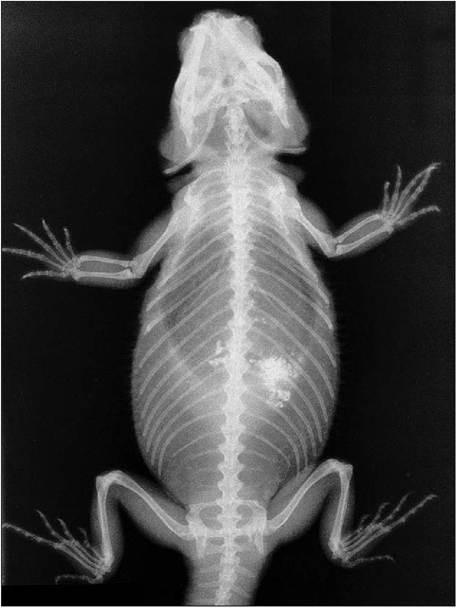
Figure 4.1 • Dorsoventral radiograph of normal Bearded dragon (Pogona vitticeps). Some substrate is visible in the stomach.
Family: Iguanidae
These are moderate to large in size and include many herbivorous species. They have a large, laterally compressed body with nuchal and dorsal crest, large gular pouch, and conspicuous subtympanic plate. The tail is up to three times the snout-to-vent length and can be whip like. Femoral pores are prominent in the male. Males are generally more brightly colored, some displaying an orange hue in the mating season. The coloring of females tends to wash out with age. Iguanas are pleurodont and have nasal salt glands. Several species have a prominent parietal eye. Nearly all are oviparous. Many have partitions in the colon to slow down food ingesta (Evans 1986; Pough 1998b).
Examples:
Green iguana (Iguana iguana) (Fig. 4.2), Marine iguana (Amblyrhynchus cristatus), Chuckwalla (Sauromalus spp.), Basilisk (Basilicus spp.).
Family: Agamidae
These are mainly terrestrial lizards with well-developed limbs and are the old world equivalent of Iguanidae. They have acrodont teeth and some species have almost rodentlike incisors at the front of the jaw. Some species have sexually dimorphic crests and spines. They are mainly oviparous.
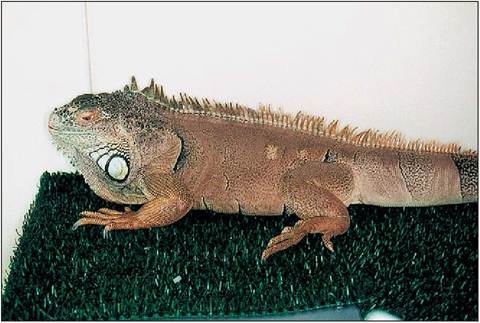
Figure 4.2 • Green iguana (Iguana iguana).
The South-east Asian Flying lizard (Draco volans) is the only lizard capable of gliding flight. This is achieved by having elongated ribs supporting webs of skin which can be opened like a fan for gliding.
The Australian Frilled lizard has a frill which it can erect when danger threatens (Pough 1998b).Examples:
Flying lizard (Draco volans), Frilled lizard (Chlamydosaurus kingii), Water dragon (Physignathus sp.) (Fig. 4.3), Bearded dragon (Pogona vitticeps).
Family: Chameleonidae
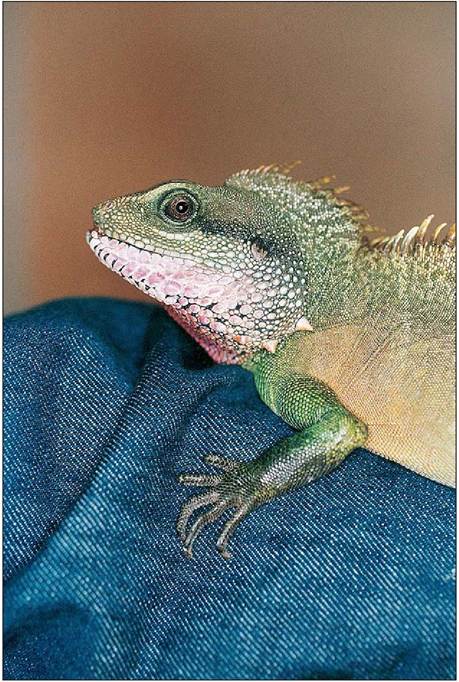
Figure 4.3 • Male Water dragon (Physignathus cocincinus).
These are arboreal with a laterally compressed body and are mainly diurnal and insectivorous. The upper and lower eyelid is fused to form a pyramid mound with the eye as the aperture in the center. Each eye is capable of independent movement and they use accommodation to measure distance. The eye lens is like a telephoto lens and the large retina and high number of cones provide the chameleon with large visual images of its prey (Evans 1986).
The tongue is rapidly extensible to a distance of at least twice the animal's trunk length and is used for apprehending insect prey. The hyoglossal skeleton is modified into an extension called the processus entoglossus, which at rest keeps the tongue folded in pleats at the back of the mouth. A powerful accelerator muscle propels the tongue forward like a spring. The tongue tip is also sticky to catch the prey. Jacobson's organ is poorly developed.
Chameleons have very specialized skulls with their parietal crest raised into a casque. They have lost the skull kinesis seen in other lizards, which was presumably made redundant by the powerful tongue (Pough 1998e). The acrodont teeth, unlike in other species, do not have pleurodont teeth rostrally as the premaxilla is quite reduced with few teeth there at all. The chameleons' laterally compressed bodies and prehensile feet enable them to keep their center of gravity over a narrow support base. Their vertical limbs and highly mobile pectoral girdle gives them a longer step and the ability to reach forward more onto branches.
The feet are zygodactyl, with toes fused together and opposed in groups of two and three (Fig. 4.12). The tail is prehensile and usually tightly coiled distally, with no autotomy. Rapid color changes are possible. Sexual dimorphism is common. They can be oviparous or viviparous (Bellairs 1969a, 1969f; Pough 1998b).Examples:
Yemen veiled chameleon (Chamaeleo calyptratus) (Fig. 4.4), Parson's chameleon (Calumma parsonii).
Family: Gekkonidae/Eublepharidae
These are crepuscular or nocturnal insectivores with a flattened head and body. Most have adhesive toe pads which contain rows of tiny overlapping scales ventrally called lamellae. Each lamella has tiny, branching hairs called setae which can number up to one million in some gecko species. The ends of these setae are spatulate and it is the friction between these endings that creates the adhesive qualities of the feet and enables them to walk across ceilings and glass, even holding on by only one foot (Bellairs 1969a; Evans 1986; Pough 1998b).
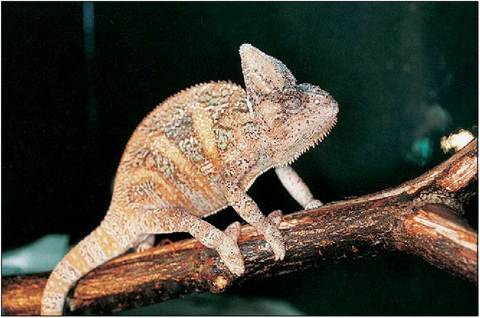
Figure 4.4 • Yemen veiled chameleon (Chamaeleo calyptratus) perching, showing high helmet casque and zygodactyl feet.
60
Many have loose skin and fat pads in the tail. Autotomy is common. Many lack eyelids which, like snakes, are fused to form a spectacle. They are not sexually dimorphic. They are oviparous and lay very hard-shelled eggs. Eublepharids are unusual in that they are terrestrial and have eyelids. They lack the adhesive lamellae and so are unable to climb.
Examples:
Leopard gecko (Eublepharis macularius), Tokay gecko (Gekko gecko), Standing’s day gecko (Phelsuma standingi).
Family: Varanidae
These are the giants of the lizard world and can reach a length of 3.6 m (Komodo dragon). Often called monitor lizards or, in Australia, “goannas.” They are stocky with smooth scales. The tongue is forked for half its length and, as in snakes, is used more for exploration than tasting (Evans 1986).
In some species ossification of the hemipenes can be seen on radiographs. Despite their size they are active predators with higher metabolic rates than most other lizards (Bennett, AF 1972). They are oviparous and have no autotomy (Pough 1998b).Examples:
Komodo dragon (Varanus komodoensis), Bosc monitor (Varanus exanthematicus).
Family: Scincidae
These are a large terrestrial family that live mostly on or underground. They are small to medium in size (5-20 cm), are smooth scaled and are glossy in appearance. Osteoderms are present beneath the scales and the young often have blue tails (Pough 1998b). The limbs are short in relation to the body and some species are completely limbless. (Different species may have four limbs, two limbs or no limbs) (Fig. 4.5). They have a prominent ear opening; eyelids are fused to form a spectacle in some. The tail can be lost and regenerates.
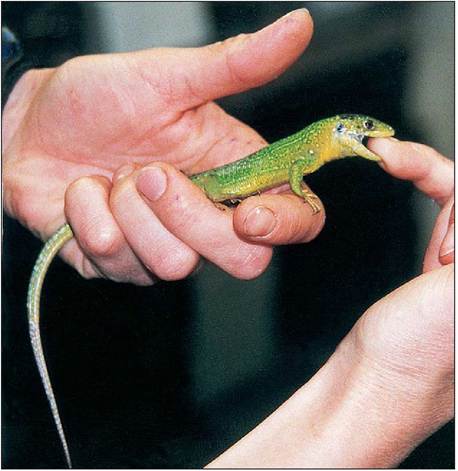
Figure 4.5 • Skinks have short limbs relative to body size and prominent ear openings. The tail can be lost and regenerates.
Some species are oviparous; some are viviparous with well- developed placentation. Except for the herbivorous arboreal Solomon Island skink they are mainly insectivorous (Evans 1986; Pough 1998b).
Examples:
Blue-tongued skinks (Tiliqua spp.), Solomon Island skink (Corucia zebrata).