GENERAL EXTERNAL ANATOMY
The rat has a stocky body and a scaly tail that is about 85% of the body length (Fig. 10.1) (Bivin et al. 1979). The ears are small and covered with fine hairs. The male is larger than the female.
The body weight of the male is 450 to 520 g and that of the female is 250 to 300 g.Head
The upper lips are hairy and cover the incisors so that only the tips are visible. They are cleaved midline by a deep,
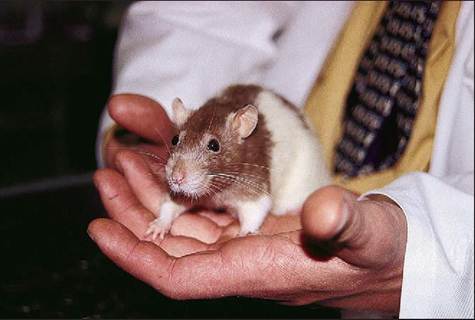
Figure 10.1 • The brown rat (Rattus norvegicus).
hairless philtrum. The nasal skin is also hairless and contains the slitlike nostrils, which can be closed under water. The space between the lips, cheeks, and teeth is called the vestibule.
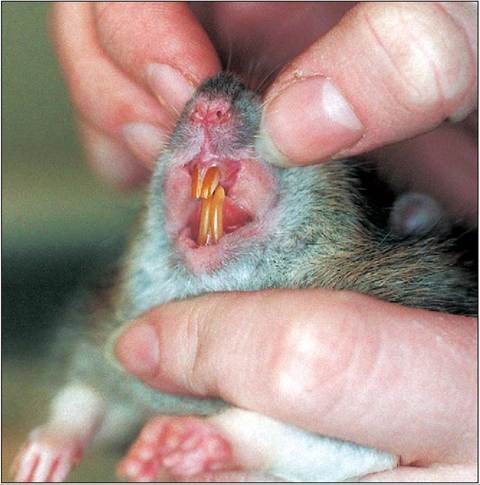
Figure 10.2 • The yellowish color of rat incisors is due to iron pigments. At rest, the lower incisors lie behind the upper incisors and the length of the lower crown is two to three times longer than the upper crown. This is normal and should not be mistaken for malocclusion.
Teeth
The incisors are used for fighting, holding food, excavating while burrowing, and gnawing. Iron pigments are responsible for the yellow-orange color of the incisors (Fallon 1996) (Fig. 10.2).
Eyes
The eyes are black, except in albinos. They are spherical in shape and there is frequent blinking. The third eyelid is poorly formed, giving the eyes a bulging appearance (Bivin et al. 1979). Albino rats have poor vision but use sensitive vibrissae and olfaction instead (Harkness & Wagner 1995).
Tail
The tail is long in relation to body size and very sensitive to pain. It plays a large role in thermoregulation and balancing. The cutis of the tail forms over 210 caudally directed overlapping scales, which are heavily keratinized on the upper epidermis (Hebel & Stromberg 1986f).
Three short bristles project from each scale. The tail is covered by a layer of orange-yellow sebum.Feet
There is considerable difference between the length of the front and hindlimbs, enabling the rat to run fast with hopping movements. The rat stands plantigrade so the palmar and plantar skin areas are hairless (they are also devoid of sebaceous glands), with heavily keratinized pads (Hebel & Stromberg 1986e). Sweat glands lie embedded in the fat deposits of the subcutis. These function not for evaporative cooling but for maintaining adhesive friction between the foot and surfaces.
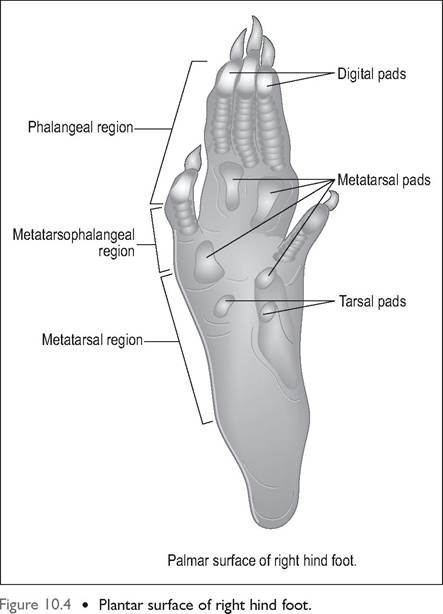
Both fore and hindlimb have five digits, although the first digit of the forefoot is markedly reduced and has a flattened nail (Bivin et al. 1979) (Fig. 10.3). The front paw has five digital pads, three metacarpal and two carpal pads, while the hind leg has five digital, four metatarsal and two tarsal pads (Figs. 10.4 and 10.5). The rest of all the phalanges are covered by a curved claw.
External genitalia
Male
There is a common urogenital aperture (Fig. 10.6). The testicles are evident from 3-4 weeks in the male but the rat may need to be held vertically to let the testes drop into the scrotum. In adult males the large oblong scrotum on either side gives the male rat a rounded distal silhouette. The anus is obscured by the hair but the anogenital distance is twice that of the female. Newborn male rats have a more prominent genital papilla and a greater anogenital distance. There are no nipples in the male.
Female
The female has a shorter anogenital distance than the male. The urethra opens at the base of the clitoris, which is enclosed in a little prepuce. The vulva lies just caudal to this. The female appears to taper towards the tail in a triangular shape (Fig. 10.7).
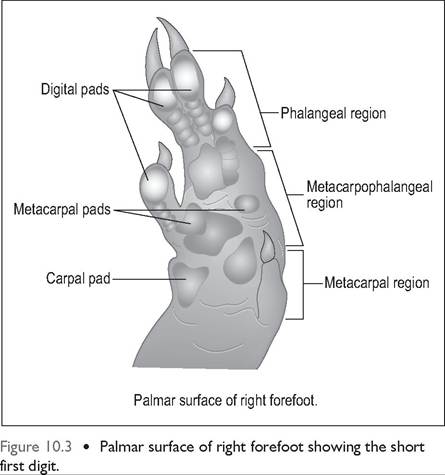
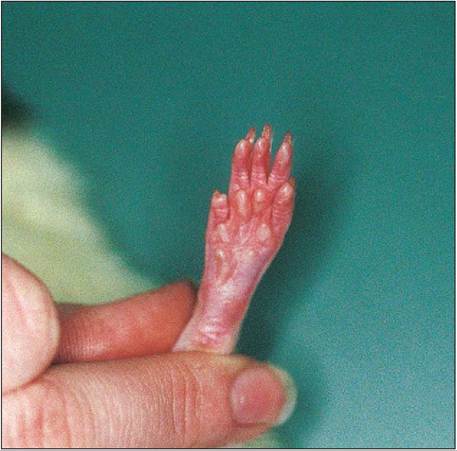
Figure 10.5 • Detail of left hind foot.
rat they appear to merge as one continuous sheet. Nipples are visible from 8-15 days of age (Fig. 10.22).